🍳 Oven Wattage Calculator
Estimate oven amps, energy use, preheat time, and safe circuit headroom with a nameplate wattage check for home or commercial cooking.
Start with the oven nameplate wattage. If you enter a measured preheat time, the calculator compares it with the model estimate and uses the measured value for session energy.
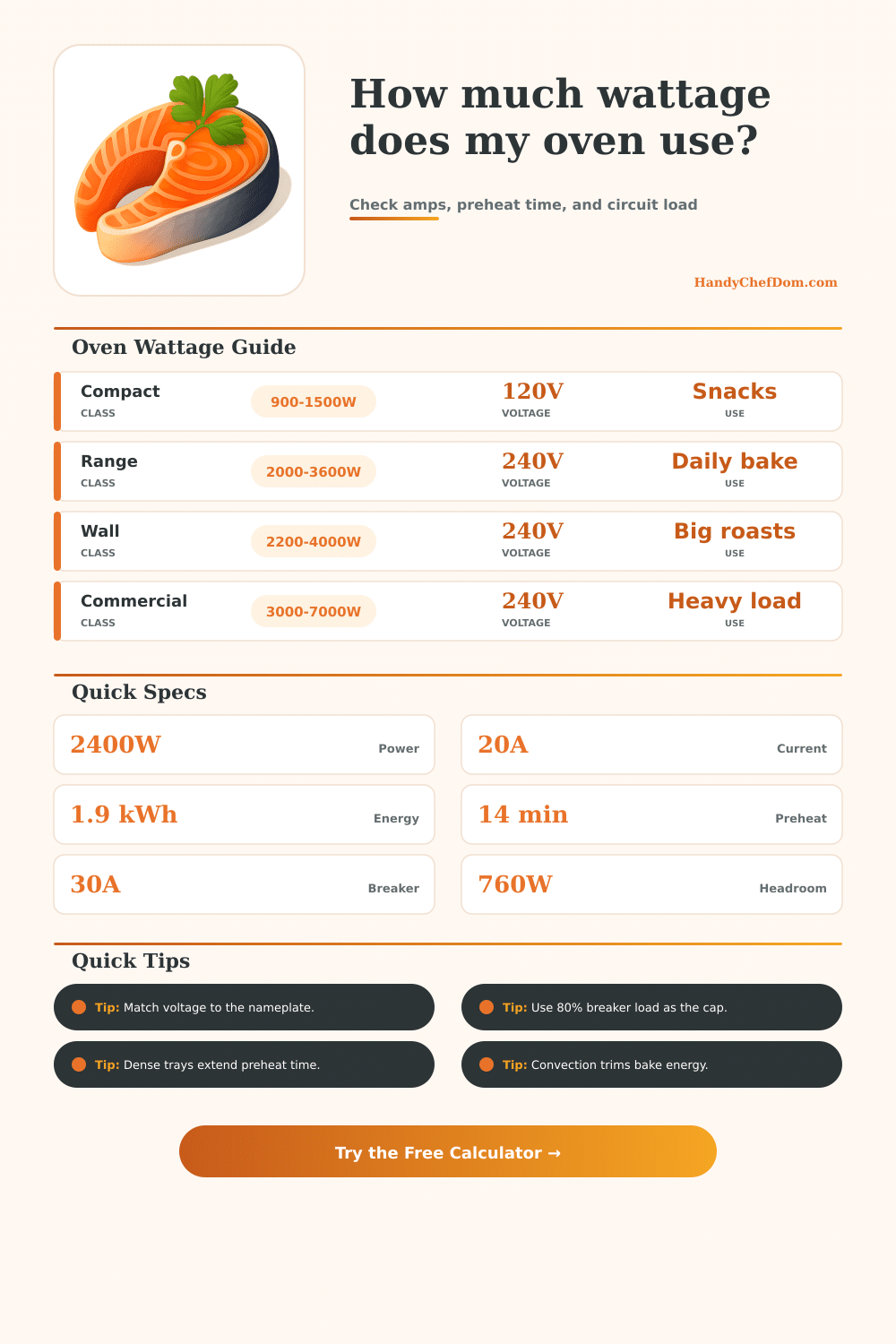
| Class | Typical watts | Voltage | Best use |
|---|---|---|---|
| Compact countertop | 900-1500 | 120 V | Snacks |
| Toaster oven | 1000-1600 | 120 V | Trays |
| Standard range | 2000-3600 | 240 V | Daily bake |
| Single wall oven | 2200-4000 | 240 V | Roasts |
| Double wall oven | 3000-6000 | 240 V | Large meals |
| Commercial convection | 3000-7000 | 208-240 V | High load |
| Breaker | 120 V safe | 240 V safe | Note |
|---|---|---|---|
| 15 A | 1440 W | 2880 W | Compact ovens |
| 20 A | 1920 W | 3840 W | Small ranges |
| 30 A | 2880 W | 5760 W | Standard ovens |
| 40 A | 3840 W | 7680 W | Double ovens |
| 50 A | 4800 W | 9600 W | Large doubles |
| 60 A | 5760 W | 11520 W | Commercial lines |
| Mode | Duty | Preheat | Comment |
|---|---|---|---|
| Bake | 58% | 12-18 min | Steady cycle |
| Roast | 64% | 14-20 min | More recovery |
| Convection | 52% | 10-16 min | Fan assist |
| Broil | 74% | 6-10 min | Top heat |
| Pizza | 67% | 18-28 min | Stone load |
| Warm | 38% | 5-8 min | Low hold |
| Session | 1500 W | 2500 W | 3500 W |
|---|---|---|---|
| 30 min | 0.75 kWh | 1.25 kWh | 1.75 kWh |
| 60 min | 1.50 kWh | 2.50 kWh | 3.50 kWh |
| 90 min | 2.25 kWh | 3.75 kWh | 5.25 kWh |
| 120 min | 3.00 kWh | 5.00 kWh | 7.00 kWh |
| 150 min | 3.75 kWh | 6.25 kWh | 8.75 kWh |
| 180 min | 4.50 kWh | 7.50 kWh | 10.50 kWh |
Ovens requires a significant amount of electrical power. Ovens often use more power than any other appliance in a kitchen. If the oven draws more power then the power limits of the circuit breaker, the circuit breaker will trip.
To avoid tripping the circuit breaker, it is essential to understand the wattage needs of an oven. You can typicaly find the wattage of the oven on the nameplate located on the back of the oven or on the oven door frame. The peak wattage of the oven is the maximum amount of electricity the oven will use to perform its function.
Oven Power Use and How to Avoid Tripping the Breaker
The time that it takes for the oven to preheat are an indication of the efficiency of the oven. The time it takes for an oven to preheat to the desired temperature can differ depending on the size of the oven. Small countertop ovens typicaly take less time to preheat as they contain less mass of air.
Large wall ovens take longer to preheat as they contain more mass of air. Additionally, the type of food that will be baking in the oven will have an impact on the preheat time. A single tray of item will take less time to preheat than a sheet pan of lasagna.
Convection mode will reduce the time it takes for an oven to preheat to the desired temperature as the fan will circulate the heat in the oven. Circuit headroom can prevent circuit breakers from tripping due to excessive use of power by the oven. However, most people dont think of circuit headroom when purchasing an appliance like an oven.
Circuit breakers are only rated to handle 80% of their total power capacity. For example, a 30-amp circuit headroom breaker on a 240-volt circuit will provide a maximum of 5760 watts of power. If an oven that draws 3500 watts of power is plugged into a circuit without headroom, there will be electrical issues with the oven during cooking.
Additionally, if other appliances is shared on the same circuit as the oven, this will also place additional demand on the circuit. The duty cycle of an oven explain how the oven maintains a desired temperature. You can understand the duty cycle as the number of times the oven heating elements will turn on and off until the desired temperature is reached.
Once the oven reaches the temperature that is programmed into the oven, the heating elements will cycle on and off. In bake mode, the oven heating elements will cycle on and off 58% of the time. In broil mode, the heating elements will cycle on and off 74% of the time due to the high heat used in broil mode.
If there is a dense load of food in the oven, the duty cycle will increase. If the duty cycle increases, the oven will use more power from the electrical supply. The energy that an oven will use can be found by taking the wattage of the oven and multiplying the number of hours that the oven will be in use.
If an oven is set to 375 degrees for 45 minute, the oven will use a certain amount of kilowatt hours of energy. The energy used by an oven includes the energy used to preheat the oven to the selected temperature. The preheat phase of an oven typically uses a considerable amount of energy during a short time period for baking.
Compact ovens that use 120-volt circuits can use up all of the power on a toaster circuit. However, 240-volt electric ranges will require dedicated electrical lines. Ovens come in many types, each with their power need and their use.
Compact ovens use between 900 and 1500 watts of power. The compact ovens are typically used for simple cooking tasks on the countertop of the kitchen. Ranges use between 2000 and 3600 watts of power.
These appliances are typicaly used for cooking tasks for the entire family. Wall ovens and commercial convection ovens use the most power for these appliances as they are used for cooking large volume of food. If the oven has a power output that is inadequate for your cooking needs, you may experience issue with the oven.
You can improve efficiency of an oven by making specific adjustment to the cooking process. Using convection mode will save energy as the heat will be distributed even throughout the oven. Avoid overpacking the oven racks as this will make the oven heat the food as if it is performing a heavy load.
Always ensure that the electrical connections match those noted on the nameplate of the oven. For example, if a 240-volt oven is connected to a 208-volt line, the oven will only output 75% of its desired heat output. This will make the oven take longer to preheat to the desired cooking temperature.
It should of been checked before installation.