🥕 Pickle Brine Calculator
Plan salt, vinegar, liquid fill, and jar yield for crunchy dill, sweet, or fermented pickle batches.
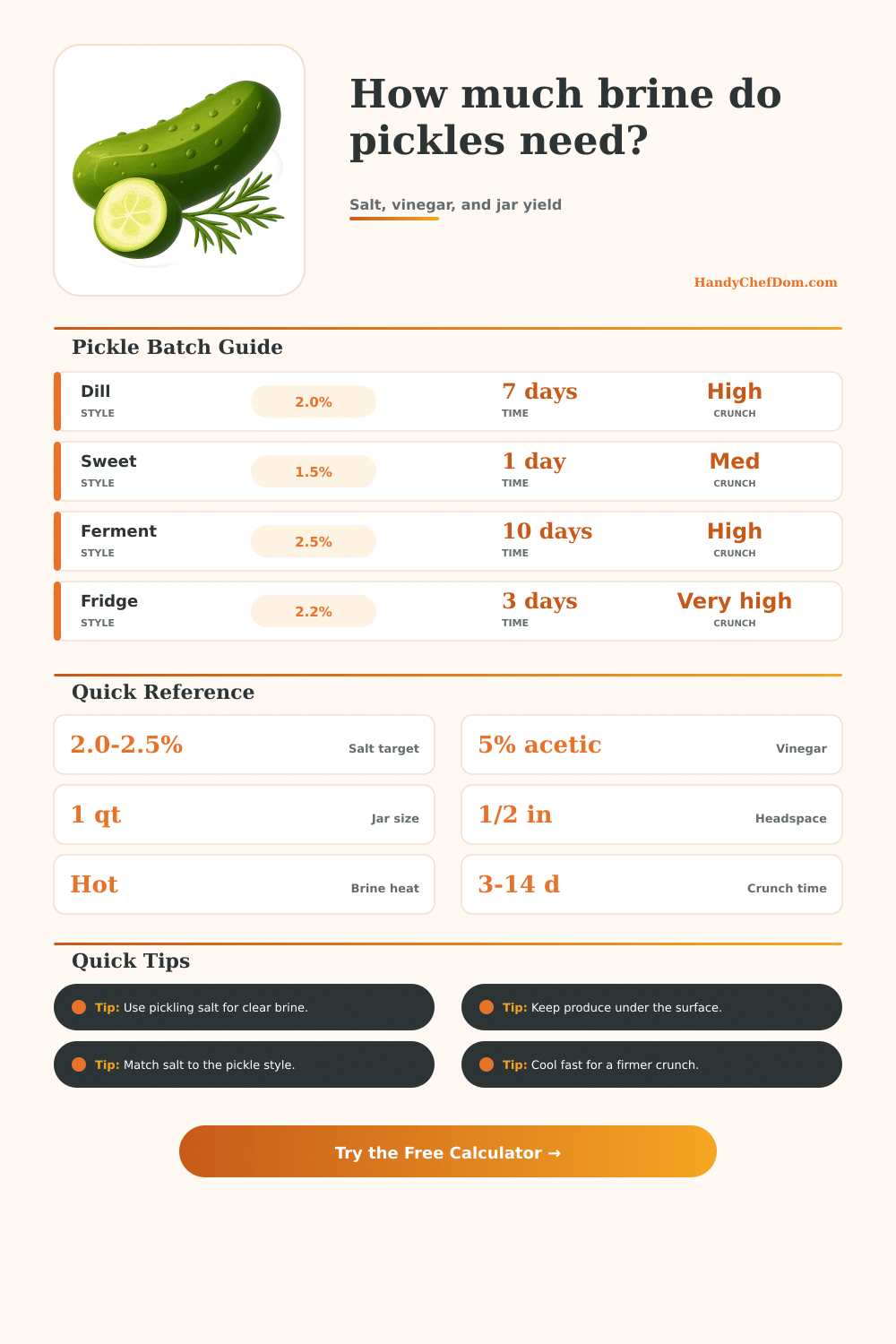
| Style | Salt | Acid | Days | Use |
|---|---|---|---|---|
| Dill | 2.0% | 5% | 7 | Snacks |
| Sweet | 1.5% | 5% | 1 | Chips |
| Ferment | 2.5% | 0% | 10 | Crunch |
| Fridge | 2.2% | 5% | 3 | Fast |
| Style | Liquid | Salt | Notes |
|---|---|---|---|
| Dill spears | 650 ml/kg | 2.0% | classic |
| Sweet chips | 700 ml/kg | 1.5% | sugar |
| Fermented | 450 ml/kg | 2.5% | no acid |
| Fridge mix | 600 ml/kg | 2.2% | quick |
| Vinegar mix | 680 ml/kg | 5% | sharp |
| Cold pack | 620 ml/kg | 4% | crisp |
| Ferment boost | 480 ml/kg | 2.8% | tangy |
| Jar | ml | oz | Headspace |
|---|---|---|---|
| Pint | 473 | 16 | 1/2 in |
| Quart | 946 | 32 | 1/2 in |
| Half-gallon | 1893 | 64 | 3/4 in |
| Metric jar | 1000 | 34 | 1 cm |
| Half pint | 237 | 8 | 1/4 in |
| Wide mouth | 946 | 32 | easy pack |
| Tall metric | 1250 | 42 | 1 cm |
| Salt | Volume | By weight | Use |
|---|---|---|---|
| Pickling | 1 tsp | 6 g | clear |
| Kosher | 1 tsp | 4 g | varies |
| Sea salt | 1 tsp | 5 g | fine |
| Table salt | 1 tsp | 6 g | not ideal |
| Diamond Crystal | 1 tsp | 3 g | light |
| Fine sea | 1 tsp | 5 g | steady |
| Flake salt | 1 tsp | 2 g | soft |
| Veg | Cut | Density | Crunch |
|---|---|---|---|
| Cucumber | Spear | 0.60 | High |
| Carrot | Stick | 0.80 | Med |
| Radish | Slice | 0.75 | High |
| Onion | Ring | 0.50 | Soft |
| Zucchini | Chips | 0.70 | Med |
| Cauliflower | Floret | 0.55 | Firm |
| Pepper | Strip | 0.45 | Snappy |
Pickling require the right balance of salt, vinegar, and an amount of liquid to use with the vegetables to ensure that the pickles will be safe to eat and have the correct texture. If a person use too little liquid when creating pickles, the pickles will float within the jar and the pickles that float will eventually become soft. If a person uses too much vinegar, the vinegar will overpower the flavor of the vegetables.
Using a pickle brine calculator will allow a person to determine the proper amount of salt, vinegar, and liquid needed for their brine by using mathematical formulas to calculate the ingredients needed. Salt is an essential ingredient in the brine because salt will draw out the moisture from the vegetables and because salt will inhibit the growth of bad bacteria within the brine. The amount of salt that is used in the brine is crucial because the percentage of salt will determine if the pickle is fermented or based on vinegar.
How to Use a Pickle Brine Calculator
For instance, 1.5 percent salt is used for sweet pickles while 2.5 percent salt is used for fermented pickles. Using the wrong percentage of salt will lead to mushy pickles and unpleasent flavor in the pickled vegetables. Vinegar is an ingredient that provides acidity to the brine and adds tang to the pickles.
The vinegar that is used for making pickles should have a 5 percent acidity rate because this will ensure that the pickles will have a good amount of sharpness. Using vinegar that is weaker than 5 percent acidity will require the addition of more vinegar to the brine so that the acidity of the brine is strong enough. A pickle brine calculator account for the strength of the vinegar that will be used so that the acidity of the brine remains within a safe level.
The density of the vegetables will impact the amount of brine required to soak the vegetables in the brine. Vegetables like cucumber spear is less dense than carrot sticks so they will require more of the brine. The vegetables will settle in the jar so the amount of brine needed should be calculated according to the space that the vegetables will take up in the jar.
The brine should cover the vegetables because vegetables that are not covered in the brine may spoil. Pickles come in various types and require different amount of brine to achieve the desired results. Dill pickles have a specific amount of liquid to vegetables ratio.
Bread and butter pickles contain more sugar than dill pickles. For instance, bread and butter pickles require 30 grams of sugar per kilogram of vegetables. Fermented pickles does not use vinegar but use a higher amount of salt to help create the acidity in the brine.
The type of salt used will change the weight of the salt that should be used in the recipe. Pickling salt weighs 6 grams per teaspoon while kosher salt weighs 4 grams per teaspoon. The difference in weights requires the use of a weighing scale so that the percentage of salt in the brine is maintained.
Using the pickle brine calculator will reveal several piece of information about the brining process. The brine calculator will show the volume of the brine that will be used. The brine calculator will also show the dose of salt in grams that will be required.
The brine calculator will show the amount of vinegar that will be needed for the brine and the yield of the jars that will be filled with the brine. The yield of the jars will show how many jars will be filled with the brine. The retention and waste of the brine will show how much brine will be left over after the pickles have settled.
Common mistakes when making brined pickles are when a person does not consider the settling of the vegetables in the jar. The vegetables will settle within the jar so the brine level should be checked after ten minutes of placing the jar of vegetables in the jar. More brine should be added if the vegetables have settled in the jar.
A half inch gap should be left at the top of the jar for the vegetables to expand. If the pickles are to be fridge pickles, the brine should be cooled quickly after boiling because cooling the brine quickly will preserve the crunch of the vegetables. The vegetables can be changed but the math will remain the same for the brining process.
Vegetables like cauliflower florets, red peppers, and radishes require the same amount of brine as pickles and contain the same amount of salt requirements. Salt will draw out the juices in the vegetables through osmosis and vinegar will ensure that the pickles have an acidic pH level that remains below 4.6. If the acid level of the brine is below 4.6 the pickles will be safe to eat.
The vegetables should be weighed after being sliced because weighing the vegetables after slicing will provide more accuratey information about how much brine to use.