🔥 Pizza Oven Brick Calculator
Estimate floor bricks, shell bricks, arch pieces, and mortar volume for a dome or barrel build.
Classic round dome estimate with a spherical shell, floor ring, arch, and waste built in.
Most common hot-face brick for a classic wood-fired build.
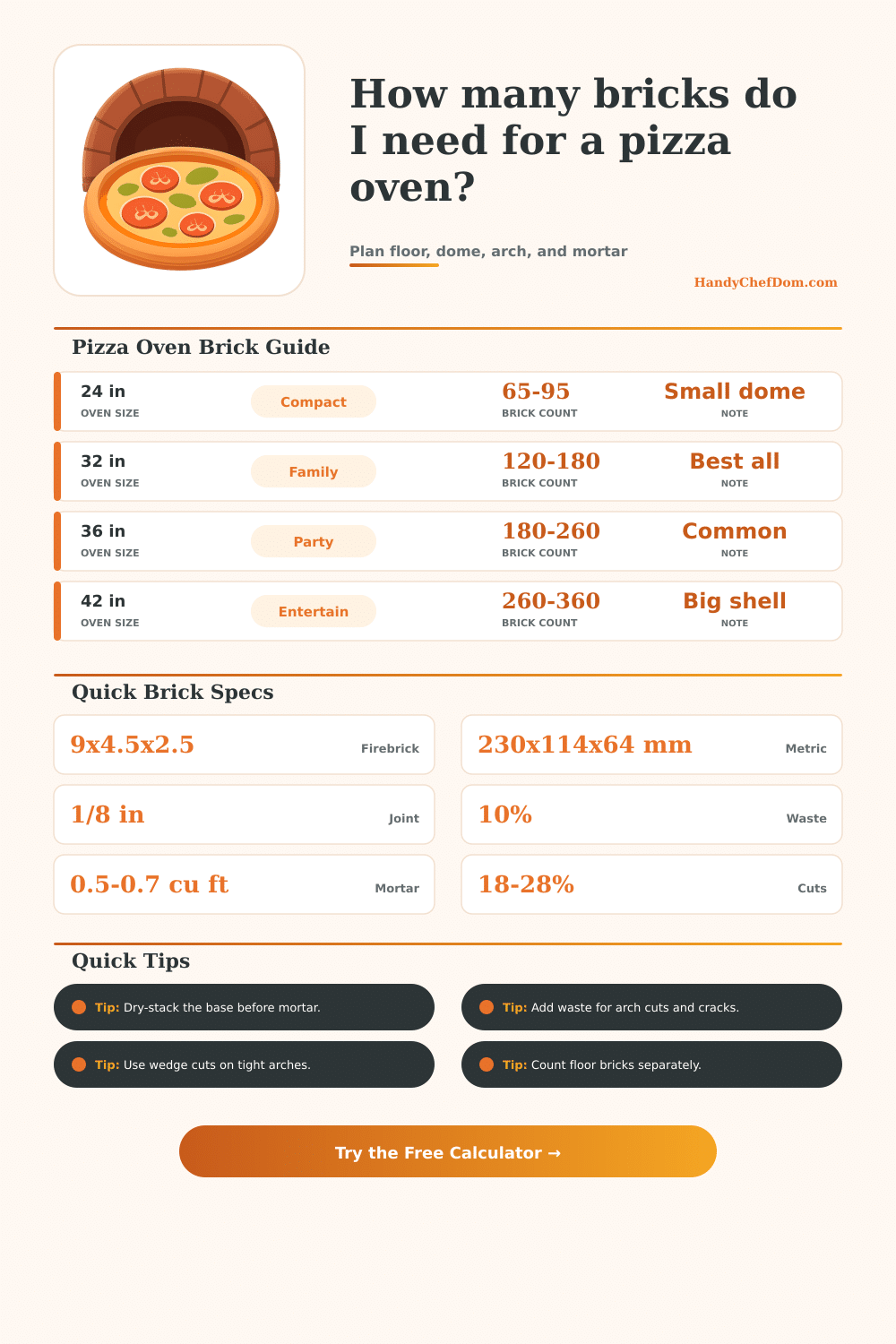
| Oven Size | Span | Brick Count | Use |
|---|---|---|---|
| 24 in | Compact | 65-95 | Small dome |
| 30 in | Backyard | 100-150 | Weeknight pies |
| 32 in | Family | 120-180 | Everyday build |
| 36 in | Party | 180-260 | Most common |
| 42 in | Entertain | 260-360 | Large shell |
| 48 in | Big | 320-460 | Heavy oven |
| Brick Format | Size | Best For | Note |
|---|---|---|---|
| Standard firebrick | 9 x 4.5 x 2.5 | Floor and shell | Most common hot-face brick |
| Split firebrick | 9 x 4.5 x 1.25 | Thinner shell | Light and easy to cut |
| Metric refractory | 230 x 114 x 64 mm | Metric builds | Good exact fit |
| Arch wedge | 9 x 4.5 x 2.5 | Opening arch | Helps tighter curves |
| Clay paver | 8 x 4 x 2 | Budget floor | Use where heat is lower |
| Reclaimed brick | Varies | Rustic build | Allow more waste |
| Feature | Factor | Effect | Note |
|---|---|---|---|
| Dome shell | 0.82 | Curved volume | Best for round ovens |
| Barrel shell | 0.84 | Long vault | Works for rectangular plans |
| Hybrid build | 0.80 | Mixed shape | Needs more trimming |
| Floor bed | 1.00 | Flat coverage | Counts almost exactly |
| Arch ring | 0.78 | Wedge loss | Plan extra cut bricks |
| Waste allowance | 10-15% | Safety buffer | Use more for reclaimed stock |
| Coverage | Bricks / sq ft | Joint | Use |
|---|---|---|---|
| Standard brick | 3.4-3.7 | 1/8 in | Clean layout |
| Split brick | 6.8-7.2 | 1/8 in | Thinner shell |
| Metric brick | 3.5-3.8 | 3 mm | Metric job |
| Floor lay | 3.4-3.7 | 1/8 in | Flat floor |
| Arch work | 2.8-3.2 | Varies | More cuts |
| Reclaimed mix | 3.0-4.0 | Varies | More waste |
Building a wood-fired pizza oven require a precise count of firebricks to ensure that a person does not run out of material during the construction process. Planning the number of firebricks for the oven floor, oven shell, and oven arch prior to mixing the mortar will prevent mistakes during the building of an oven. The oven floor is the first part of the oven that must be constructed.
The oven floor is the foundation of the oven. According to the oven design, the oven floor should be sized to cover the same inner diameter of the cooking area that will be constructed. Standard firebricks are 9 inches in length by 4.5 inches in width by 2.5 inches in thickness.
How to Count Firebricks for a Wood Fired Pizza Oven
You will use these firebricks to construct the oven floor. Thin mortar joints, approximately one-eighth of an inch thick, must be used for the floor. Using thin mortar joints on the oven floor allow the heat to pass through the oven floor.
Using mortar joints that are too thick will waste some of the firebrick. Using mortar joints that are too thin may cause the bonds between firebricks to weaken. Due to the circular shape of the oven floor, most firebricks will need to be cut into wedge to create an even floor.
This part of the oven will require having extra firebricks available. The oven dome is more complex than the oven floor. The oven dome is constructed in the form of a partial sphere.
As the oven dome rises from the oven floor to the oven domes peak, the diameter of the oven dome decreases. The rise of the oven dome from the oven floor to the oven domes peak will dictate the angle of the oven dome. The thickness of the oven walls will dictate how much heat is retained by the oven.
For instance, a 32-inch span oven dome might have a rise height of 16 inches and a thickness of the oven walls of 12 inches. Due to the fact that firebricks cannot bend, the oven dome will be constructed in ring of firebricks. Additionally, many firebricks will need to be cut to accommodate the decreasing diameter of the oven dome as it rise to its peak.
Building an oven with a round oven dome may be less efficient than constructing a barrel vault oven. A barrel vault oven has a longer oven dome and uses a different shell factor compared to a round oven dome. The oven arch is the entrance to the oven.
The width and height of the oven arch will determine the face area of the oven. The depth of the oven walls will determine the total volume of the oven. The firebricks must be cut to form the keystone ring that will support the oven arch.
As the oven arch rises from the oven floor, many firebricks will need to be trim. Approximately 35 percent of the firebricks used in the oven arch will need to be cut. It is also possible to build a landing that extends forward from the oven arch.
Building a landing will add to the total count of firebricks that are needed. In addition to the firebricks that are required for the oven, 10 to 15 percent of the firebricks should be allotted for waste. If the firebricks to be used in the oven are reclaimed, the waste percentage should be 16 percent.
The mortar that is used to bind the firebricks together will require approximately 10 to 12 percent of the total area of the firebrick surfaces. The mortar that is used should be refractory so that the firebricks will not melt at the high temperature of 2000 degrees Fahrenheit. The mortar sets quickly, so you should mix batches of mortar.
The total mass of the oven will be the weight of the firebricks and the mortar. The density of the mass of the oven will be 120 pounds per cubic foot. With an oven that has a 36-inch span, the oven will be very heavy.
Thus, a solid foundation must be established for the oven. The best way to plan the oven is to use the presets for different types of ovens. The presets will allow a person to plan and order the firebricks that is required to build the oven.
Presets will provide realistic dimensions for ovens of different sizes. For instance, a 24-inch compact dome oven is best for a single cook and a 42-inch entertainer oven can accommodate a large group of cookers. There are also different types of firebrick.
Split firebricks are half the height of the standard firebrick. Additionally, metric firebricks are available to accommodate different international standard. However, most people will encounter difficulty when attempting to use custom dimensions for the oven.
Thus, it is best for a person to stay close to the dimensions of the firebricks of proven sizes. When constructing the oven, dry laying the oven floor ring will allow a person to establish the span of the oven using a string. If the oven floor is not level during the dry laying process, the errors will accumulate as the oven is constructed.
Once the oven floor is constructed and level with the oven floor, mortar can be added to set the oven floor. When constructing the oven dome, a radius string from the center of the oven can be used to mark the oven dome. An angle grinder with a diamond blade should be used to cut the firebricks.
Additionally, goggles should be worn when using the angle grinder as it produce sparks. The waste allowance for the firebricks should not be skimped on. Full firebricks will be required for the oven floor because of the direct contact with the flame.
However, split firebricks can be used for the oven dome at higher points because they do not require as much exposure to the flame. To successfully build the oven, specific tool will be required. A spirit level will be used to ensure the oven is built on a level foundation.
A tape measure will be used to lay the oven shell. A mixing tub will be used to prepare the mortar. A radius string will be used to lay the oven dome in a circle.
Finally, it is also recommended to order additional firebricks beyond the total number that are needed for the oven. These spare firebricks can be used to patch any cracks or vent in the oven structure. You’ll find that having alot of extra material helps.
Dont forget that yours is a big project. It would of been better to have more if you didnt plan well. You cant start without teh right tools.
Actualy, many people forget the importance of the oven’s size. If you’re building it, make sure the dimensions are moddern and correct.