Pressure Cooker Conversion Calculator
Convert simmer, braise, slow-cooker, and fresh recipe times into a pressure cooker estimate with liquid, release, and altitude adjustments.
Choose the original cooking style, then var the calculator tune the pressure time, liquid floor, and finish method for a more realistic kitchen estimate.
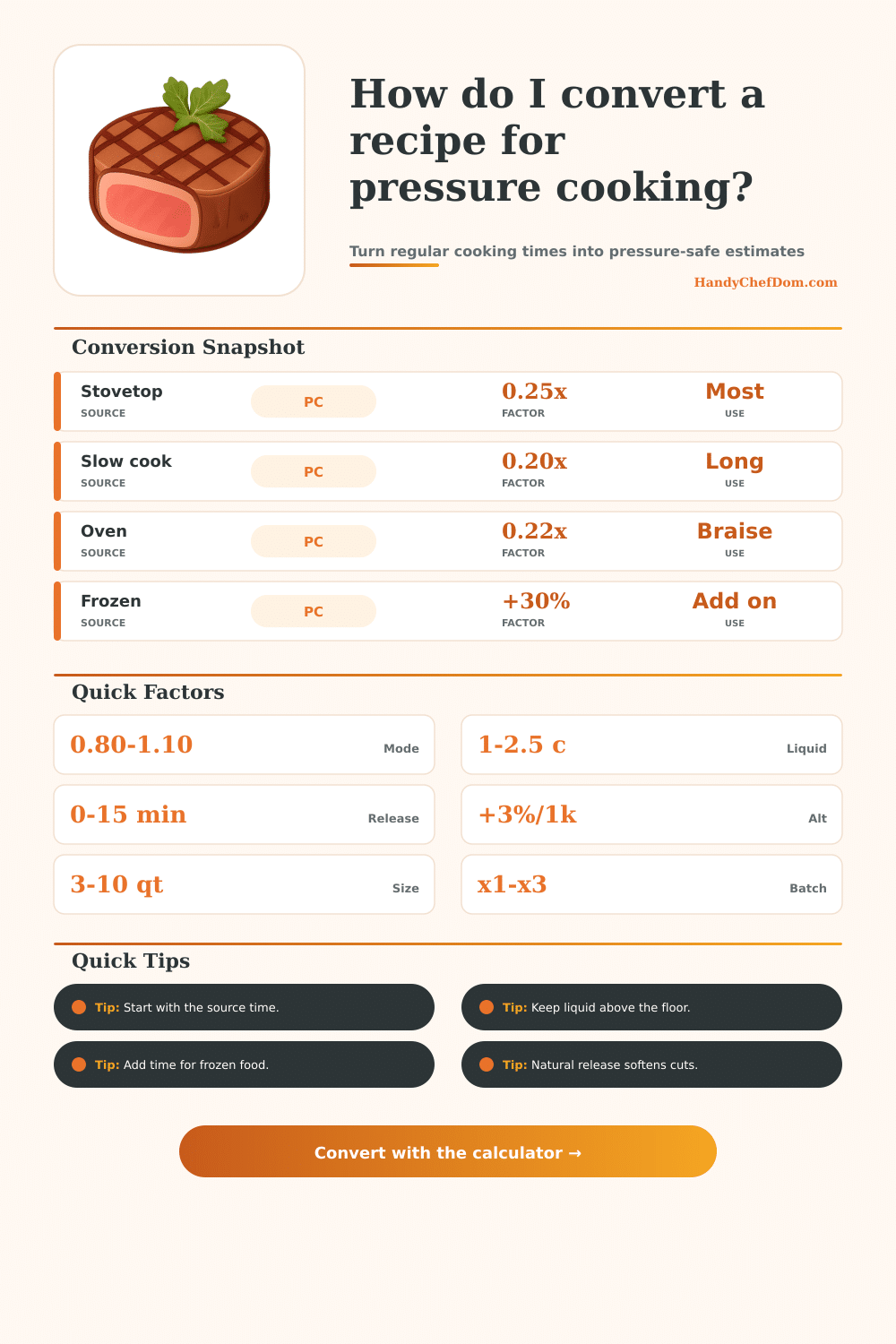
| Source | Factor | Best For | Note |
|---|---|---|---|
| Stovetop | 0.28x | Soups | Common base |
| Slow cooker | 0.12x | Long braise | Shortest move |
| Oven | 0.20x | Roasts | Dry heat shift |
| Fresh prep | 0.35x | New batches | Use as guide |
| Mode | Psi | Speed | Use |
|---|---|---|---|
| Low | 5-7 | Gentle | Fish |
| High | 10-12 | Std | Most |
| Max | 15 | Fast | Some |
| Steam | Varies | Model | Special |
| Size | Floor | Headroom | Hint |
|---|---|---|---|
| 3 qt | 1 cup | Low | Small pots |
| 6 qt | 1.5 c | Good | Most homes |
| 8 qt | 2 c | More | Family use |
| 10 qt | 2.5 c | Max | Big batches |
| Release | Wait | Best For | Texture |
|---|---|---|---|
| Quick | 0-3 min | Rice | Firm |
| Mixed | 5-8 min | Chicken | Balanced |
| Natural | 10-15 min | Roasts | Tender |
| Full rest | 15+ min | Beans | Soft |
Pressure cookers works by trapping the steam inside a seal container. The trapped steam increase the boiling point of the liquid in the pressure cooker to 250 degrees Fahrenheit. Because the boiling point of the liquid is higher in a pressure cooker, the food in the pot will cook more faster.
A pressure cooker allow for the collagen in meat to break down quickely. Furthermore, a pressure cooker allows beans to cook and soften in a much shorter period of time. Therefore, when converting a recipe that used stovetop cooking to one that uses a pressure cooker, the cook must adjust the cook time because a pressure cooker is more efficient at using heat than a pot over the stove.
How a Pressure Cooker Works and How to Use It
The amount of foods that is placed into a pressure cooker will impact the cooking time for that pot of food. If a large batch of food is placed into a pressure cooker, the heat must travel through the deep layers of the food to reach the center of the food. If the heat must travel through a large number of layers, it will take longer to evenly cook the food.
Thus, a large batch of food may take longer to cook than a smaller batch. The size of the pressure cooker will also impact the amount of liquid that are required for the cooking process. For instance, a three-quart pressure cooker will require at least one cup of liquid to create the steam necessary to cook the food.
In comparison, a ten-quart pressure cooker will require two and a half cups of liquid to create the steam necessary to cook the food. The amount of liquid that must be added to a pressure cooker is because the liquid within the pressure cooker will create the steam that build the pressure within the pot. The starting temperature of the food that is to be cooked will impact the cooking time within the pressure cooker.
If the food that is to be cooked is frozen, it will take approximately 30 percent longer to cook the food because the center of the food that is frozen will remain cold to the touch. In comparison, room-temperature food will not require the cooking time to be increased because the food will heat even. The texture that is desired from the food will also play a role in the setting of the timer for the pressure cooker.
If the food is vegetables that are to remain firm, it will require shorter cooking time in the pressure cooker. If it is meat that is to be tenderize, the cooking time should be longer in the pressure cooker. Another factor that will impact how a pressure cooker function is the altitude at which it is used.
If the altitude is above 2,000 feet above sea level, the pressure will be lower, which will require longer cooking times for the food. For each 1,000 feet of altitude above sea level, the cooking time will need to be increased by three percent. For instance, at 5,000 feet of altitude, the cooking time will need to be increased by five percent in the pressure cooker.
Another factor that will impact the texture of the food when cooked in a pressure cooker is the method used to release the pressure from the cooker. If the cook quick releases the pressure from the cooker, this can be useful in cooking rice so that the rice does not become too soft. The alternative to quickly releasing the pressure from the cooker is to allow the pressure to naturally decrease in the cooker over a period of 10 to 15 minutes.
This natural release of pressure is useful in cooking meat so that the meat will become tenderized during the cooking process. Lastly, the mixed release of the pressure is when the pressure is allowed to naturally decrease for five to eight minutes, after which the cook can quick release the remainder of the pressure. This method is useful for cooking chicken because it allows the chicken to retain its juices yet not become too difficult to eat.
By following a few basic rules when converting recipes, it is possible to find the correct cooking time for foods in a pressure cooker. Recipes that utilize a slow cooker to cook for six to eight hours can be cooked quick in a pressure cooker. Additionally, recipes that use an oven to cook the food for braising can be cooked by reducing the cooking time to one-fifth of the length of the original recipe.
If there is no original cooking time for the recipe, using the baseline cooking time for a pressure cooker can be used as the starting point for cooking the recipe in the pressure cooker. In using a pressure cooker, there are some rules that should be followed to ensure the foods cook properly. One of the rules is not to overload the pressure cooker with too much food at one time.
If there is an overloaded pot of food in the cooker, the food in the deep layers of the food will remain cold to the touch. Secondly, ensure that there is enough liquid to cook the food in the pressure cooker. If there is not enough liquid in the cooker, steam will not be able to be created.
Thirdly, dont rush the release of the pressure from the cooker, especially when cooking meat. This can cause the meat to become tough. Finally, ensure that there is at least one inch of liquid resting on the bottom of the pressure cooker, or it will trigger the burn notice on the machine.