🍜 Ramen Calories Calculator
Build your bowl ingredient by ingredient and get a complete calorie & macro breakdown
| Ingredient | Typical Serving | Calories | Protein | Carbs | Fat |
|---|---|---|---|---|---|
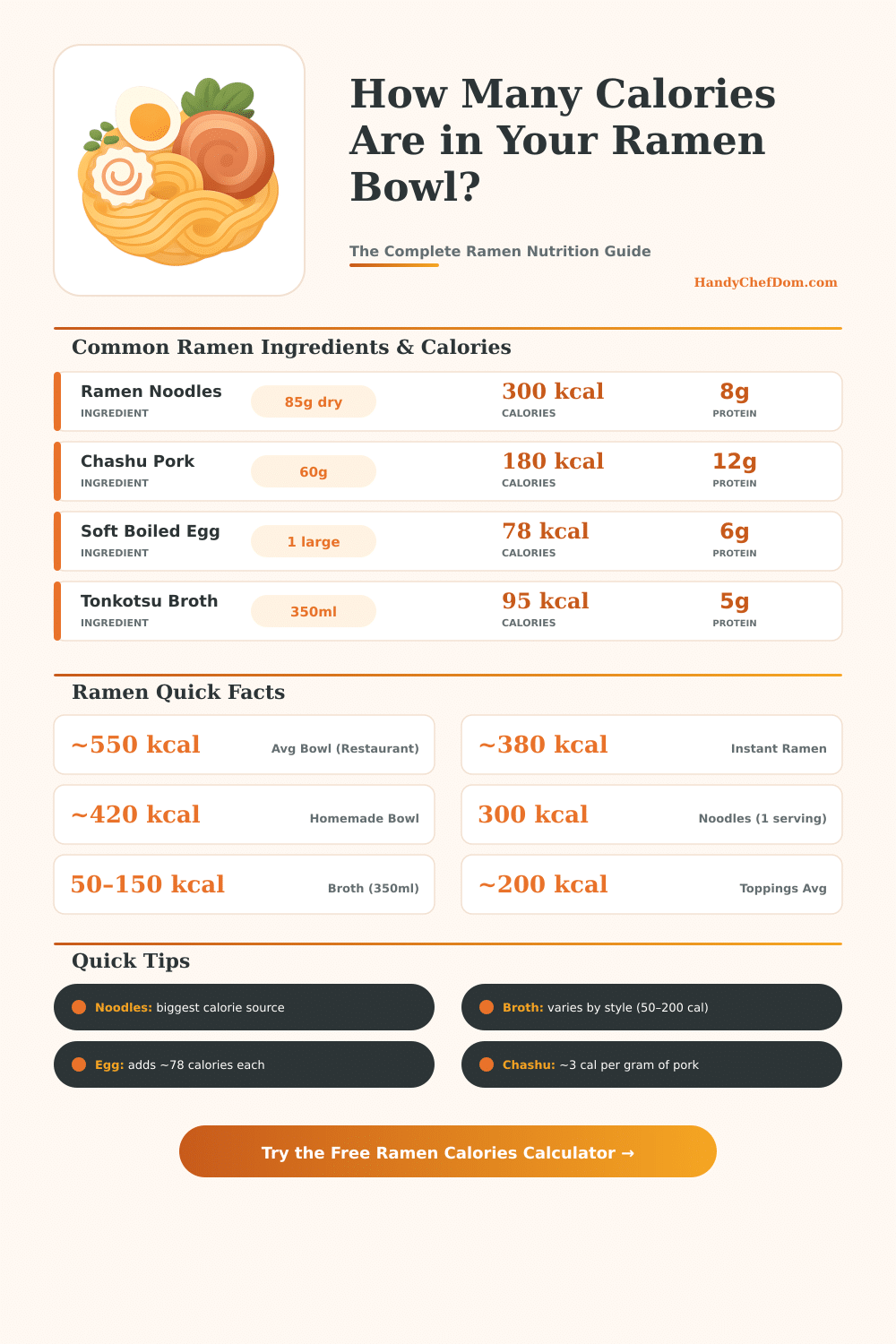
| Wheat Ramen Noodles (dry) | 85g / 3 oz | 300 kcal | 8g | 60g | 1g |
| Soba Noodles (dry) | 85g / 3 oz | 272 kcal | 12g | 56g | 1g |
| Shirataki Noodles | 170g / 6 oz | 20 kcal | 0g | 5g | 0g |
| Tonkotsu Broth | 400ml / 13.5 fl oz | 72 kcal | 5g | 0g | 4g |
| Miso Broth | 400ml / 13.5 fl oz | 56 kcal | 4g | 6g | 1g |
| Shoyu Broth | 400ml / 13.5 fl oz | 48 kcal | 3g | 4g | 1g |
| Chashu Pork Belly | 60g / 2.1 oz | 186 kcal | 11g | 2g | 15g |
| Soft-Boiled Ramen Egg | 1 large (50g) | 78 kcal | 6g | 1g | 5g |
| Corn (sweet, canned) | 40g / 1.4 oz | 34 kcal | 1g | 7g | 0g |
| Bamboo Shoots | 40g / 1.4 oz | 11 kcal | 1g | 2g | 0g |
| Nori Sheet | 1 sheet (2.5g) | 10 kcal | 1g | 1g | 0g |
| Shiitake Mushrooms | 50g / 1.75 oz | 18 kcal | 2g | 3g | 0g |
| Butter | 10g / 0.35 oz | 72 kcal | 0g | 0g | 8g |
| Sesame Oil | 5g / 0.18 oz | 44 kcal | 0g | 0g | 5g |
| Firm Tofu | 100g / 3.5 oz | 76 kcal | 8g | 2g | 4g |
| Spinach / Bok Choy | 50g / 1.75 oz | 12 kcal | 1g | 2g | 0g |
| Bean Sprouts | 50g / 1.75 oz | 16 kcal | 2g | 3g | 0g |
| Green Onions | 10g / 0.35 oz | 3 kcal | 0g | 1g | 0g |
| Ramen Style | Avg Calories | Protein | Carbs | Fat | Sodium |
|---|---|---|---|---|---|
| Tonkotsu Ramen | 550–700 kcal | 25–35g | 55–70g | 20–30g | 1,800–2,500mg |
| Shoyu Ramen | 400–550 kcal | 20–30g | 55–65g | 8–15g | 1,500–2,200mg |
| Miso Ramen | 450–600 kcal | 18–28g | 55–68g | 12–20g | 1,600–2,300mg |
| Shio Ramen | 350–480 kcal | 18–25g | 50–62g | 6–12g | 1,400–2,000mg |
| Instant Ramen (dry pkg) | 350–420 kcal | 8–12g | 52–60g | 14–18g | 1,600–2,700mg |
| Vegan / Vegetable Ramen | 280–420 kcal | 8–18g | 52–65g | 4–10g | 900–1,800mg |
| Spicy Tantanmen | 600–780 kcal | 22–32g | 50–65g | 25–38g | 1,800–2,600mg |
Ramen is a Japanese noodle dish. It belongs to Japanese Chinese cuisine and uses wheat noodles in Chinese style, served with various warm broth flavors. Before it was simple food for street vendors, but now it became popular globally as a delicacy.
That famous food, which has deep Chinese roots, does not lack its three main parts: broth, noodles and toppings. It guarantees a filling meal.
Ramen Basics: Broth, Noodles and Toppings
Rich and creamy tonkotsu are one of the most favorite broths. You prepare it by cooking pork feet, chicken backs and thick pork backs for hours, until the collagen comes out and turns into gelatin. Tonkotsu with shoyu-tare you can serve with daikon, enoki mushrooms, baby bok choy and tamago eggs.
The pork belly simply melts in the bowl. Ramen requires a delicate flavor balance, and smoky taste contrasts well with the delicacy, although it can overpower others.
Homemade ramen recipe includes delicious noodles, juicy chicken in flavorful broth with vegetables and good spices. It you easily prepare and serve with soft boiled eggs. Fast ramen for your pantry skips the salty seasoning and uses miso with butter for delicious, satisfying bowl in only 15 minutes.
Homemade ramen noodles are not like this difficult as they seem, and a pasta machine simplifies the rolling and cutting.
The soft boiled egg on top of ramen called ajitsuke tamago in Japanese, which means marinated eggs. They are soft boiled eggs soaked in soy sauce with mirin, sugar and other spices. To do this, boil water, place the egg directly from the refrigerator, boil 6 minutes and then plunge in an ice bath.
Remove the shell and cut it in two parts.
Fresh ramen noodles come in 6 ounce servings per pack, and cook in 2 to 4 minutes in hot water. The ingredients are wheat flour, cleaned water, wheat gluten, sea salt, sodium carbonate, potassium carbonate, cornstarch and riboflavin color. Around 140 to 150 grams of noodles per soup serving is good measure.
Japanese ramen bowls usually have 35 to 50 ounces of size.
Cheap processed ramen commonly lack micronutrients, which on a long-term basis can hurt health. The noodles have a bad name because of the seasoning packets that usually come with them, but themselves they are not very different from other wheat noodles. Every bag of instant ramen contains two servings, each of which has 190 calories.
In Japan you are encouraged to slurp ramen, because it shows enjoyment of the meal.