🚪 Range Hood CFM Calculator for Gas and Electric Ranges
Size hood airflow for gas, electric, induction, and high-heat cooking with duct losses, hood style, and make-up air thresholds.
The calculator starts with a cooktop load baseline, then adjusts for hood capture, duct length, elbows, ceiling height, duct diameter, and kitchen openness.
| Cooktop | Load | Start CFM | Note |
|---|---|---|---|
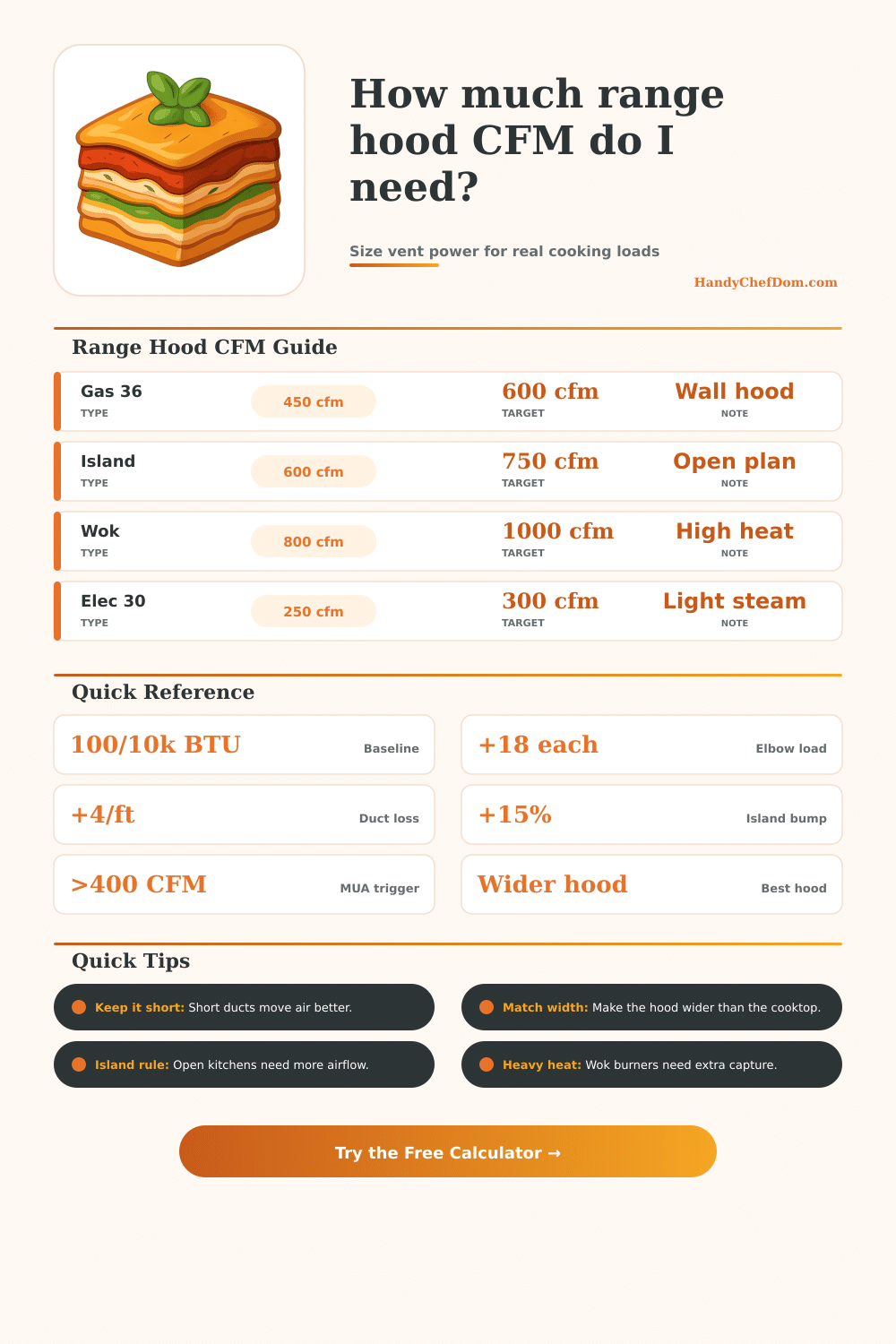
| 30" electric | Low steam | 250-300 | Quiet home |
| 36" gas | Mid load | 450-600 | Family range |
| 48" pro | High load | 800-1000 | Large heat |
| Wok burner | Very high | 900-1200 | Open flame |
| Griddle | Heavy steam | 700-900 | Breakfast line |
| Induction | Low steam | 200-350 | Less smoke |
| Hood style | Factor | Best fit | Note |
|---|---|---|---|
| Under-cabinet | 1.00x | Compact | Simple runs |
| Wall mount | 1.05x | Most homes | Good capture |
| Insert | 0.96x | Custom | Cabinet box |
| Island | 1.15x | Open plan | More spill |
| Pro-style | 1.12x | Heavy use | Wide canopy |
| Baffle hood | 1.08x | Grease | Easy clean |
| Duct run | Penalty | Use case | Note |
|---|---|---|---|
| 0-10 ft | None | Short run | Best case |
| 11-15 ft | +20 CFM | Mid run | Normal home |
| 16-25 ft | +40 CFM | Long run | Watch bends |
| 1 elbow | +18 CFM | 90 turn | Adds drag |
| 2 elbows | +36 CFM | Corner run | Plan ahead |
| 6 in duct | +25 CFM | Small duct | Less flow |
| Scenario | Width | Target | Note |
|---|---|---|---|
| Quiet kitchen | 30 in | 250-350 | Low steam |
| Family gas | 36 in | 450-650 | Daily cook |
| Open island | 42 in | 600-900 | More spill |
| Pro range | 48 in | 800-1200 | Strong pull |
| Wok station | 36-48 in | 900-1500 | Heavy heat |
| Induction | 30-36 in | 200-400 | Lower smoke |
A range hood will removes smoke, steam, grease, and heat from the kitchen. The effectiveness of a range hood will be measured in CFM, which are the measurement of the amount of air that the range hood will pull into the range hood every minute. The CFM requirements of your cooktop will determine the type of range hood that you must select.
You should not select a range hood for your kitchen based solely on teh visual style of the range hood. If you select a range hood that has a low CFM measurement, it will not be able to effectively remove smoke and grease from the kitchen. As a result, the smoke and grease will remain in your kitchen.
Choose the Right CFM for Your Range Hood
The cooking method that you use in your kitchen will determine the CFM requirements of your range hood. For example, simmering liquids on an electric cooktop will create steam in the cooktop. The range hood that you use will have to have enough CFM to effective remove the steam that is created in the kitchen.
Using cooking method such as searing meat on a gas range will produce smoke and grease. Range hoods that are created to remove smoke and grease will have higher CFM ratings than those that are used for other cooking methods. You should also consider the total BTU output of your cooktop.
The total BTU output of your cooktop will determine the amount of heat energy that the cooktop will produce. Gas range tend to produce a higher total BTU output than other types of cooktops. Cooktops with high total BTU outputs will require range hoods with higher CFM ratings to effectively remove the smoke and grease that is produced.
The style of your range hood can impact the CFM of your range hood. For example, a wall mount canopy range hood will capture smoke and grease from three sides of your cooktop. A wall mount canopy range hood will be useful in kitchens in which the cooktop is against one of the walls in the kitchen.
Island range hoods will hang from the ceiling above the cooktop. The CFM ratings for island range hoods will be higher than for other range hood style in order to prevent the smoke from entering the other living areas of the home. Under-cabinet range hoods will be installed beneath one of the cabinets in the kitchen.
Depending on the width of the cabinet, an under-cabinet range hood might not be able to effectively remove smoke and grease from the range. The range hood should be installed to overhang the cooktop by several inches on each side. This will create a better seal to ensure that smoke and grease are effectively removed from the range.
Your range hood will include ductwork that will help to remove smoke, steam, grease, and heat from the cooktop. The length of the ductwork and the number of elbows in the ductwork will reduce the CFM of the range hood. Each foot of ductwork will reduce the CFM of the range hood.
Each elbow in the ductwork will reduce the effectiveness of the range hood; a 90-degree elbow in the ductwork will reduce the effectiveness of the range hood. If the range hood has long ductwork or many elbows in the ductwork, the CFM of the range hood will have to be more higher to compensate for the resistance of the ductwork. The diameter of the ductwork will impact the CFM of the range hood; the smaller the diameter of the ductwork, the less CFM the range hood will produce.
Your kitchen layout will impact the CFM of the range hood that you use in your kitchen. If your kitchen is a closed kitchen, it will contain smoke and steam more easily than an open kitchen layout. In an open kitchen, the smoke and steam can drift into the other living area of the home.
If your kitchen layout is an open kitchen layout, you will have to purchase a range hood that has higher CFM ratings. In addition to the layout of your kitchen, you must also consider the make-up air requirements for your range hood. Range hoods that expel more than 400 or 800 CFM of air will require a make-up air vent to be installed in your kitchen.
Building codes will require a make-up air vent to provide air to the range hood in place of the air that the range hood expel. If you do not include a make-up air vent for the range hood, the range hood will create negative pressure in the kitchen. This negative kitchen pressure may cause dangerous gases to be drawn into the home from other kitchen appliances.
In order to determine how many CFM you need for your cooktop, you can use a baseline formula to calculate the CFM requirements of your kitchen range hood. A baseline formula for determining the CFM requirements is to provide 100 CFM for every 10,000 BTU of the cooktop range hood. You must adjust for your specific needs.
For example, if your cooktop is electric rather than gas, you will require less CFM. The same formula can be used to calculate the requirements for an electric cooktop. However, you will have to increase the CFM of the range hood if the range hood ductwork is longer than the standard range hood ductwork or if you have an island cooktop range hood.
Finally, you should clean the range hood grease filter regularly; if the range hood grease filters are clogged, the CFM of the range hood will be reduced. If the grease filters are clogged, the range hood will not effectively remove smoke and grease from the cooktop range.