Raw Chicken Breast to Cooked Weight Calculator
Estimate cooked yield, plan raw portions, and size servings by cooking method.
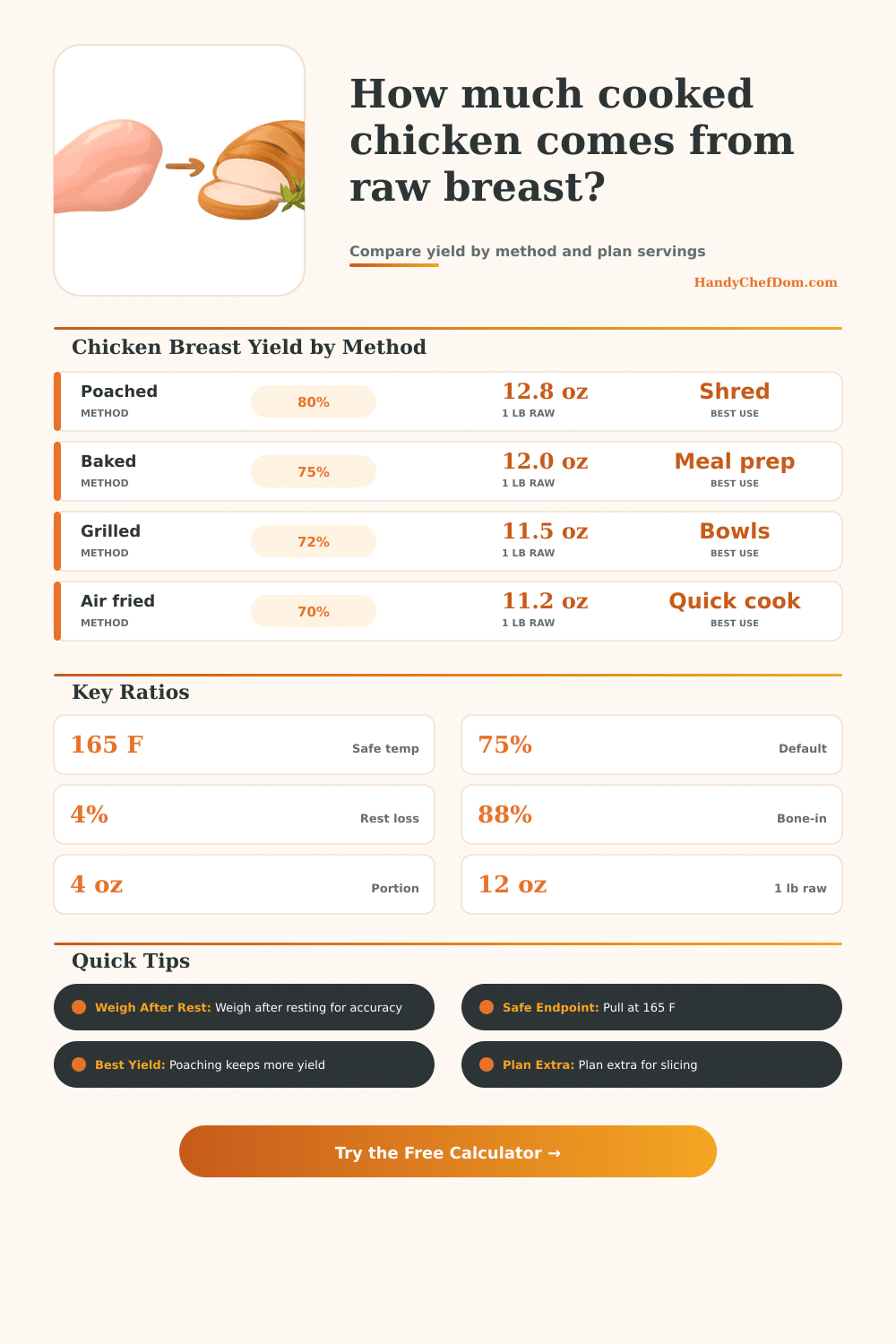
| Method | Yield | 1 lb Raw | Best Use |
|---|---|---|---|
| Poached | 80% | 12.8 oz | Shred |
| Baked | 75% | 12.0 oz | Meal prep |
| Grilled | 72% | 11.5 oz | Bowls |
| Air fried | 70% | 11.2 oz | Quick cook |
| Breast Style | Factor | Yield Note | Plan Note |
|---|---|---|---|
| Boneless skinless | 1.00 | Most common | Use base |
| Bone-in breast | 0.88 | More trim | Add extra raw |
| Thin cutlets | 0.96 | Fast cook | Less shrink |
| Butterflied | 0.98 | Even cook | Good middle |
| Use Case | Cooked per Person | Raw per Person | Note |
|---|---|---|---|
| Dinner plates | 5-6 oz | 7-8 oz | Standard |
| Salad topping | 3-4 oz | 4-5 oz | Lighter |
| Sandwiches | 4 oz | 5-6 oz | Sliced |
| Meal prep | 6-8 oz | 8-10 oz | Protein dense |
| Raw Amount | Poached | Baked | Grilled |
|---|---|---|---|
| 1 lb | 12.8 oz | 12.0 oz | 11.5 oz |
| 2 lb | 25.6 oz | 24.0 oz | 23.0 oz |
| 4 lb | 51.2 oz | 48.0 oz | 46.0 oz |
| 1 kg | 800 g | 750 g | 720 g |
Chicken breasts will shrink during the cooking process due to the loss of moisture. As the cook cooks the chicken breast, the water evaporate from the meat. Additionally, the fat will also leave the chicken breast.
Thus, the weight of the cooked chicken breast will be less then the raw chicken breast. The weight of the chicken breast that will shrink depend upon the cooking method and the cut of the chicken breast. Depending upon the cooking method, the yield of the chicken breast will change.
How Much Chicken Breast Shrinks When Cooked
Poached chicken breast will retain its moisture and will yield more chicken breast than grilled or bake breast. When a cook grills or bakes chicken breast, the dry heat will cause the moisture to leave the chicken breast. Additionally, grilling may lead to more weight loss of the chicken breast than baking.
Thin cutlets will lose less weight than thicker cutlets because the thin cutlets will cook faster to allow for even heat penetration into the chicken breast. If bone-in chicken breast is used, you will have to purchase more raw weight since the cook will need to trim the bones away. Considering the weight loss of the chicken breast is important.
For instance, if four people are to be fed with a 4-ounce portion of chicken breast, 1.5 pounds of raw chicken breast wont be enough. The loss of 25 to 30 percent of the weight of the raw chicken breast will need to be considered. Additionally, if batches of chicken breast is to be cooked, the weight loss should be considered in the purchase of the raw chicken breast.
A buffer should be used when cooking large batch of chicken breast to account for any mistake in trimming or cooking. The cooking method will change the amount of the chicken breast that will be yielded. For instance, if a cook grills thick boneless skinless chicken breast, the yield will be 72 percent of the raw weight of the chicken breast.
Thin cutlets of chicken breast will yield closer to 96 percent. If the chicken is being made into a soup, the cook can poach the chicken breast and 80 percent of the raw chicken breast will be yielded. Air frying the chicken will prepare the chicken quickly but the yield will be less chicken breast than other method.
Chicken breast should be removed from the heat source once the chicken breast reaches 165 degrees Fahrenheit. Once the chicken breast reaches this temperature, it should be tented and rested for five to ten minutes. During this time, the juices will redistribute within the chicken breast but some of the weight will be lost to the cutting board.
While many may not weigh the chicken breast after it has rested, weighing the chicken breast after resting is an important step in preparing chicken breast. If individual portion of the chicken breast are eyed out, error can be made when feeding large amounts of chicken breast. The type of chicken breast that is purchased will also impact the yield of the cooked chicken breast.
If a cook purchases bone-in chicken breast, 12 percent of the weight of the chicken breast will be lost to the discarded bone. If chicken breast with skin is purchased, the fat will render but some of the weight will be lost. If the cook stuffs chicken breast, the yield will be less than chicken breast without filling.
Depending upon the type of meal that is being prepared, the weight of the raw chicken breast that is purchased will change. For dinner portion, 5 to 6 ounces of raw chicken breast should be purchased per person. For salads, 3 to 4 ounces of raw chicken breast should be purchased per person.
For sandwiches, 4 ounces of raw chicken breast per person will be needed. If the chicken breast is to be part of a high-protein week, 6 to 8 ounces of raw chicken breast per person can be purchased. To avoid weight loss of the chicken breast, cooking method like sous vide can be used.
Additionally, the raw weight of the chicken breast will not equal the cooked weight of the chicken breast. One pound of raw chicken breast will result in 11 to 13 ounces of cooked chicken breast. When cooking large batches of chicken breast, a five percent buffer should be included.
This five percent can account for some chicken breasts being larger than others or the chicken breast drying out during the cooking process. Additionally, it is necessary to ensure that the chicken breast reaches 165 degrees Fahrenheit. By removing the chicken breast from the heat source slightly early, it can finish cooking while resting.
Removing the chicken breast from the heat source too early or cooking the chicken breast beyond 165 degrees will lead to weight loss due to the additional evaporation of the moisture from the chicken breast. Finally, to accurately portion the chicken breast, it is best to use a scale to weigh the chicken breast. Using the feel of the chicken breast to portion may lead to incorrect amount of chicken breast portioned for each individual.