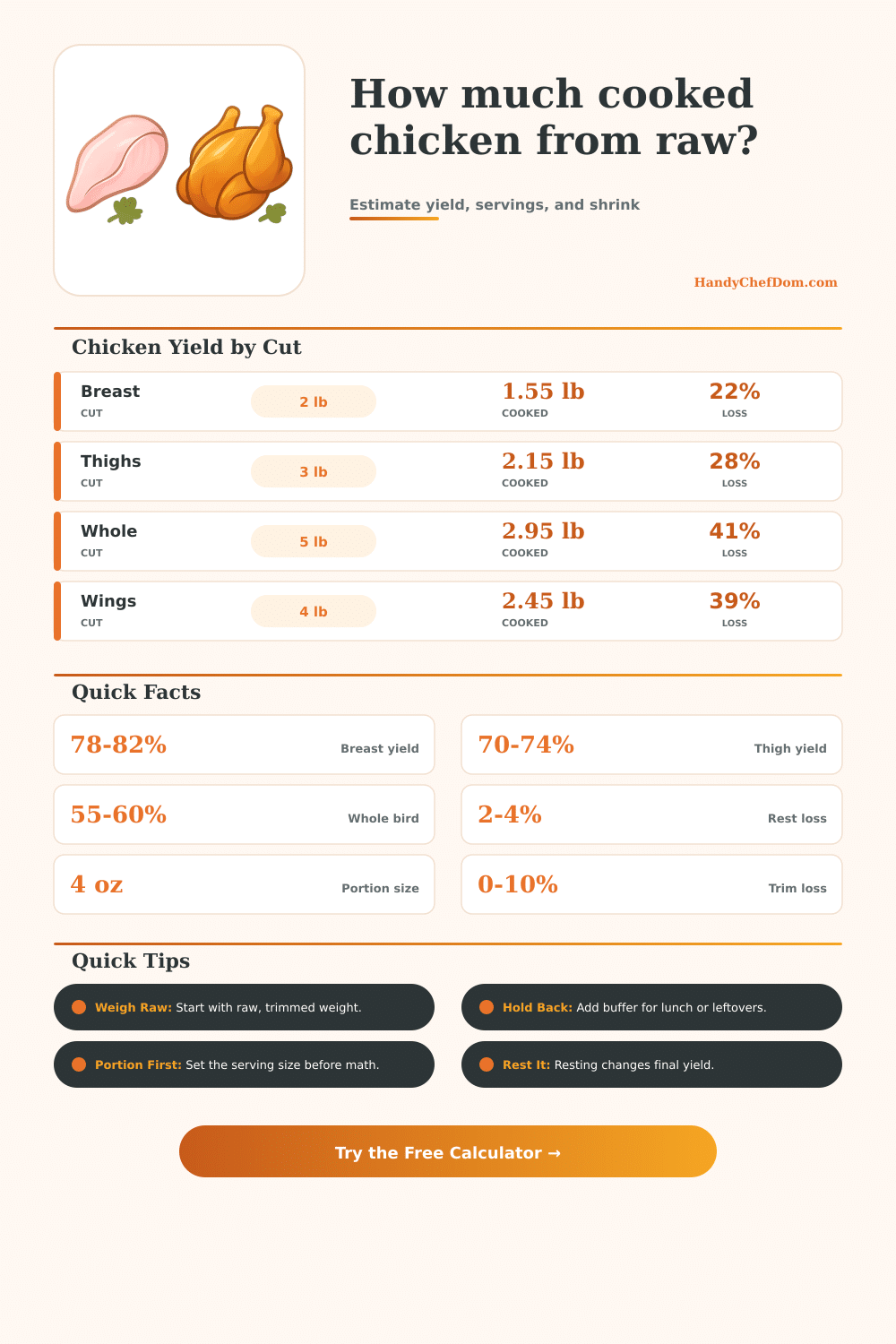
Raw to Cooked Chicken Weight Calculator
Estimate cooked yield, servings, and shrink for breasts, thighs, whole birds, wings, and shredded batches.
Use raw weight first, then var the calculator apply cut yield, method, and handling loss to estimate cooked portions.
| Cut | Yield | Portion | Best Use |
|---|---|---|---|
| Boneless Breast | 78-82% | 4 oz | Meal prep |
| Bone-In Breast | 64-69% | 4 oz | Roast trays |
| Boneless Thigh | 76-80% | 4 oz | Tacos |
| Bone-In Thigh | 70-74% | 4 oz | Family dinner |
| Wings | 60-64% | 3 oz | Party trays |
| Whole Bird | 55-60% | 4 oz | Roasts |
| Method | Factor | Loss | Note |
|---|---|---|---|
| Bake | 0.97 | 3% | Stable yield |
| Roast | 0.98 | 2% | Dry heat |
| Grill | 0.95 | 5% | More evaporation |
| Air Fry | 0.96 | 4% | Fast finish |
| Skillet | 0.94 | 6% | Highest shrink |
| Poach | 0.93 | 7% | Gentle cook |
| Style | Portion | Metric | Use |
|---|---|---|---|
| Entree | 4 oz | 113 g | Plates |
| Tacos | 3 oz | 85 g | Wraps |
| Sandwich | 3.5 oz | 99 g | Lunch |
| Salad | 3 oz | 85 g | Toppers |
| Bowl | 4.5 oz | 128 g | Rice bowls |
| Meal Prep | 4.25 oz | 121 g | Containers |
| Raw | Cooked | Servings | Loss |
|---|---|---|---|
| 2 lb breast | 1.55 lb | 6 | 22% |
| 3 lb thighs | 2.15 lb | 8 | 28% |
| 5 lb whole | 2.95 lb | 12 | 41% |
| 4 lb wings | 2.45 lb | 11 | 39% |
| 4.5 lb drum | 3.15 lb | 13 | 30% |
| 3 lb ground | 2.55 lb | 10 | 15% |
When you purchase chicken from the store, the weight of the chicken that are purchased is the raw weight of the chicken. However, the weight of the chicken will decrease after it has being cooked. The percentage of the weight that the chicken loses while it is being cook is known as the shrink of the chicken.
Because of this shrinkage, it is possible that the amount of chicken that is cooked is less than the amount that is intend to be served. If you do not account for the shrinkage of the chicken in the preparation of the meals that is to be prepared, there is the potential that there will not be enough chicken to feed all that is intended to be fed. The primary reason that chicken decreases in weight after it is cooked is due to the loss of moisture that occurs within the chicken during the cooking process.
How Much Weight Does Chicken Lose When Cooked
Raw chicken contains 75% of water that is contained within the bird’s body. When the chicken is cooked, the proteins that are present within the raw chicken begins to tighten, and the proteins loses the water that is contained within the raw chicken. Additionally, the fat of the chicken will render during the cooking process, and the bones of the chicken will not contribute to the weight of the cooked chicken meats.
In order to accurately account for the shrinkage of the chicken, you can measure the raw weight of the chicken after the initial trimming of the chicken. You should trim any excess fat that is contained in the chicken prior to measuring the weight of the chicken. The cooking method that is employed will also impact the weight of the chicken after it is cooked.
For example, chicken that is sautéed will lose more weight then chicken that is poached. Additionally, chicken that is cooked with the skin on the chicken will gain a small amount of weight from the fat that is rendered during the cooking process. However, the cooking method and the trimming of the skin will always have an impact upon the final weight of the cooked chicken.
In addition to measuring the raw weight of the chicken, it is also important to consider the way in which the chicken will be served. For example, an entree portion of chicken will require 4 ounces of cooked chicken. However, meals like tacos will only require 3 ounce of cooked chicken.
Therefore, if planning for a week’s worth of meals, 4.25 ounces of cooked chicken per container may be required. A buffer of 10% of the chicken that is accounted for can also be purchased to ensure that there is enough chicken to feed those who will be eating the meals. Another factor that may impact the weight of the chicken that is cooked is the resting of the chicken after it has being cooked.
While the juices will redistribute within the cooked chicken while it rests, some of the juice can escape the chicken and land on the cutting board. Additionally, overcooking the chicken will result in the chicken losing additional weight due to the squeezing of the proteins out of the raw chicken. Brining the chicken prior to cooking will counteract this loss of weight; brining will lock the moisture into the chicken and increase the yield of the chicken.
Brining the chicken can increase the yield of the chicken by as much as 5%. Another factor that may impact the weight of the cooked chicken is the type of chicken that is purchased for the meals. If you purchase bone-in chicken, the weight of the chicken will be greater than the cooked meat that is obtained after removing the bones from the cooked chicken.
Additionally, if you cook chicken breasts that are skinless using dry heat, the chicken will dry out and lose weight. Chicken wings contain a high amount of bone, which will decrease the amount of cooked meat that can be obtained from a large pack of chicken wings. Ground chicken will experience less shrinkage than chicken that are whole.
In order to determine how much raw chicken will be required to prepare meals for individuals, you can use the math behind the shrinkage of raw chicken. For example, if 2.5 pounds of boneless chicken breast is cooked and the yield of chicken is 78%, 1.9 pounds of cooked chicken will be obtained. Therefore, 1.9 pounds divided by 4 ounce is 5 meals that can be prepared with the chicken.
Additionally, if 5 pound of whole chicken is cooked, the 60% edible portion of the chicken will provide enough meat to prepare 12 meals for individuals. In order to ensure that there is enough chicken for the individuals who will eat the prepared meals, there are a few steps that can be taken prior to shopping for chicken. First, you can compare the various cuts of chicken that are available at the store.
Chicken breasts will contain less fat and moisture than chicken thighs. Second, the amount of weight that chicken will lose during the cooking process in the kitchen can be tracked. Weighing the chicken while it is warm will ensure that the weight of the raw chicken is correctly measured.
Finally, cooked chicken should be stored in airtight container in order to prevent the chicken from drying out in the refrigerator. You should of accounted for the weight changes to avoid any problems. It is actualy important to keep track of the weight to ensure your recipe works.
Its better to be safe than sorry when your preparing meals. This process is much easier than it looks, and you can follow it with alot of ease. You’ll find that the moddern ways to cook chicken makes it much more comfortabley to manage.
Dont forget that the chickens size matter.