Recipe Converter Calculator
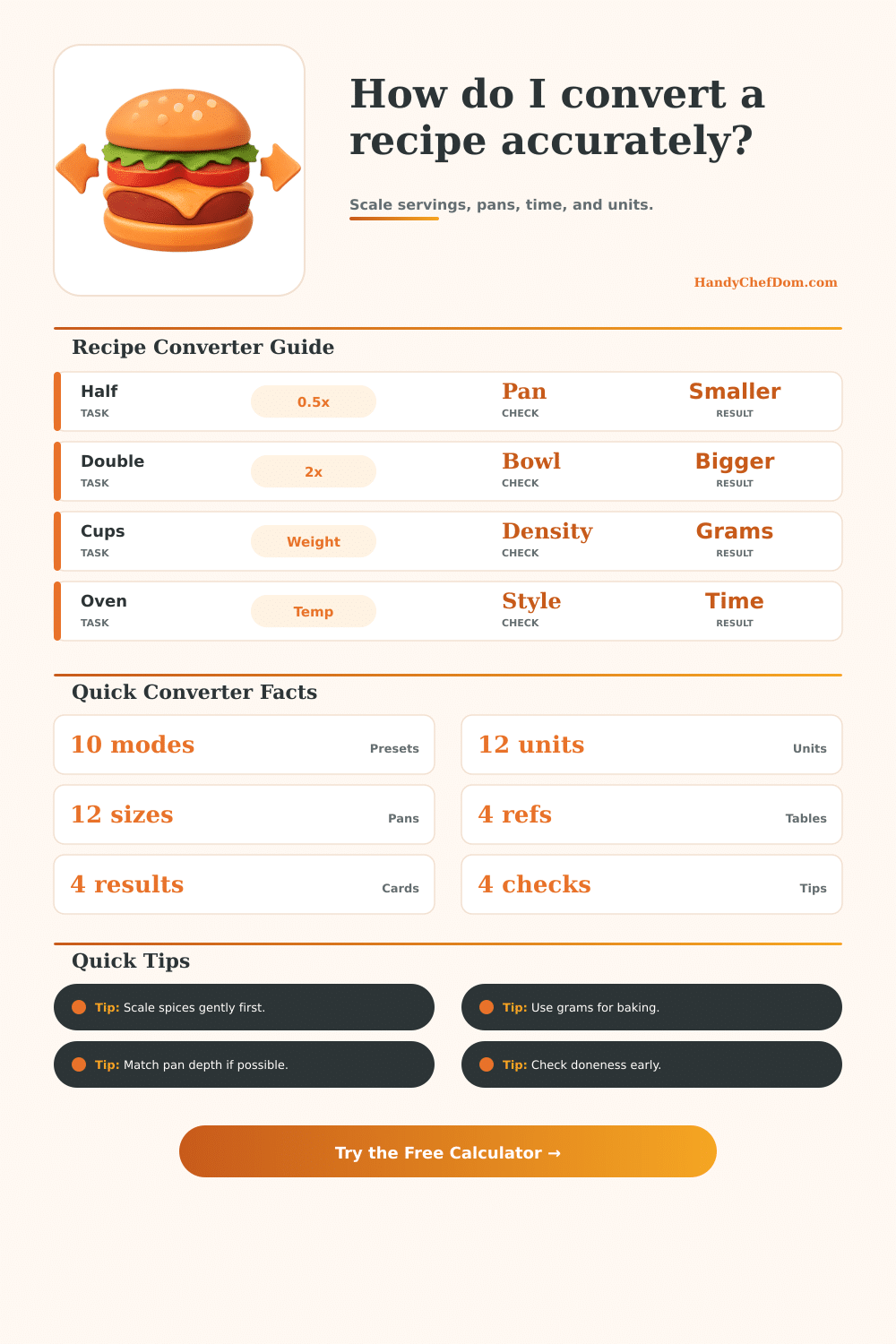
Scale a recipe up or down, translate a key ingredient from cups to grams, adjust for pan changes, and estimate oven time without losing the practical kitchen checks that make a converted recipe work.
1Choose a real kitchen preset
Start with a preset or enter your own recipe details. The converter keeps the math visible so you can sanity-check the batch before cooking.
2Enter recipe details
Your converted recipe
3Comparison grid
4Ingredient weight reference
| Ingredient | 1 cup grams | Best use | Conversion note |
|---|---|---|---|
| All-purpose flour | 125 g | Cakes, cookies, sauces | Spoon into the cup, then level for the closest volume match. |
| Granulated sugar | 200 g | Cookies, cakes, syrups | Sugar is denser than flour, so cup swaps are not equal by weight. |
| Brown sugar packed | 220 g | Bars, cookies, glazes | Use packed volume when converting older American recipes. |
| Butter | 227 g | Pastry, frosting, saute | One stick is about 113 g or 8 tablespoons. |
| Milk | 245 g | Batters, soups, custards | Close to water, but slightly heavier per cup. |
| Honey | 340 g | Glazes, breads, marinades | Very dense, so weigh it when accuracy matters. |
| Cocoa powder | 100 g | Cakes, brownies, drinks | Brand and sifting can change the cup weight noticeably. |
| Rolled oats | 90 g | Granola, cookies, bowls | Do not treat oats like flour when converting cups to grams. |
These are practical kitchen weights, not lab constants. For critical baking, use the weight printed by the recipe author when available.
5Volume and weight equivalents
| Measure | Metric | US equivalent | Recipe converter use |
|---|---|---|---|
| 1 teaspoon | 4.93 ml | one third tablespoon | Useful for salt, spice, vanilla, and small leavening amounts. |
| 1 tablespoon | 14.79 ml | 3 teaspoons | Good for oil, butter, sauce, and small liquid changes. |
| 1 cup | 236.59 ml | 16 tablespoons | Volume cup, not the same as a fixed gram weight. |
| 1 fluid ounce | 29.57 ml | 2 tablespoons | Best for liquids, not dry ingredient weight ounces. |
| 1 ounce weight | 28.35 g | one sixteenth pound | Use only for weight conversions, not fluid ounces. |
| 1 pound | 453.59 g | 16 ounces | Helpful for meat, vegetables, flour bags, and bulk prep. |
6Pan and pot conversion reference
| Pan or pot | Approx area | Compared with 9 round | Kitchen note |
|---|---|---|---|
| 8 in round | 50 sq in | 0.79x | Deeper batter than 9 inch if the batch is unchanged. |
| 9 in round | 64 sq in | 1.00x | Common cake layer baseline for home baking. |
| 10 in round | 79 sq in | 1.24x | Often needs more batter or a shorter bake. |
| 8 in square | 64 sq in | 1.00x | Close swap for one 9 inch round cake layer. |
| 9 in square | 81 sq in | 1.27x | Creates a thinner layer if the batter stays the same. |
| 9 x 13 pan | 117 sq in | 1.84x | Often close to two 9 inch round layers. |
| 9 x 5 loaf | 45 sq in | 0.71x | Depth matters more than area for quick breads. |
| Half sheet | 216 sq in | 3.40x | Use for bars, slab cakes, roasting, and party batches. |
7Oven temperature and timing guide
| Fahrenheit | Celsius | Gas mark | How to adjust |
|---|---|---|---|
| 300 F | 149 C | 2 | Low bake for custards, slow drying, and gentle reheating. |
| 325 F | 163 C | 3 | Helpful for deeper pans that need more time in the center. |
| 350 F | 177 C | 4 | Default baking temperature for many cakes, cookies, and casseroles. |
| 375 F | 191 C | 5 | Useful when you want browning without a very long cook time. |
| 400 F | 204 C | 6 | Good for roasting vegetables, sheet pan dinners, and crisp edges. |
| 425 F | 218 C | 7 | Use for pizza, biscuits, and quick browning with close monitoring. |
To scale a recipe, change the amount of the ingredients to make the recipe for the desired numbers of servings. Scaling a recipe involve more than simply multiplying each ingredient quantity by the number that will result in the desired number of servings. Changing the amounts of ingredients can change the way in which the ingredients interact with each other within the pans, as well as the flavor of the foods as it is consumed.
A recipe converter tool ensure that these changed amounts of ingredients are calculated correct for the desired serving size. When scaling a recipe, it is necessary to decide on the type of measurements of ingredient that will be used in the recipe. Using volume measurement can introduce inaccuracies in the recipe because the density of the ingredient can change based on how the ingredient is packed into the volume measurement unit.
How to Scale a Recipe
Using weight measurements avoid these types of inaccuracy because the weight of the ingredient dont change based on the way in which it is measured. Therefore, when scaling a recipe, it is better to use weight measurements so that each batch of the recipe include the same amount of the ingredient. The recipe converter tool allow the user to choose grams as the unit of measurement to ensure that you do not use volume measurements in the scaled recipe.
Another consideration in scaling a recipe is the size of the pan in which the recipe will be cooked. The shape of the pan can change the amount of the recipe that the pan can hold. For instance, using a pan with a different shape then the pan that was used to cook the recipe with the original measurements can hold the batter differently due to the change in the pans surface area.
The recipe converter tool allows the user to compare the surface areas of the pans to determine if the recipe will cook more faster with the new pan, or if more time is required to cook the recipe to the same degree of doneness. It is important to consider the size of the pan prior to cooking the recipe. Simply scaling the recipe without considering the pan size may result in undercooked or overcooked ingredient.
Pan size and cooking time should both be considered prior to cooking the recipe. The last consideration when scaling a recipe is seasoning the recipe. Many seasonings, like salt and pepper, do not scale in the same way as the other ingredient in the recipe.
For instance, if you are to double the recipe in size, doubling the amount of salt may result in the food taste too salty. This is due to the human taste buds ability to perceive salt differently with larger quantity of food. Recipe converters include a setting to adjust for flavor to ensure that seasonings are scaled differently from the other ingredients.
It is always safe to add more seasoning to food after the cooking process, but it is impossible to remove seasoning from food once you have added it. Oven temperature and oven timing are also affected when you scale a recipe. If you are cooking a larger batch of food, you may have to lower the oven temperature to prevent the outside of the food from cooking and potentially burning before the inside of the recipe is fully cooked.
The recipe converter will estimate a new cooking time for you according to the ratio of the recipe’s servings and the fill factor of the pan. While cooking timer are helpful, you should always use visual cues to determine when the food is done cooking. Equipment limitations are another issue to consider when scaling a recipe.
The mixer bowl and baking pans in your kitchen may be too small to contain the new amount of the recipe’s products, especially if the new amount of the product exceed the capacity of your equipment. The recipe converter includes preset button that will show you the new amount of each ingredient without having to begin cooking. Additionally, you may enter your own dimensions for a baking pan in the recipe converter.
Temperature conversion is another task that the recipe converter can perform for you. If your recipe uses Fahrenheit measurement for temperature but your kitchen’s oven uses Celsius measurement, the recipe converter will show you the original temperature and the converted temperature. For instance, if the recipe requires 350 degrees Fahrenheit, the recipe converter may display 350 degrees Fahrenheit and 177 degrees Celsius.
Choose the oven setting that is closest to the required temperature. The recipe converter can also round the measurements to make the numbers easier for you to read and use when following the recipe. Calculators produce measurements with decimals, but measuring tool will find it difficult for you to measure decimals.
The rounding option will round the decimals to the nearest whole ingredient measurement. Use the mode that displays the exact decimal measurement if you are preparing a delicate recipe that requires precision in the quantities of its ingredients. Finally, the recipe converter help you understand the relationships between the servings of a recipe, the area of a baking pan, and the time it take to cook the recipe.
By understanding these relationship, you can better anticipate the alterations to a recipe that you create by scaling it. If you use the recipe converter correctly, you will be able to successfully create a new recipe that tastes the same as the original recipe.