🍷 Red Wine Reducing Time Calculator
Estimate red wine reduction time from starting volume, target volume, pan diameter, simmer intensity, sugar or stock addition, altitude, lid status, desired texture, and sauce use.
Enter the wine volume you are reducing, the target finish volume, and the pan conditions. The calculator treats wine as the main evaporating liquid, then adjusts for sugar, stock, lid coverage, altitude, texture, and how the sauce will be used.
| Wine Profile | Best Use | Time Effect | Finish Cue |
|---|---|---|---|
| Dry red table wine | Everyday pan sauce | Baseline evaporation | Small bubbles turn glossy and aroma softens. |
| Cabernet or tannic red | Beef, roast, or game sauces | Slightly longer | Stop before bitterness dominates the spoon taste. |
| Pinot noir or light red | Chicken, pork, mushrooms, or lighter plates | Slightly faster | Light syrup body with a clean pan trail. |
| Port-style sweet red | Glaze or drizzle | Slower finish checks | Thick, shiny bubbles and slow spoon drip. |
| Wine plus pan drippings | Deglazed skillet sauce | More scorch risk | Fond dissolves and the sauce coats evenly. |
| Starting Volume | Half Reduction | Quarter Reduction | Metric Equivalent |
|---|---|---|---|
| 1 cup | 1/2 cup | 1/4 cup | 237 ml to 118 ml or 59 ml |
| 2 cups | 1 cup | 1/2 cup | 473 ml to 237 ml or 118 ml |
| 3 cups | 1 1/2 cups | 3/4 cup | 710 ml to 355 ml or 177 ml |
| 4 cups | 2 cups | 1 cup | 946 ml to 473 ml or 237 ml |
| 6 cups | 3 cups | 1 1/2 cups | 1.42 L to 710 ml or 355 ml |
| Pan or Lid Choice | Steam Escape | Calculator Effect | When It Fits |
|---|---|---|---|
| Open wide skillet | High | Fastest timing | Quick sauces and glazes. |
| Saucier, open | Moderate high | Balanced timing | Whisked sauces with butter or stock. |
| Straight saucepan | Moderate | Longer timing | Deeper batches and gentle simmer control. |
| Cracked lid | Low moderate | Large time increase | Only when splatter control matters. |
| Mostly covered | Very low | Not ideal for reducing | Holding aroma, not fast concentration. |
| Sauce Use | Target Texture | Typical Reduction | Method Note |
|---|---|---|---|
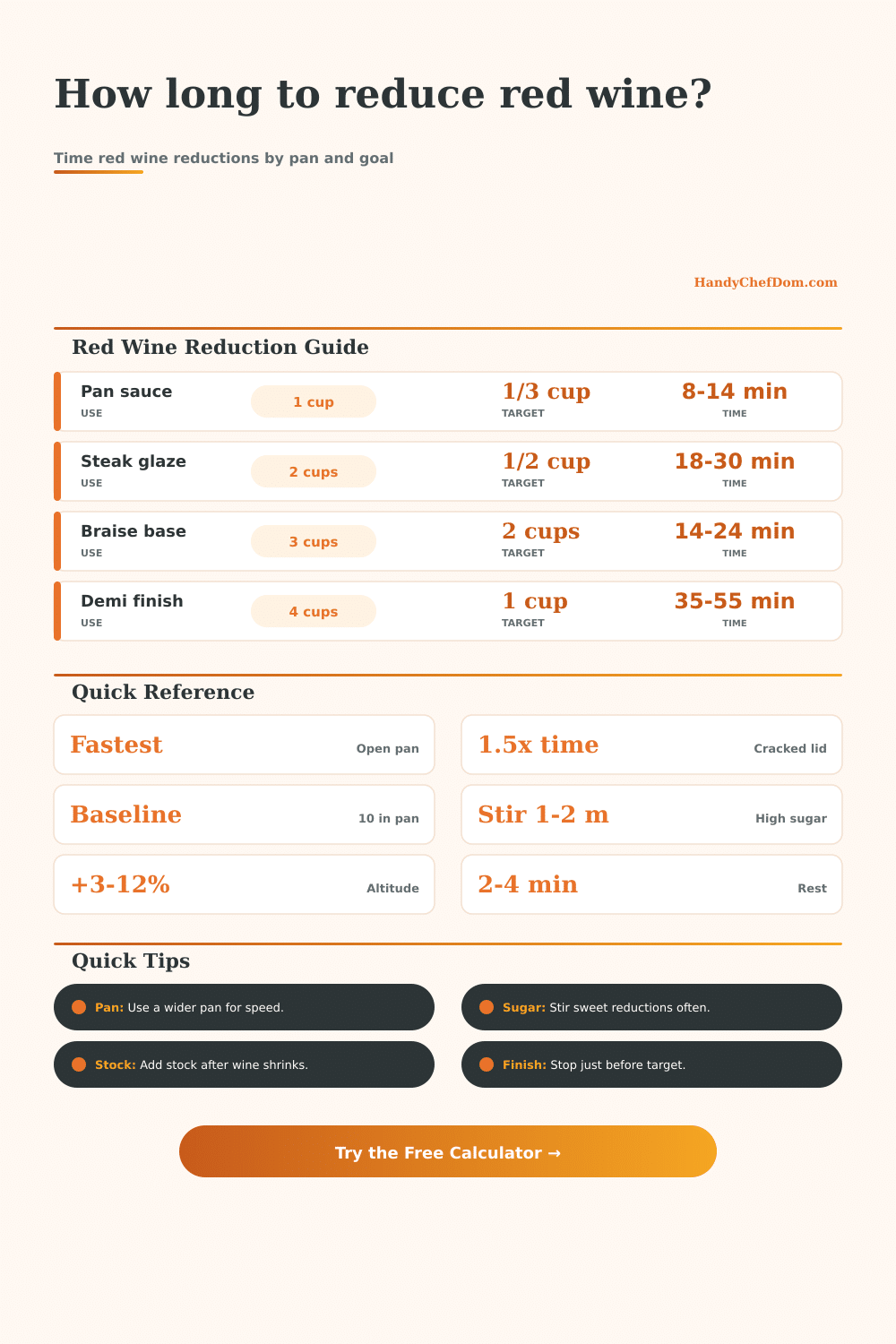
| Quick pan sauce | Coats the back of a spoon | 60 to 70 percent removed | Reduce wine first, then add stock or butter. |
| Steak or roast glaze | Glossy glaze | 70 to 80 percent removed | Check often during the final few minutes. |
| Braise base | Loose wine base | 30 to 50 percent removed | Stop before adding the main braising liquid. |
| Demi-glace finish | Nappe or syrupy | 75 to 85 percent removed | Use lower heat once gelatin body appears. |
| Plate drizzle | Syrupy intense reduction | 80 to 90 percent removed | Pull early because carryover thickens it. |
You start to panic when you are making a red wine reduction for your next dinner party and it is taking longer then expected. The steak has been seared; Cabernet has been used to deglaze the pan; but now the simmering sauce wont thicken. That’s because it isn’t all about time. It’s about heat intensity, sugar content, surface area, and knowing exactly when sauce is finished.
Reduction is an active drying process that requires attention, most home cooks approach this task passively, assuming they’re waiting for something to happen. Use the calculator above. It handle the complicated math surrounding evaporation rate and volume loss, leaving you free to listen to sensory clues that really count.
Why Your Red Wine Reduction Is Not Thickening
This brings us to the first variable which confuses people: the pan itself. Evaporation occurs on surface, not on the bottom. Therefore, a wide skillet will reduce wine far more quickley than, say, a narrow saucepan. Secondly, if your pan has straight sides and is deep, the steam will get trapped, condense again into the liquid and slow down process considerably. When professional chefs want something to go fast, what do they reach for? You guessed it, a wide saute pan. It considers both style and diameter of the pan and then adjusts its estimate accordingly based off how much surface area of the liquid is exposed to air.
And here’s where many people fall down. They’re covering the pan to avoid making a mess, but they end up trapping all the moisture they’re trying to escape. If you’re cracking the lid to avoid splashing, expect it to take roughly half again as long.
Add some sugar, however, and you change everything. A sweet red such as Port, jam, or even just honey makes the reduction much thicker. They boils at a slightly higher temperature (than plain water) but they also caramelize at an alarming rate. The calculator takes that into account and also warns you: a sweet glaze will need to be stirred far more frequentley.
There’s no such thing as leaving a reduction alone if it contains any kind of jam, fruit or otherwise. What feels like a gentle simmer on your dry wine will reduce sugar to a bitter sludge within less than a minute. That’s why the check interval drops in the results when you choose to include sweet additions. It’s not just a time function, it’s a safety function too.
There’s also one other silent factor: Altitude. That’s right, Denver dwellers, water boils at a different temp, depending on how high above sea level you live. So not only does it affect the rate of evaporation (ever so slightly), but it also affects the way that simmer act. For each five-hundred feet increase in elevation, the boiling point decreases by roughly a degree Fahrenheit. Over twenty minutes of cooking time, that difference adds up. The tool takes your altitude into account to give a more realistic cooking time. This is especially true if you’re trying to achieve a very specific texture (like nappe, when sauce clings cleanly to the back of a spoon).
What constitutes texture isn’t arbitrary: It’s subjective. But there are certain textures that a braising liquid must have. It should be loose enough for cooking while maintaining tenderness of the meat. Similarly, a glaze for steak must be thick enough to hold onto the steak, but not so thick as to run off the plate. By associating target textures with particular percentage reductions, the calculator allow you to set those targets and define what “done” means in terms of texture.
In some cases, like a quick pan sauce, maybe you just want to reduce by 60 percent. In other cases, like a finished demi-glace, perhaps you want to go all the way down to 80 percent. Why does that matter? It is not just about time, but about concentration. If you reduce the wine too much, you will increase the flavor, but you will also concentrate the acid and tannin. This makes your sauce taste harsh and metallic.
This leads to some trade-offs when creating the sauces, which are well explained on the page with the reference tables that break down how various types of wine will play out. Lighter-bodied wines such as Pinot Noir decrease quicker and result in a lighter sauce. On the other hand, tannin-rich reds such as Cabernet should be handled with care, pushing them past their limit will cause increased bitterness. The goal is not so much to stick to a recipe but rather to know what kind of wine is behaving in your pot.
A clock is not the best judge of a good sauce. It will provide a time frame, but let’s leave the decision making to our own senses. Seek out the change from fast and rapid bubbling to a slower, glossy one. Check the trail left by a spoon through the sauce: does it retain its form? Sample it. Is this the flavor of a concentrated, pure wine? Congratulations, you’re done. Does it still have the character of water with a hint of wine? Give it an extra minute.
While the math will get you roughly there, the palate and the eye are what complete the task. Once you shift focus away from the ticking clock and toward the dancing bubbles, the anxiety subsides and the reduction becomes less of a race then a rhythm. Your friends around the dinner table won’t even realize how close you came to burning the sugar.