Sea Salt to Table Salt Conversion Calculator
Swap grain sizes by weight or spoon measure, then see the table salt equivalent, sodium load, and serving-by-serving breakdown.
Use the closest spoon style you actually measure with. The calculator adjusts for grain size, fill level, use case, and the saltiness target.
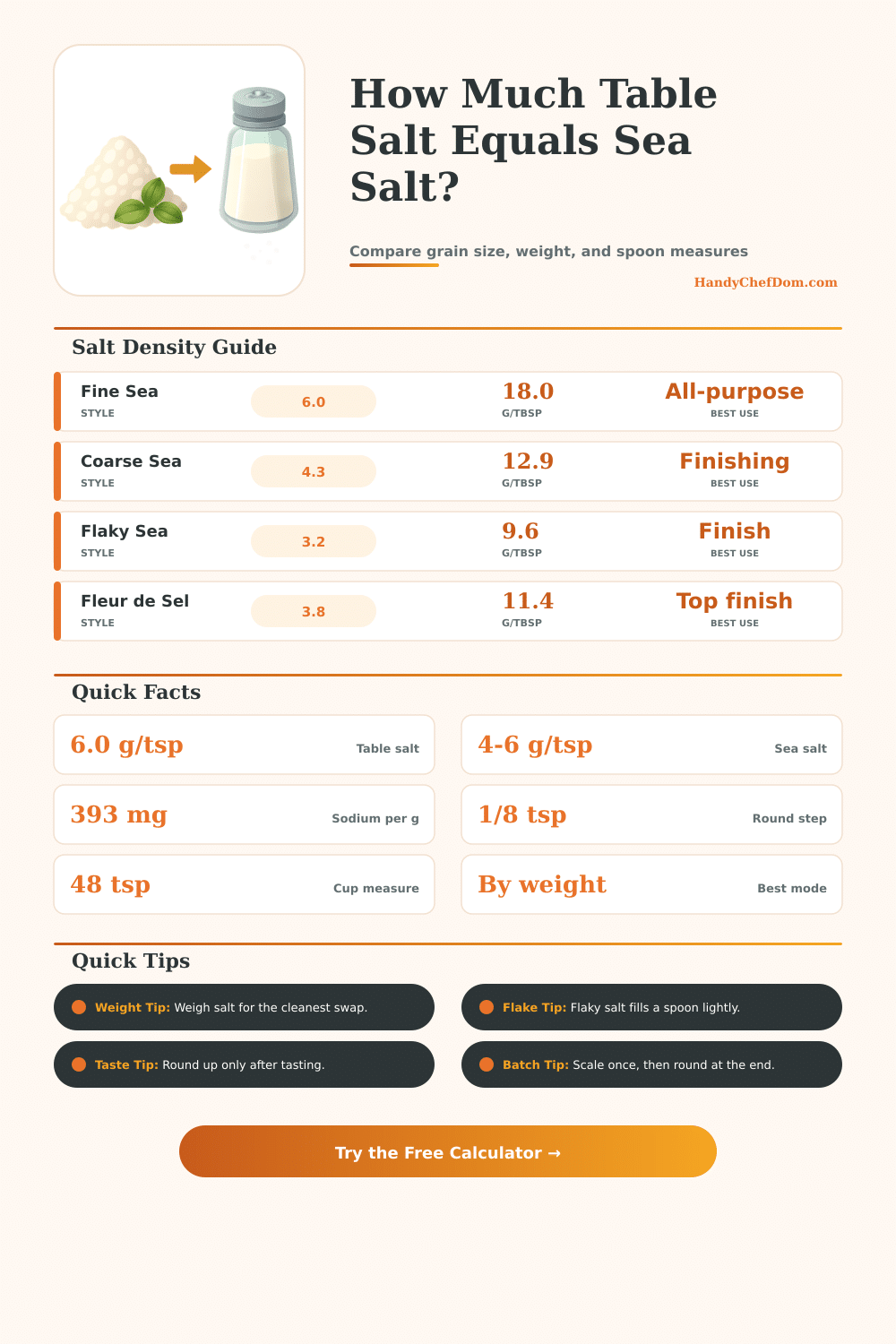
| Sea Style | g/tsp | g/Tbsp | Note |
|---|---|---|---|
| Fine Sea | 6.0 | 18.0 | Even scoop |
| Medium Sea | 5.0 | 15.0 | All purpose |
| Coarse Sea | 4.3 | 12.9 | Loose fill |
| Flaky Sea | 3.2 | 9.6 | Light finish |
| Table Salt | g/tsp | g/Tbsp | Note |
|---|---|---|---|
| Table | 6.0 | 18.0 | Classic |
| Iodized | 6.1 | 18.3 | Fine grains |
| Fine Table | 5.8 | 17.4 | Quick mix |
| Pickling | 5.4 | 16.2 | Clean brine |
| Input | Sea tsp | Table tsp | Comment |
|---|---|---|---|
| 1 tsp | 1.0 | 1.0 | Same by weight |
| 1 Tbsp | 3.0 | 3.0 | Sea varies |
| 1 cup | 48.0 | 48.0 | Big batch |
| 10 g | 1.7 | 1.7 | Weigh it |
| Salt g | Sodium mg | Use | Note |
|---|---|---|---|
| 1.0 | 393 | Season | Light |
| 3.0 | 1180 | Soup | Mid |
| 6.0 | 2360 | Brine | Bold |
| 12.0 | 4720 | Batch | Large |
Salt density and salt grain size is the primary reasons why salt conversions are necesary. Salt density refer to the weight of the salt that fit into a specific volume, such as a teaspoon. Table salt is highly processed to containing the same density throughout each package.
Most recipes uses table salt, and they assume that the density of the salt will remain the same in each recipe. However, sea salt can contain various grain size that alter the salt density of that sea salt. Grain size is a major factor in salt density.
Salt Density and Grain Size
The larger the salt crystals, the more air will be within the scooped salt. Because of the air within the coarse salt, the weight of the salt within a spoon will be less than the weight of coarse sea salt. For example, one level teaspoon of fine table salt contains 6 gram of salt.
However, one level teaspoon of coarse sea salt may only contain 4 grams of salt. Flaky sea salt is less dense than coarse sea salt. One level teaspoon of flaky sea salt may only contain 3 gram of salt.
Therefore, you must use more volume of flaky sea salt to provide the same amount of sodium as table salt. The way salt is scooped into the spoon will change the weight of the salt. If a loose scoop is used to scoop salt into the spoon, the weight will be less than if the salt are packed into the spoon.
Using a loose scoop will decrease the weight of the salt by around 6%. Packing the salt will increase the weight of the salt by 8%. Therefore, people needs to be aware of the way they scoop the salt to maintain the precise measurement of salt in the recipe.
Precision in the amount of salt is essential in baking to allow the dough to rise correctly. Using salt conversions will allow the food to have the correct amount of sodium. Using coarse sea salt instead of table salt will require the salt volume in the recipe to be increased.
Additionally, the salt can be measured to allow for the flavor to be more pronounced. For example, reducing the salt level by 10% will reduce the amount of sodium that is consumed. Increasing the salt level by 20% will enhance the flavor of the food.
Using a scale to measure the salt in grams will provide the most accurate measurement of salt for a recipe. Salt weight wont change depending on the type of salt that is being measured. One gram of any type of salt will contain 393 mg of sodium.
Therefore, measuring salt in grams will eliminate the confusion caused by the grain size of the salt. However, volume measurement in teaspoons will be less accurate in the amount of sodium that is provided by the salt. Different type of salt have different uses in the kitchen.
Table salt is a neutral salt and is used for seasoning food and baking. Sea salt contain trace minerals and can enhance the flavor of food. Coarse sea salt is used in salt grinders to obtain the fine salt needed for cooking and flaky sea salt is used as a finishing salt to enhance the flavor of the foods surface.
However, finishing salts should not be used in dough. The airiness of the salt will require a large volume of salt to provide the necessary sodium level for dough. This can have a negative impact on the texture of the dough.
When cooking, seasonants should be tasted as the recipe is being prepared. Salt density can be a problem when preparing a recipe for many people. If cooking a large batch of food, the cook should calculate the measurements for salt before adding the salt to the pot.
By understanding the different factor related to salt, cooks and chefs can use salt more effective than they used to in the kitchen.