🍕 Stadler Pizza Dough Calculator
Calculate exact flour, water, yeast & salt amounts for any number of pizzas
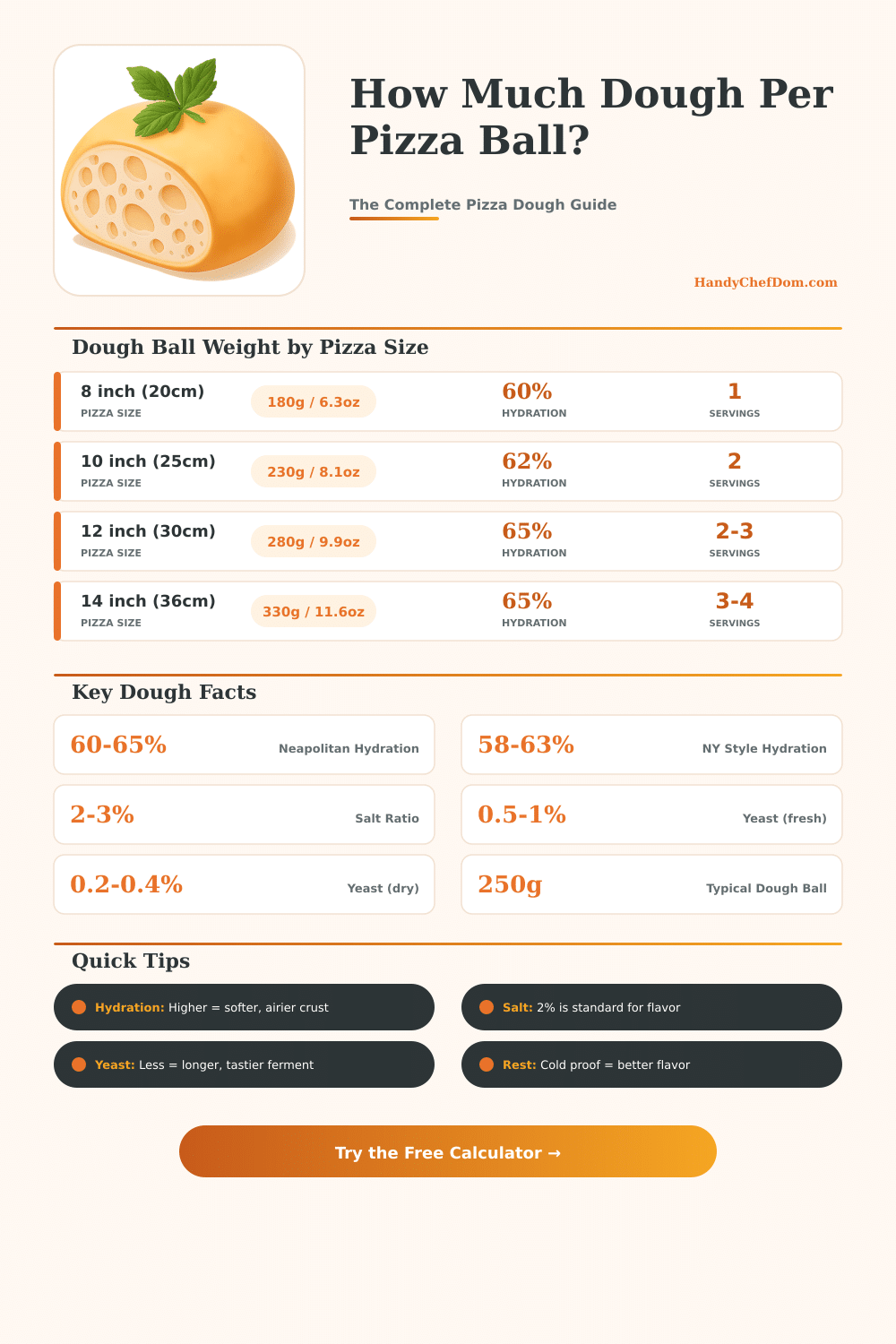
| Pizza Size | Dough Ball (Metric) | Dough Ball (Imperial) | Typical Servings |
|---|---|---|---|
| 8 in / 20 cm (Personal) | 180 g | 6.3 oz | 1 |
| 10 in / 25 cm (Small) | 230 g | 8.1 oz | 2 |
| 12 in / 30 cm (Medium) | 280 g | 9.9 oz | 2–3 |
| 14 in / 36 cm (Large) | 330 g | 11.6 oz | 3–4 |
| 16 in / 40 cm (XL) | 380 g | 13.4 oz | 4–5 |
| Style | Hydration | Texture |
|---|---|---|
| Neapolitan | 60–65% | Soft, chewy, airy |
| New York | 58–63% | Foldable, chewy |
| Roman | 65–70% | Crispy, light |
| Sicilian | 68–75% | Thick, focaccia-like |
| Detroit | 70–75% | Pillowy, crispy base |
| Yeast Type | % of Flour | Notes |
|---|---|---|
| Instant (IDY) | 0.2–0.4% | Add direct to flour |
| Active Dry | 0.3–0.5% | Dissolve in water first |
| Fresh Yeast | 0.6–1.0% | 3x weight of instant |
| Long cold proof | 0.05–0.1% | 48–72 hrs in fridge |
| Fermentation Time | Room Temp | Instant Yeast % | Active Dry % | Fresh Yeast % |
|---|---|---|---|---|
| 2 hours (quick) | ~23°C / 73°F | 0.5% | 0.6% | 1.5% |
| 8 hours (same-day) | ~23°C / 73°F | 0.3% | 0.4% | 0.9% |
| 24 hours (cold) | 4°C / 39°F | 0.15% | 0.2% | 0.45% |
| 48 hours (cold) | 4°C / 39°F | 0.08% | 0.1% | 0.25% |
| 72 hours (cold) | 4°C / 39°F | 0.05% | 0.07% | 0.15% |
| Metric Amount | Imperial (oz) | US Cups (approx) | Ingredient |
|---|---|---|---|
| 100 g | 3.5 oz | ⅓ cup | Flour (bread flour) |
| 250 g | 8.8 oz | 2 cups | Flour (bread flour) |
| 500 g | 17.6 oz | 4 cups | Flour (bread flour) |
| 100 ml | 3.4 fl oz | ⅓ cup | Water |
| 5 g | 0.18 oz | 1 tsp | Salt |
| 1 g | 0.04 oz | ¼ tsp | Instant yeast |
| 7 g | 0.25 oz | 2¼ tsp | One yeast packet |
Performance of pizza dough at home is much more simple than many believe. Suffice six basic ingredients, and you do not require fancy flours. Regular flour works well but bread flour also works.
Everything mixes in one single bowl, no need for a stand blender, although it does speed things up if available. Surprisingly, very little actual kneading is required and you observe only one rising period.
How to Make Simple Pizza Dough at Home
The list of ingredients pleases by its shortness: water, yeast, flour, olive oil, a bit of sugar and salt. About gear, nothing special is required. Simple bowls and a wooden spoon will suffice to reach the target.
One starts by activating the yeast, which only means to mix warm water with sugar and yeast, then wait around ten minutes until it foams and bubbles. The water must be warm, but should not burn the skin.
The length of the rise of the dough ranges according to the method that one uses. Some recipes allow it rest only 30 minutes. Others require almost 90 minutes for one rise.
For one-batch pizza, cook around 10 minutes of blending, followed by 30 to 60 minutes of resting before enter the oven. When it rose, oil the dough balls, cover them with plastic sheet and leave them at room temperature during some hours. Then the dough becomes really light and nice, and work with it becomes a delight.
Here happens something interesting: cold fermentation in the refrigerator really changes the pizza dough. From my attempts, waiting at least two days before baking gives clearly better taste and much longer lasting flavor. With less yeast the dough rises slowly during several hours at room temperature, witch coincides with the secret that many bakers swear by.
Entirely therefore, one can leave the dough prove in the refrigerator as long as you want, if only in a covered bowl, otherwise it dries on the surface.
Right weight of the dough really changes the result. For a 10-inch pizza, I found around 180 grams fit, more or minus. For 12 inches, aim close to 260 grams.
At 14 inches, around 350 grams have the ideal ratio. It helps to stretch the dough slowly, give it time to rest between every try.
A pizza stone really changes your results. The warming spreads more evenly, and the crust becomes crisp. Dust the pizza board with cornstarch or flour, so that everything slides on the stone without sticking.
For pan pizza, mix some tablespoons of olive oil in the dough and leave it rise in a well oiled pan… That gives a thick, crispy, golden base, while the inside stays puffy and soft under the toppings. The moisture level of the dough seriously affects the texture of the crust.
It should be a bit tacky, pulling from thebowl edges, but yet soft in the hands.