Stuffed Chicken Roasting Time Chart Calculator
Estimate roast time, rest windows, and serving yield for stuffed chicken by weight, oven temp, and stuffing load
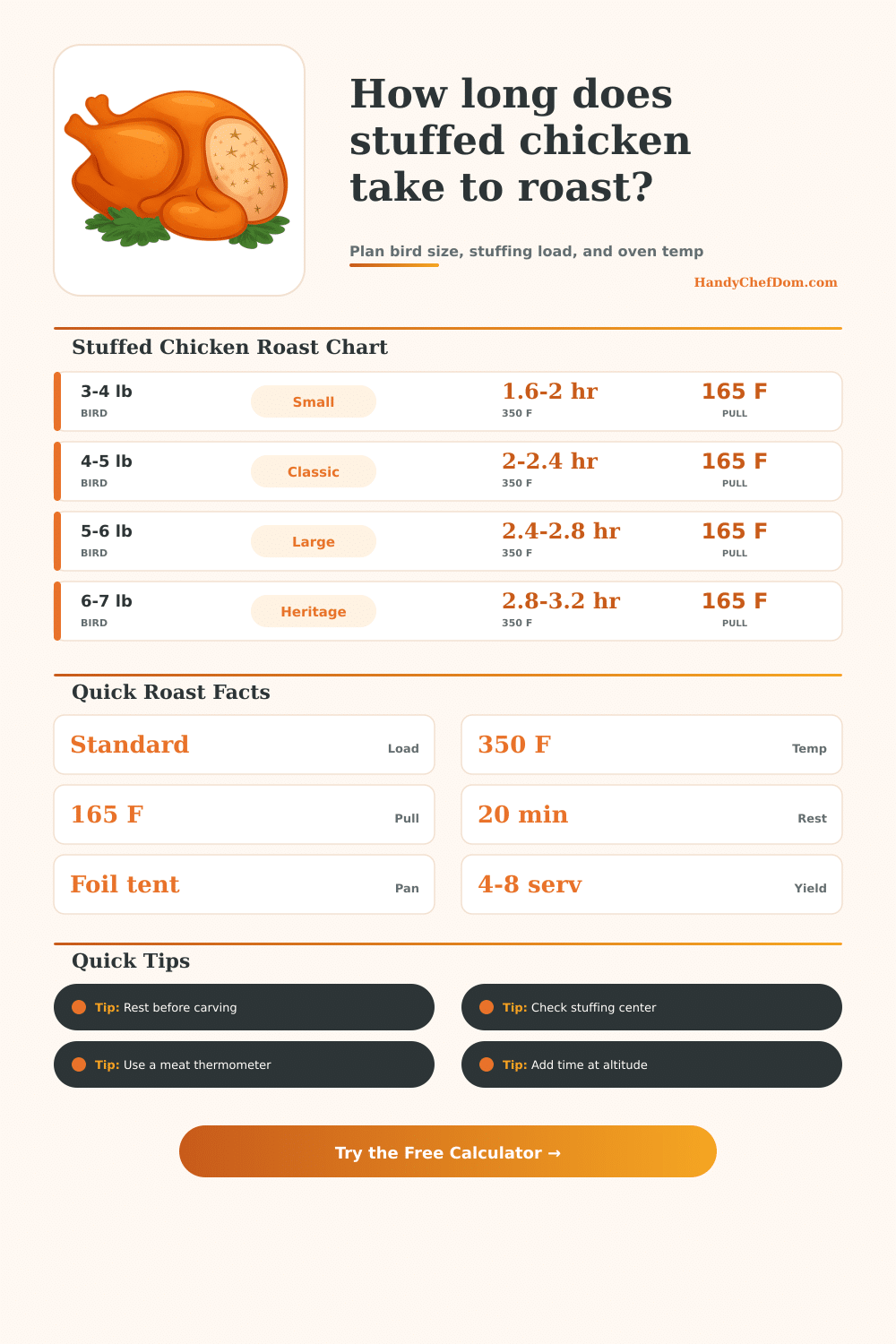
| Bird | Weight | 350 F | Pull Temp |
|---|---|---|---|
| Small roast | 3-4 lb | 1.6-2 hr | 165 F |
| Classic bird | 4-5 lb | 2-2.4 hr | 165 F |
| Large roast | 5-6 lb | 2.4-2.8 hr | 165 F |
| Heritage bird | 6-7 lb | 2.8-3.2 hr | 165 F |
| Factor | Light | Standard | Packed |
|---|---|---|---|
| Load factor | 0.95 | 1.00 | 1.15 |
| Stuffing temp | 160 F | 165 F | 165 F |
| Rest window | 15 min | 20 min | 30 min |
| Safe center | Opaque | Juices clear | Firm set |
| Condition | Factor | Impact | Note |
|---|---|---|---|
| Foil tent | 1.00 | Steady heat | Even color |
| Covered open | 0.98 | Moist start | Finish open |
| Open roast | 0.96 | Faster browning | Watch skin |
| 6000 ft | 1.09 | Longer roast | Add buffer |
Roasting a stuffed chicken require the management of heat according to the cooking rates of the stuffing and the chicken. Because the stuffing will insulate the chicken, the heat will take longer to reach the thicker portions of the chicken. If these factors isnt managed, the chicken may end up either too dry or pink in the center.
In order to avoid these outcomes, roasting time chart can be used to create an effectiv plan for roasting the stuffed chicken. The weight of the chicken will impact the cooking times. Smaller chickens will generaly heat to the desired temperature more fast than larger chickens.
How to Roast a Stuffed Chicken Safely
For instance, a 3-pound chicken will heat faster than a 7-pound chicken. However, the smaller chicken has less margin for error. Large chickens need to be roast at steady, low temperatures to ensure that the heat reaches the thick portions of the chicken without drying out the outer portions.
Additionally, the amount of stuffing will impact the cooking times of the chicken. Chickens with smaller portion of stuffing will take shorter cooking times than chickens that have large amounts of stuffing in the chicken; more minutes per pound will be required for chickens with large portions of stuffing to properly heat the stuffing. Oven temperatures will impact the cooking times for the chicken.
Standard temperatures are 350 degrees; however, 375 degrees will cook the chicken faster. However, if you roast the chicken at 375 degrees, you should watch the skin to ensure it does not burn. Additionally, the style of pan in which the chicken is roasted can impact the results of roasting the chicken.
If a foil tent is used to cover the chicken, the steam will help to keep the chicken moist. If there is no foil tent covering the chicken, the skin will crisp more sooner but may not brown evenly. The altitude at which the chicken is roasted will also impact the cooking times.
At altitudes above 4,000 feet, the thinner air will require the chicken to cook for 10% more time to reach the safe internal temperatures. These factors relating to the altitude must be accounted for in the preparation of the chicken. The internal temperature of the chicken is the most important factor in roasting.
The center of the thickest portion of the thigh must reach 165 degrees to ensure that the chicken is safe to eat; this is the temperature recommended by the USDA. Many cooks will remove the chicken from the oven at 160 to 168 degrees because of the phenomenon known as carryover cooking; the internal temperature will rise after the chicken is removed from the heat source. The chicken should be allowed to rest for at least 20 minutes after it is removed from the oven.
Allowing the chicken to rest will allow the juice to redistribute within the chicken properly and prevent the chicken from becoming too dry when it is carved. In addition to the safety requirement for the chicken, the stuffing must also reach an internal temperature of 165 degrees. Ensure that the center of the stuffing reaches this temperature with a thermometer.
If the stuffing contains raw ingredients, such as sausage, you must pre-cook the ingredients prior to adding the stuffing to the chicken. Another factor to consider when roasting a chicken is the number of people to be fed. Approximately 4-pound 5-pound chickens will feed four people; a 6-pound chicken will feed 6 to 8 people.
Additionally, because the stuffing increase the weight of the roasted chicken, there will also be increased servings. In order to successfully roast the stuffed chicken, some mistake should be avoided. For instance, do not stuff the chicken too full; this will lead to a soggy center.
Additionally, the skin should be dried prior to roasting; otherwise, the skin will not crisp but steam the skin of the chicken. Additionally, an instant read thermometer will provide the best indication of when the chicken and stuffing have reach 165 degrees; this is more accurate than a timer. While visual cues can help indicate doneness, a thermometer will provide the most accurate indication of when the chicken is properly cooked.