🍯 2:1 Sugar Syrup Calculator
Calculate exact sugar & water amounts for rich 2:1 simple syrup
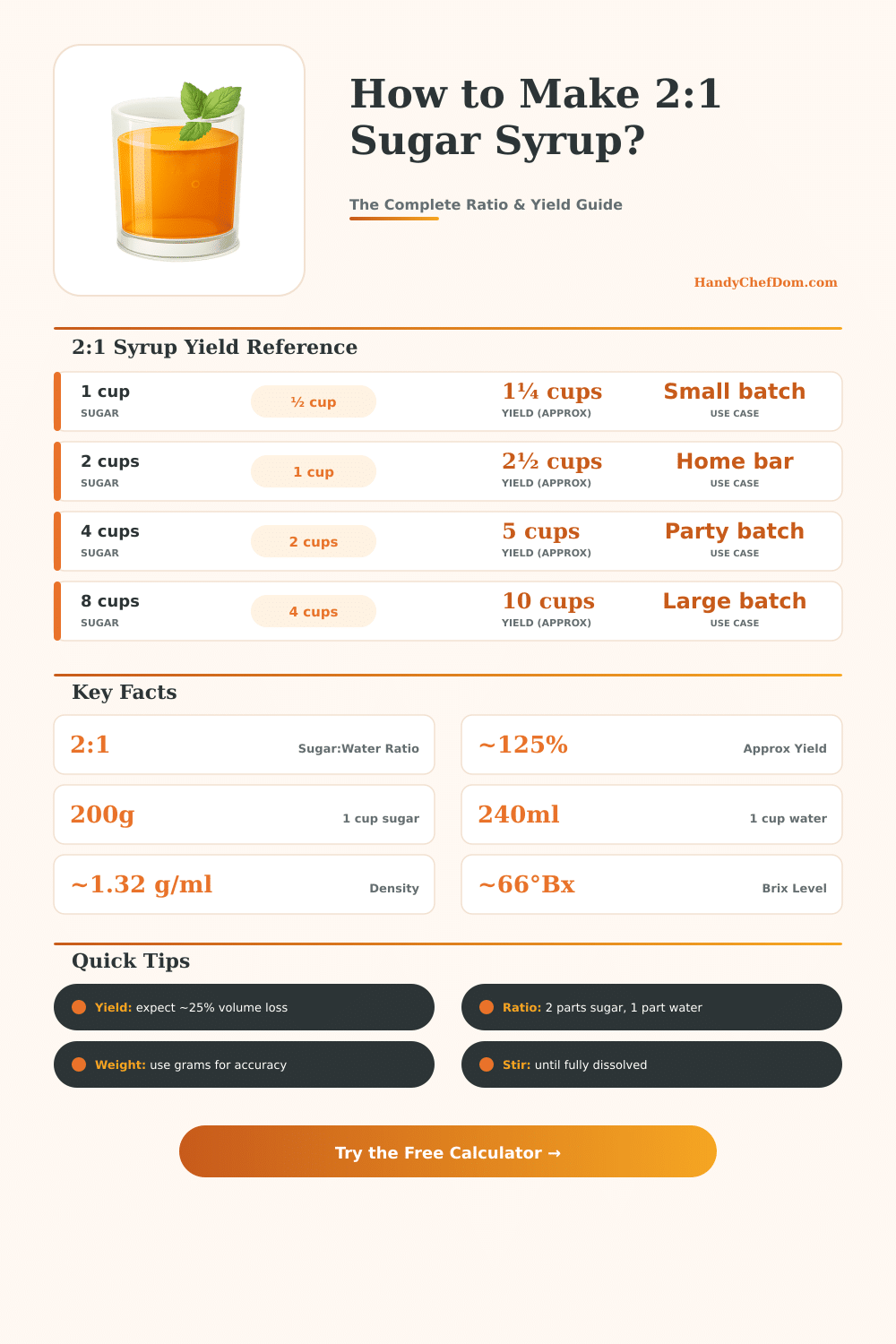
| Sugar (g) | Water (g / ml) | Approx Yield (ml) | Approx Yield (cups) | Common Use |
|---|---|---|---|---|
| 50g | 25g / 25ml | ~63ml | ~¼ cup | Single cocktail batch |
| 100g | 50g / 50ml | ~125ml | ~½ cup | Home bar small |
| 200g | 100g / 100ml | ~250ml | ~1 cup | Home bar standard |
| 400g | 200g / 200ml | ~500ml | ~2 cups | Home bar large |
| 800g | 400g / 400ml | ~1000ml | ~4 cups | Event / party |
| 1600g | 800g / 800ml | ~2000ml | ~8 cups | Large event |
| Imperial | Metric |
|---|---|
| 1 tsp | 4.9 ml |
| 1 tbsp | 14.8 ml |
| 1 fl oz | 29.6 ml |
| ¼ cup | 59 ml |
| ½ cup | 118 ml |
| 1 cup | 237 ml |
| 1 pint | 473 ml |
| 1 quart | 946 ml |
| Volume | Weight (g) |
|---|---|
| 1 tsp sugar | 4g |
| 1 tbsp sugar | 12.5g |
| ¼ cup sugar | 50g |
| ½ cup sugar | 100g |
| 1 cup sugar | 200g |
| 2 cups sugar | 400g |
| 4 cups sugar | 800g |
| 1 lb sugar | 454g |
| Syrup Type | Ratio | Brix (°Bx) | Density (g/ml) | Sweetness vs 1:1 |
|---|---|---|---|---|
| Thin Simple Syrup | 1:2 (sugar:water) | ~33°Bx | ~1.14 g/ml | Half as sweet |
| Simple Syrup | 1:1 (equal) | ~50°Bx | ~1.23 g/ml | Baseline |
| Rich Simple Syrup | 2:1 (sugar:water) | ~66°Bx | ~1.32 g/ml | ~1.5× sweeter |
| Extra Rich Syrup | 3:1 (sugar:water) | ~75°Bx | ~1.40 g/ml | ~2× sweeter |
At the core, sugar syrup is sugar dissolved in water. Basically, you take granulated sugar and make it a liquid sweetener, that gives same sweetness, only in a pourable form. The simplest ratio to remember is one-to-one: one cup water and one sugar.
Even so you can adapt that according to your need. Want thicker? Add more sugar.
How to Make Simple Syrup
Want it thinner and tender? Reduce the sugar
Why simple syrup changes the game in cocktails and cold drinks, like iced coffee? It mixes easily in liquids, while granulated sugar can not. No grains stay at the bottom of the glass, nor weird texture.
Moreover, it works well for moist cakes or fruitcakes, adding moisture and taste, that dry sugar never reaches.
The advantage of making it home is its extremely simple way. Normal granulated sugar from the cabinet works perfectly, as well as tap water. End when there is not even one grain in the pan.
If you want to escape the stove, use the no-cook method: mix equal parts water and sugar, stir well, then leave it ten to fifteen minutes. Stir occasionally while it sits, until sugar entirely dissolves and everything becomes clear. Pour in a clean jar and keep in the refrigerator.
If it ever does not look clear; especially if you see something weird inside, throw it away and start new.
Here is where the trips of powdered sugar shine. Those powdered stuff simply do not work for simple syrup, and there are three clear reasons: they have anticaking agents, dissolve wrong and change the behaviour of your syrup. You risk having something cloudy or even a gel instead of clear and pourable liquid.
Brown sugar syrup opens a whole new world. Mix brown sugar with organic cane sugar and you have a rich, complex taste. The natural flavor of cane sugar shows, mixing with the molasses notes of brown sugar to create something genuinely unique.
It works great for lattes and various desserts. To do it? Only water and brown sugar.
Flavored versions make everything fun and creative. Add lemon rind, rosemary, mint or anything that attracts you, and you created something new. Strawberry syrups taste like bottled candy.
Lavender also wins. For freshest, bright taste, especially with mint and lemon, use cold extraction instead of heat: press lemon halves in sugar and leave it for some hours. You will feel the difference immediately.
One ounce of simple syrup adds around fifty calories, all from carbohydrates. Agave syrup replaces well in cocktails, because it is reliable, cheap, shelf-stable and easy to find everywhere. Most cocktail recipes want between half and one ounce to balance the tastes correctly.
Stirring it in warm tea helps the sugar dissolve morequickly.