Sweet Potato Carb Calculator
Estimate total carbs, net carbs, fiber, cooked yield, and per-serving portions for orange, purple, Japanese, white, baby, or canned sweet potatoes.
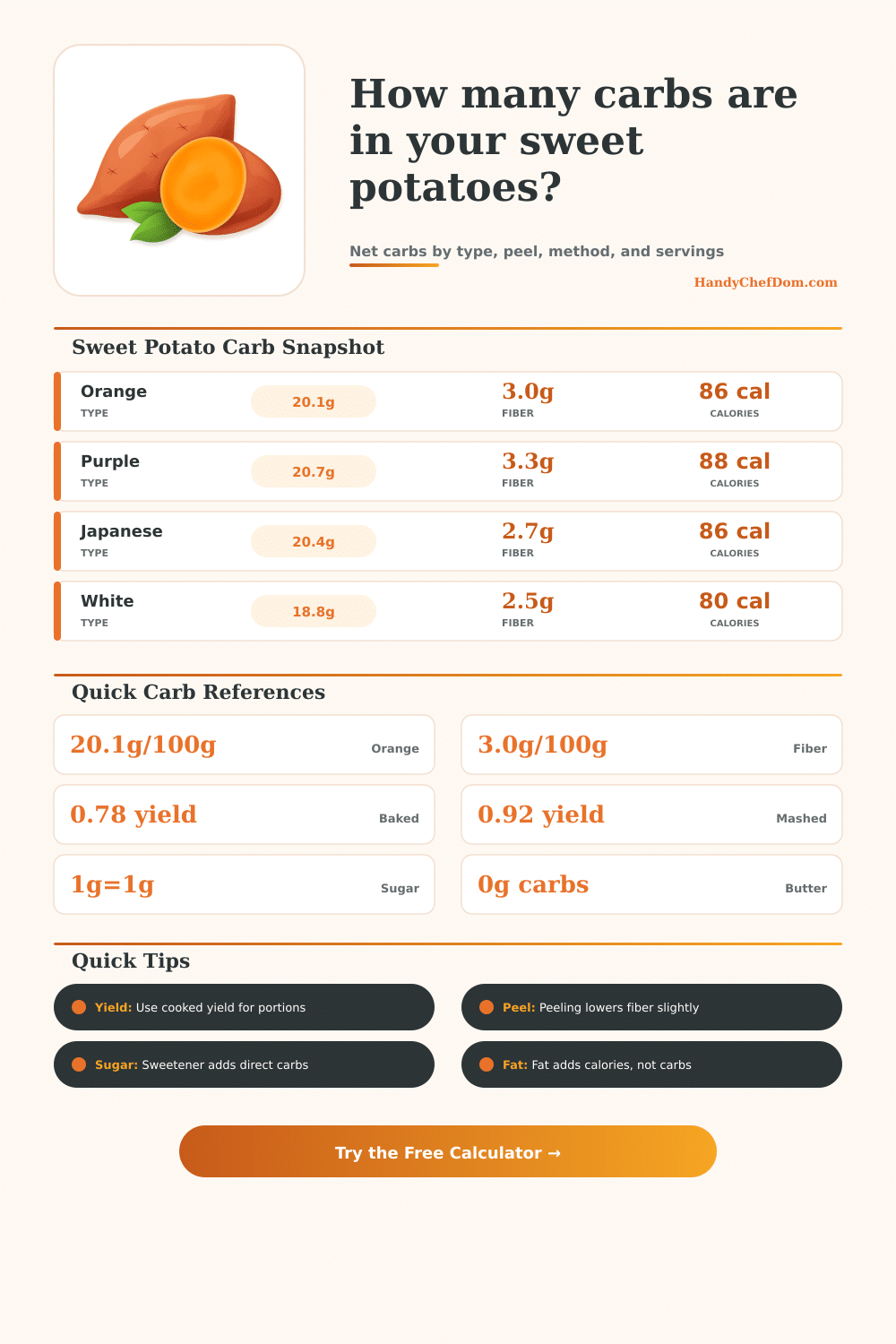
| Sweet potato type | Total carbs per 100 g | Fiber per 100 g | Estimated net carbs | Best calculator use |
|---|---|---|---|---|
| Orange flesh, raw | 20.1 g | 3.0 g | 17.1 g | Classic baked, roasted, or mashed sides |
| Purple flesh, raw | 20.7 g | 3.3 g | 17.4 g | Dense roasted pieces or colorful meal prep |
| Japanese / satsumaimo | 20.4 g | 2.7 g | 17.7 g | Drier baked slices and dessert-style portions |
| White sweet potato | 18.8 g | 2.5 g | 16.3 g | Milder mash or mixed vegetable plates |
| Baby sweet potatoes | 20.1 g | 3.1 g | 17.0 g | Count-based snack trays and lunch portions |
| Canned, drained | 21.1 g | 2.8 g | 18.3 g | Fast mashed sides after draining syrup or liquid |
| Method | Default yield factor | What it means | Carb effect | Portion note |
|---|---|---|---|---|
| Baked whole | 0.78 | Moisture loss concentrates cooked weight | Total carbs stay the same | Useful for whole-potato serving weights |
| Roasted cubes or wedges | 0.72 | More exposed surface loses more moisture | Carbs per cooked ounce rise | Good for sheet-pan portions |
| Mashed after cooking | 0.92 | Mash often keeps moisture or added liquid | Sweetener changes total carbs | Use for scooped side portions |
| Boiled or steamed | 0.95 | Less dehydration than roasting | Total carbs stay the same | Useful before mashing or chilling |
| Canned, heated | 1.00 | Drained weight is already a cooked weight | Count syrup only if included | Best for pantry side estimates |
| Serving target | Cooked portion | Approx raw weight | Orange total carbs | Orange net carbs |
|---|---|---|---|---|
| Small side | 3 oz / 85 g | 4 oz / 113 g raw | 22.7 g | 19.3 g |
| Standard side | 4 oz / 113 g | 5.6 oz / 159 g raw | 32.0 g | 27.2 g |
| Large baked potato | 6 oz / 170 g | 7.7 oz / 218 g raw | 43.8 g | 37.3 g |
| Mashed scoop | 1/2 cup / 120 g | 4.6 oz / 131 g raw | 26.3 g | 22.4 g |
| Meal-prep serving | 5 oz / 142 g | 6.9 oz / 196 g raw | 39.4 g | 33.5 g |
| Added ingredient | Carb factor used | Example entry | Added carbs | Calculator note |
|---|---|---|---|---|
| Brown or white sugar | 1.00 g carbs per gram | 20 g sugar | 20 g | Directly increases total and net carbs |
| Honey | 0.82 g carbs per gram | 20 g honey | 16.4 g | Water content lowers carb density |
| Maple syrup | 0.67 g carbs per gram | 20 g syrup | 13.4 g | Use ingredient weight, not spoon count |
| Mini marshmallows | 0.81 g carbs per gram | 20 g pieces | 16.2 g | Useful for casserole-style toppings |
| Butter, oil, or cream | 0 g carbs | 2 tbsp butter | 0 g | Adds calories and richness, not carbs |
Orange baked whole
Balanced moisture and sweetness. Use the baked yield when the skin stays on and each diner gets a whole or half potato.
Purple roasted cubes
Often denser and drier after roasting. A lower yield factor helps estimate smaller cooked pieces without changing total carbs.
Japanese slices
Starchier texture makes portions feel substantial. Count carbs from raw edible weight, then use yield for cooked portion planning.
White mashed side
Milder flavor and slightly lower carb estimate per 100 g. Mashed yield works well when moisture stays in the bowl.
Baby potatoes by count
Count mode is ideal for small pieces. Use average piece weight so the calculator can still estimate nutrition from grams.
Canned drained mash
Use drained weight and the canned method. Add syrup or sweetener only when it is actually kept in the finished dish.
Sweet potatoes: Everyone thinks that if they peel a sweet potato, they’re consuming fewer carbs (less food on the plate!). That is wrong. The carbohydrates are located in flesh, not underneath the skin. The fiber content is also found in the peel. Unless you have somehow extracted all the fiber from the peel without leaving any behind on the potato, removing the skin will either keep your net carb count the same or slightly increase it. This is because you lose some fiber which balances out the carbs.
When you prepare foods yourself rather than using a prepackaged, simple nutrition label, you have to consider the food’s type or variety. You also need to account for its weight before it was prepared and any moisture lost during preparation. After entering your desired preparation and actual weight, let the calculator do the rest. No need to worry about conversions and coefficients anymore. By deducting the fiber from the whole carb count, it distinguishes between net carbs and total carbs. This feature might interest people following certain dietary restrictions or looking to adjust their sugar intake to match their blood sugar level.
How to Count Carbs in Sweet Potatoes
Different varieties has different profiles. Most commercial sweet potatoes have orange flesh and are available at regular grocers. Other types, like purple, is sometimes a little denser with higher fiber content. And white sweet potatoes may taste a little bit less sweet then the others, though they depend on how the crop was grown and what kind of carbohydrates they contain. Selecting the correct preset brings you closer to a guess before you begin cooking.
One variable that ruins a lot of meal preps is moisture loss. When you roast and bake your sweet potatoes, some water turns into air. That causes their weight to plummet (but not their carbohydrates at all). An ounce of cooked sweet potato have more calories than an ounce of raw sweet potato because the carb content stays the same while the water evaporates. That’s the concentration factor. And most folks measure cooked food (roasted, in this case), forgetting that they’re actualy measuring concentrated caloric density. To account for this, there’s something called a yield factor.
Because cubes on a sheet pan with lots of exposed surfaces get roasted, they’ll lose more moisture than boiled slice. You might also choose to mash those spuds, which will cause you to add butter and/or milk. This raises their weight again but contributes very few carbs relative to the tubers’ inherent sweetness. Many recipes go off the rails nutritionally because of how they use sweeteners. That half-teaspoon of brown sugar or table-spoon of honey is meant to enhance the dish but contributes directly to its carbohydrate load. On top of the potato’s inherent carbs, there it goes. These additions come out as separate inputs, enabling you to trace the carb contribution of the vegetable itself vs. This includes any sweetener added.
Oil (and butter) contribute calories, of course, but also provide creaminess and satisfaction. But no: they don’t alter the carbohydrate equation. That separation lets you savor the rich, smooth pleasures without mixing up carb count with calorie density.
Another pitfall is portion size. While some side servings would easily fit within a day’s allowance, a big baked potato for two could double it without even thinking about it. Measuring by raw weight gets around this inconsistency because it’s done before any unexpected variables during cooking come into play. What goes into the oven is precisely known. The cooked yield changes this baseline to reflect reality.
Counting by pieces rather than weighing can be convenient but less accurate. An average weight per piece bridge this gap, however. While baby potatoes will vary widely in size, counting based off an estimated average weight will work better then just assuming they’re all the same.
Rather than getting too hung up on grams, it’s important to get familiar with the dynamics of your meals. For example, sweet potatoes are very healthy and will fill you up. They’re full of complex carbs that give you long-lasting energy, along with potassium and vitamin A. Being able to account for them properly lets you be flexible without accidentally going overboard.
If you know exactly how much the milk and butter change the total equation, then you could of indulged in some good ol’ fashioned mashed goodness without worry. It’s all about knowing so you can control, not guess and restrict.
Once you break free from thinking of sweet potatoes as some mystical food item and learn how they fit in the world of carbs, you’ll find they’re quite easy to cook with (the natural sugars caramelize nicely and their starchy structure softens beautifuly under heat). Knowing what’s inside allows you to combine it with healthy fats and proteins for well-balanced dishes that curb hunger while meeting your nutritional needs. You no longer have to worry about nutritional unknowns; you can just savor the taste. That knowledge makes something as humble as a root vegetable feel less like a wild card and more like a steady staple.