🍜 Thyme in Chicken Soup Calculator
Estimate dried thyme, fresh sprigs, grams, steeping time, and per-serving herb load for a balanced chicken soup pot.
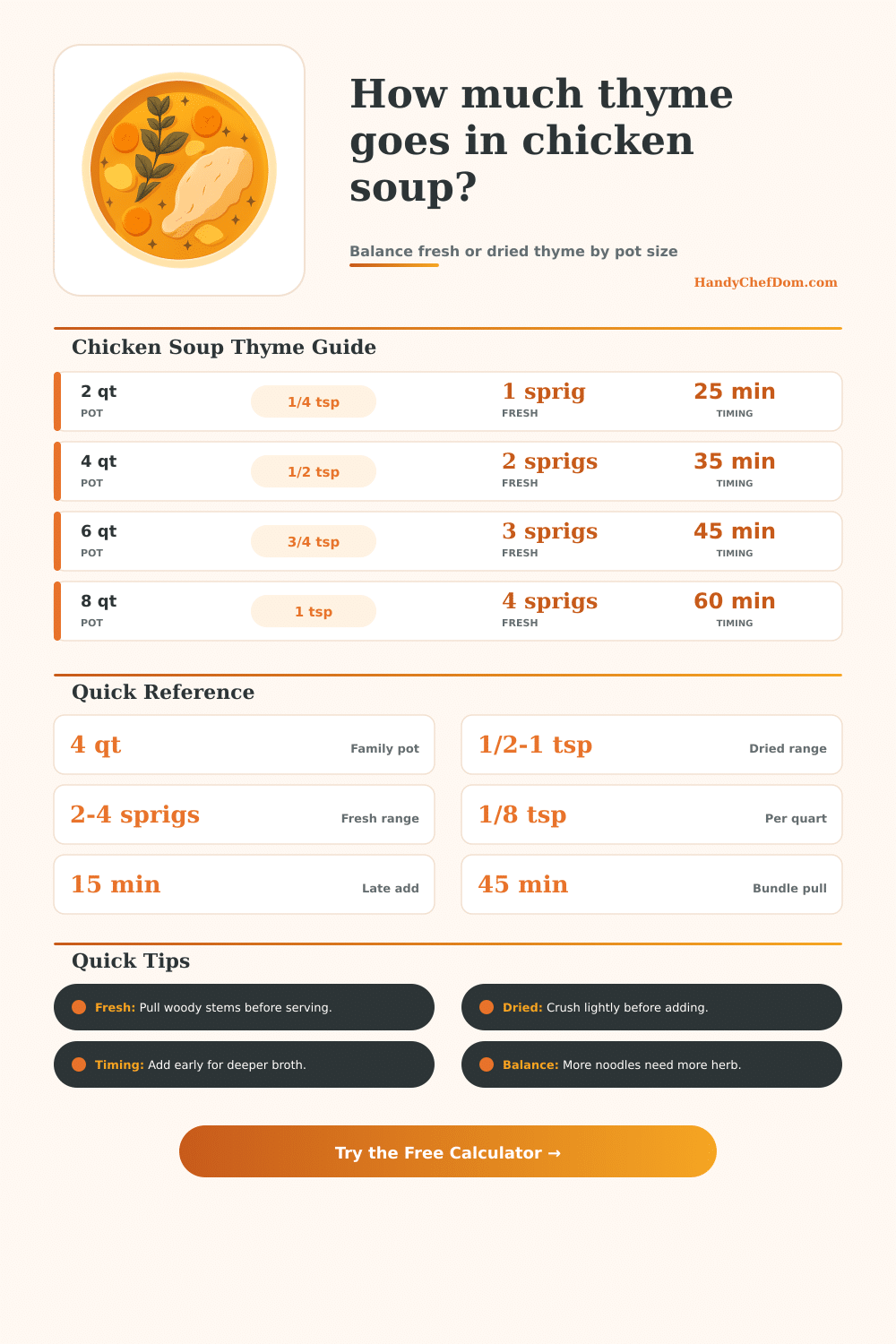
The common family-pot range is about 1/2-1 teaspoon dried thyme or 2-4 fresh sprigs. This calculator scales that range for broth, chicken, time, vegetables, starch, servings, bay leaf, and flavor target.
| Thyme Form | Soup Pot Range | Equivalent | Best Use |
|---|---|---|---|
| Dried thyme | 1/2-1 tsp | 4 qt family pot | Steady background herb flavor |
| Fresh sprigs | 2-4 sprigs | 4 qt family pot | Clean herbal aroma with easy removal |
| Fresh leaves | 2 tsp leaves | About 1 tsp dried | When stems are already stripped |
| Ground thyme | 1/4 tsp | About 1 tsp dried leaf | Use sparingly because it disperses fast |
| Thyme bundle | 3 sprigs | About 3/4 tsp dried | Good for long simmered broth |
| Late fresh thyme | 1-2 sprigs | Finishing aroma | Best when soup already tastes herbal |
| Batch Size | Broth | Dried Thyme | Fresh Sprigs |
|---|---|---|---|
| Small lunch pot | 2 qt | 1/4 tsp | 1-2 sprigs |
| Weeknight dinner | 3 qt | 3/8 tsp | 2 sprigs |
| Family soup pot | 4 qt | 1/2-1 tsp | 2-4 sprigs |
| Meal prep batch | 6 qt | 3/4-1 1/4 tsp | 3-5 sprigs |
| Large stockpot | 8 qt | 1-1 1/2 tsp | 4-7 sprigs |
| Freezer batch | 10 qt | 1 1/4-2 tsp | 5-8 sprigs |
| Timing Choice | When to Add | Flavor Result | Watch Point |
|---|---|---|---|
| Early dried | Start of simmer | Deep broth flavor | Keep dose moderate |
| Early bundle | Start of simmer | Clean herbal base | Pull after 45-60 min |
| Mid simmer | 25-35 min left | Balanced and rounded | Best default timing |
| Late fresh | 10-15 min left | Brighter aroma | Use fewer sprigs |
| Long stock | First hour only | Savory background | Remove bundle early |
| Reheated soup | Last 5-10 min | Refreshes aroma | Avoid adding full dose |
| Pairing | Ratio with Thyme | Soup Style | Flavor Note |
|---|---|---|---|
| Parsley | 2 parts parsley | Classic noodle | Fresh and clean |
| Sage | 1/3 part sage | Roast chicken soup | Warm and savory |
| Rosemary | 1/4 part rosemary | Hearty broth | Piney and strong |
| Dill | 1 part dill | Rice or lemon soup | Bright and soft |
| Bay leaf | 1 leaf per pot | Long simmer | Woody background |
| Marjoram | 1/2 part marjoram | Gentle family soup | Sweet herbal edge |
The flavors of chicken soup need balancing by herbs, with thyme being the one most cooks reach for. Don’t use too much or it will taste like you’re drinking from a pine forest. But don’t use too little, or the soup will be flat. Finding the right amount for your pot is what’s called for.
How much? There is no one right amount of anything; it depends on several factors. Base it off the amount of broth, then adjust based on other factor like how flavorful the chicken is, or what kind of starch you use, etc. How sweet are your veggies? That will alter flavor profile. If you use bay leaves, that compete with the flavor profile. And if you simmer too long, the leavins extract even more flavor from leaves, requiring less thyme. The calculator adjust for all those variables after you input yours.
How to Use This Calculator
In the same pot of soup, fresh and dry thyme don’t act alike: The former has a cleaner smell, and can be fished out at serving time, without letting broth go bitter over a lengthy simmer. Dried thyme gets around to infusing each spoonful so when should it enter the pot? If you are making a large batch to be frozen, the calculator can helps you plan which form to use, taking into account how long it’ll be simmered.
We make common mistakes with chicken soup because we assume that all chicken soups is alike. A lightly dressed vegetable broth requires far fewer thyme leaves then does a thick, hearty broth filled with dark meat and pasta. Carrots and other sweet vegetables push the flavor one way, while starchy fillers require a bit more herb to prevent any one-note effect. Adjust accordingly by using this calculator (no guesswork required).
There’s one more wrinkle to the equation: simmering time. The longer the cook, the more you want to restraint yourself. You must also consider your herb-to-pot ratio more carefully, using a tied bundle that can be fished out halfway through a long slow pot. If you oversteep thyme, it get dull and woody. No bueno in chicken soup. You’re looking for a bright note.
But that’s not all: You can also see what a single serving should carry, which is helpful if you’re adjusting a recipe (down to save money, up because more people are coming). Or maybe you made too much and need to reheat some later on. Now you know how much of everything to add to perk things up, while still keeping the herbs balanced for size of the dish.
It works out so that the inputs each mean something, so once you know what they measure, the result makes sense. The suggestion shouldn’t of seem like a guess anymore; it becomes useful to you.