Tree Sap to Maple Syrup Calculator
Estimate sap needed, syrup yield, and boil time for maple syrup batches using sap sugar content, tree type, and the 86 rule.
| Tree | Sugar | Sap:1 Gal | Use |
|---|---|---|---|
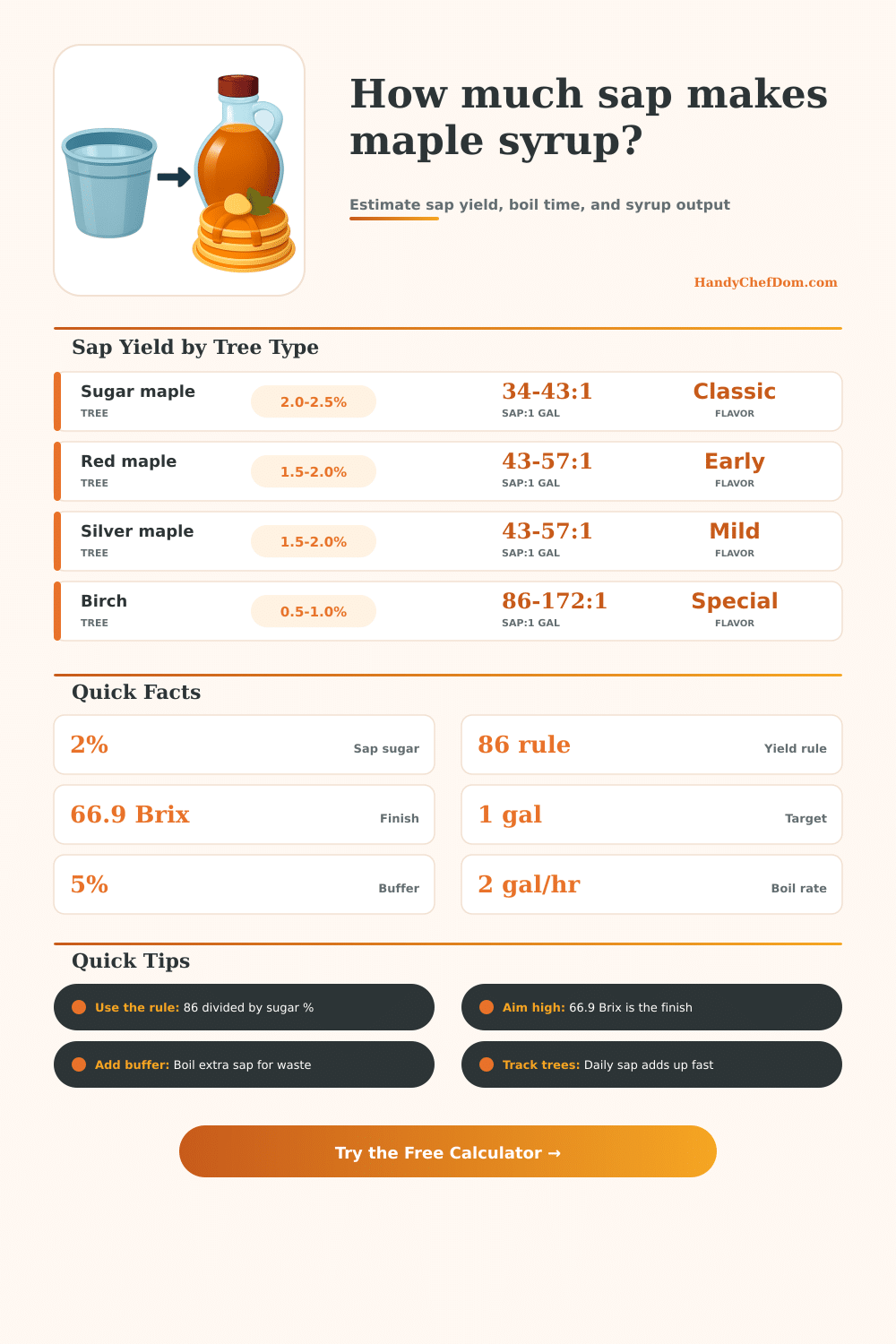
| Sugar maple | 2.0-2.5% | 34-43:1 | Classic |
| Black maple | 2.0-2.4% | 36-43:1 | Rich |
| Red maple | 1.5-2.0% | 43-57:1 | Early |
| Silver maple | 1.5-2.0% | 43-57:1 | Mild |
| Box elder | 1.5-2.0% | 43-57:1 | Light |
| Birch | 0.5-1.0% | 86-172:1 | Special |
| Sap % | Rule | Syrup / gal | Notes |
|---|---|---|---|
| 1.5% | 57.3 | 0.017 gal | Thin sap |
| 2.0% | 43.0 | 0.023 gal | Common |
| 2.5% | 34.4 | 0.029 gal | Great run |
| 3.0% | 28.7 | 0.035 gal | Rare sap |
| Brix | Heat | Density | Use |
|---|---|---|---|
| 66.0 | 7.0F | Std | Old style |
| 66.9 | 7.5F | Std | Target |
| 67.5 | 8.0F | Thick | Firm |
| 68.5 | 8.5F | Very thick | Strong |
| Container | Oz | Liters | Fill |
|---|---|---|---|
| Small jar | 8 | 0.24 | Gift |
| Standard jar | 12 | 0.35 | Table |
| Pint jar | 16 | 0.47 | Home |
| Quart jar | 32 | 0.95 | Bulk |
| Half gallon | 64 | 1.89 | Family |
| Gallon jug | 128 | 3.79 | Storage |
Maple sap is a liquid that is collected from tree, and it contains a small amount of sugar. Most of the sap that is collected from maple trees is primarily water. However, the sap also contains sugar from the trees, and the amount of sugar that you find within the sap can vary from tree to tree depending on the species of those tree and the weather.
Sugar maples has around two percent sugar content in their sap. Sugar maples require around forty gallon of sap to make one gallon of maple syrup. Red maples and silver maples have only around one and a half percent sugar content in their sap.
How Much Sap You Need to Make Maple Syrup
Due to the lower sugar percentage in their sap, red and silver maples requires fifty gallons of sap to produce one gallon of syrup. Lastly, birch sap contain even less sugar then maple sap, so it takes even more time to produce birch syrup and more sap to make birch syrup then maple syrup. In order to determine the amount of sap that you need to collect from maple trees in order to make syrup, you could use a mathematical calculation.
Divide eighty-six by the percentage of sugar contained in the sap from the trees to determine how many gallon of sap you need to produce one gallon of syrup. For instance, if the sugar content in the sap from the maple trees is two percent, divide eighty-six by two to get forty-three gallons of sap needed to make one gallon of syrup. In the process of collecting the sap, some of the sap will be lost.
You will lose some of the sap to foam, spills, and evaporation. In order to account for this lost sap during the collection process, you will have to collect extra sap from the maple trees. Without collecting extra sap from the maples, you will not have enough sap to produce the amount of syrup that you desire.
Another important measurement to consider during the production of maple syrup is the density of the syrup. You can measure this using a Brix scale. The goal is to produce syrup that measure sixty-six point nine Brix.
Using this measurement for the syrup will ensure that the syrup will pour correctly from the containers and will store for a longer amount of time. If you boil the sugar for too long, the syrup may become grainy. However, if you dont boil the syrup enough, the syrup may develop mold.
Use a hydrometer to measure the syrup density or use a spoon to perform a sheet test for the syrup. The number of maple trees that you have will determine how much sap you can collect from each tree each day. One mature sugar maple tree can produce one gallon of sap per day.
If you have ten maple trees, you can collect ten gallons of sap from each maple tree per day. By measuring the amount of sap that each tree produce each day, you can calculate how many days of sap collection you will need in order to reach your total goal for the amount of sap that you would like to produce. By calculating the amount of sap that your maple trees will produce each day, you can determine if you have enough sap from your trees to make the amount of syrup that you desire or if you will need more days of collecting sap from your maple trees.
The number of different type of maple trees that you own can have an impact upon the amount of labor that you require to harvest the sap. For instance, sugar maples will produce the amount of syrup that you desire with less labor than red and silver maples because the sugar content in red and silver maples is less. The sap from birch trees produce a caramel like syrup; however, it requires more fuel to boil the sap in order to create syrup because the sugar content in birch sap is very low.
Therefore, you can expect that the amount of sugar that the maple sap contains will change over the course of the season. For this reason, you should test the sugar content in the sap at the beginning of the season, in the middle of the season, and towards the end of the maple season. One last thing to decide before boiling the sap is the size of the bottle in which you will store the syrup.
If you know the total amount of syrup that you have produced from your maple trees, you can calculate how many sixteen-ounce pints of syrup you will be able to produce. If you produce too many sixteen-ounce bottles of syrup, you may find that you have half-empty bottles that you will not use efficient. You can avoid this problem if you use presets to calculate the amount of syrup that you will produce from each maple tree.
By using these calculations, you can bridge the gap between the amount of sap that you collect from the maple trees and the amount of syrup that you will produce from those sap amounts.