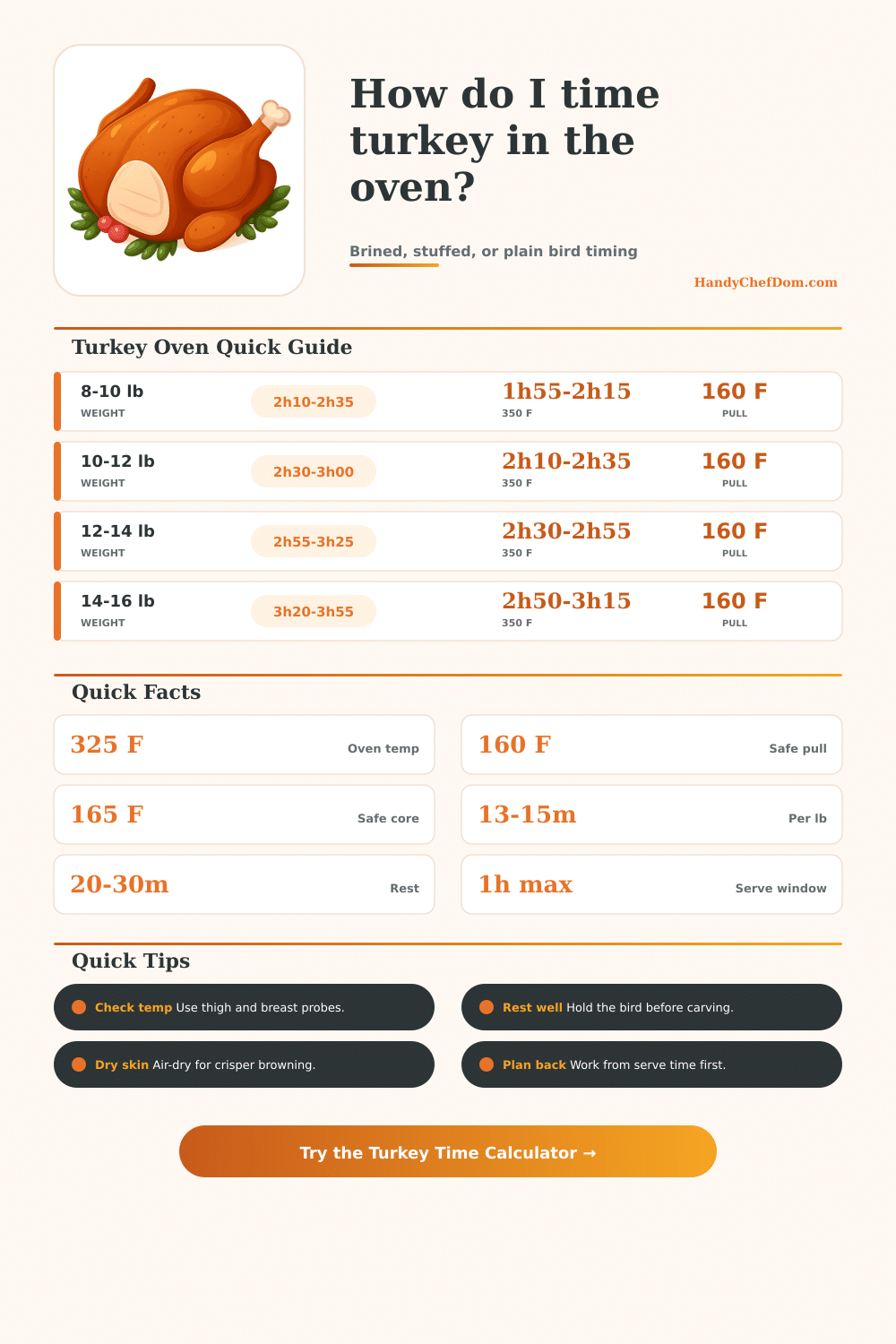
🦃 Turkey Cooking Time Calculator Oven Guide
Map roast time, rest time, and the serve window for a turkey that fits your oven and your dinner clock.
Breakdown
| Weight | 325 F | 350 F | Pull |
|---|---|---|---|
| 8-10 lb | 2h10-2h35 | 1h55-2h15 | 160 F |
| 10-12 lb | 2h30-3h00 | 2h10-2h35 | 160 F |
| 12-14 lb | 2h55-3h25 | 2h30-2h55 | 160 F |
| 14-16 lb | 3h20-3h55 | 2h50-3h15 | 160 F |
| Style | Base | Pull | Note |
|---|---|---|---|
| Whole | 13.5m | 160 F | Classic bird |
| Stuffed | 15.0m | 165 F | Needs more time |
| Breast | 16.0m | 160 F | Lean cut |
| Spatchcock | 10.5m | 160 F | Fast roast |
| Temp | Shift | Skin | Use |
|---|---|---|---|
| 325 F | Base pace | Soft | Low risk |
| 350 F | -8% | Balanced | Go-to |
| 375 F | -15% | Browner | Tighter clock |
| 400 F | -23% | Deep color | Watch close |
| Step | Timing | Clue | Goal |
|---|---|---|---|
| Dry brine | 12-36h | Skin dries | Deep salt |
| Fridge rest | 8-24h | Air flow | Crisp skin |
| Roast | Until pull | Probe | Juicy meat |
| Rest | 20-30m | Tent loose | Set juices |
In order to calculate an apropriate roasting time for turkey that is to be prepared for the meal, a person must gain an understanding of the role that the weight of the turkeys plays in the roasting time. A turkey that is of a larger weight will contain more mass than a smaller turkey. The greater the mass of the turkey, the longer that it will take for the heat to penetrates the turkey to the center.
For instance, a 12-pound turkey that is roasted at 325 degrees Fahrenheit require 13 minutes of roasting time for each pound of turkey. However, if the cook places the stuffing into the turkey prior to roasting, the stuffing will slow the transfer of heat to the center of the turkey. As a result, a turkey that contain stuffing will require 15 minutes of roasting time for each pound of turkey.
How to Calculate Turkey Roasting Time
The temperature to which the turkey is roasted will also play a role in the time that the turkey must roast. If the cook roasts the turkey at 325 degrees Fahrenheit, which is considered to be a lower temperature, the turkey will cook more even. However, if the temperature is increased to 350 or 375 degrees Fahrenheit, the turkey will roast more quick.
Additionally, if the turkey is roasted within a convection oven, which uses a fan to circulate the hot air around the turkey, the turkey will cook more quickly than if it were roasted in a conventional oven. Furthermore, the circulating air will crisp the skin of the turkey more quick than in a conventional oven. The style of the turkey can also impact the time that the turkey must roast to become fully done.
If the cook spatchcocks the turkey, which means that the backbone of the turkey is removed to flatten the turkey, the flattened turkey will cook more quick. A spatchcocked turkey may only require 10 or 11 minute of roasting time for each pound of turkey. Other styles of turkey include roasting the turkey with the bone-in breast of the turkey or roasting a turkey crown.
Each of these different styles will impact the time that the turkey must remain in the oven. A buffer percentage of time can be accounted for during the cooking schedule for the turkey, as some hot spots may be present within the oven, and the temperature within the oven may drop if the oven door is open. The turkey must be allowed to rest for 20 to 30 minutes after it has been removed from the oven.
Allowing the turkey to rest enables the juices that have collected within the turkey to be redistributed throughout the turkey. If the cook dont allow the turkey to rest, the juice will exit the turkey when the turkey is sliced. The turkey should be removed from the oven when the turkey reach 160 degrees within the thickest portion of the thigh; the internal temperature will continue to increase to 165 degrees within the turkey after it is removed from the oven.
However, the white meat within the breast will dry out more quick than the dark meat of the turkey thigh. As a result, the breast of the turkey should be removed from the oven when it reaches 155 to 160 degrees. Prior to roasting the turkey, the turkey can be dry brined or wet brined.
Dry brining mean placing salt upon the skin of the turkey; this will result in the skin of the turkey being crispy. Wet brining means soaking the turkey in a liquid; this may result in the skin of the turkey being too soggy. Additionally, a v-rack can be used to roast the turkey, as the v-rack allow air to circulate underneath the turkey.
If the turkey is to be roasted at high altitudes, more time must be accounted for in the roasting schedule, as the boiling point of water decrease at higher altitudes. The cooking schedule for the turkey should of been planned. The time that the turkey will be served can be accounted for; the turkeys resting time must be subtracted from the serving time, as well as the roasting time of the turkey.
By accounting for each of these variable, a person will be able to ensure that the turkey is roasted to perfection and ready to be eaten at the correct time.