🍞 Vital Wheat Gluten to Make Bread Flour Calculator
Calculate vital wheat gluten for all-purpose flour using protein percentages, recipe target, loaf count, batch multiplier, and hydration adjustment.
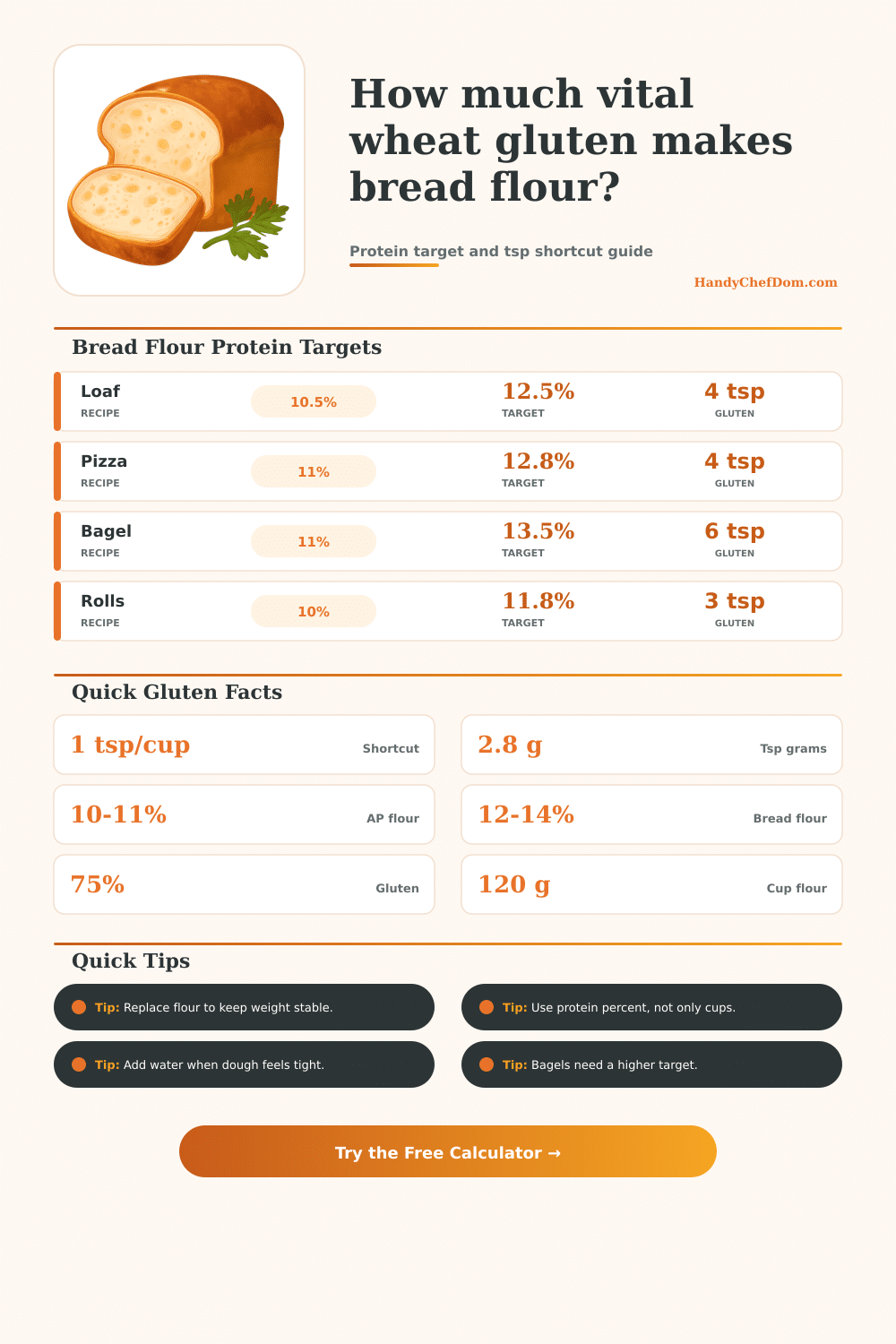
Common shortcut: about 1 teaspoon vital wheat gluten per cup of all-purpose flour. The calculator below also uses a protein-balance formula for a more exact target.
| Flour Type | Typical Protein | Best Use | Gluten Note |
|---|---|---|---|
| Cake flour | 7% to 9% | Tender cakes | Usually not ideal for bread flour swaps |
| Pastry flour | 8% to 10% | Biscuits and pastry | Needs more gluten to reach bread range |
| All-purpose flour | 10% to 11.7% | General baking | Main base for this calculator |
| Bread flour | 12% to 14% | Yeast breads | Target range for stronger dough |
| High-gluten flour | 14% to 15% | Bagels and chewy crust | Higher target, use carefully |
| Whole wheat flour | 13% to 14% | Hearty breads | Bran can still weaken structure |
| Kitchen Measure | Approx Grams | Approx Protein at 75% | Use in Calculator |
|---|---|---|---|
| 1/4 teaspoon | 0.7 g | 0.5 g protein | Fine adjustment for small doughs |
| 1/2 teaspoon | 1.4 g | 1.1 g protein | Half-step rounding |
| 1 teaspoon | 2.8 g | 2.1 g protein | Common shortcut per cup AP flour |
| 1 tablespoon | 8.4 g | 6.3 g protein | Three teaspoons for larger batches |
| 1/4 cup | 33.6 g | 25.2 g protein | Large bakery-style batch |
| By scale | Exact grams | Product label dependent | Most accurate protein targeting |
| Recipe Type | Target Protein | Texture Goal | Hydration Cue |
|---|---|---|---|
| Dinner rolls | 11.8% | Soft but structured | Use lighter water adjustment |
| Focaccia | 12.0% | Open, stretchy crumb | High hydration often works well |
| Sandwich loaf | 12.5% | Flexible slices and rise | Standard water adjustment |
| Artisan boule | 12.7% | Stronger oven spring | Watch dough feel during folds |
| Pizza dough | 12.8% | Chewy stretch | Rest helps gluten hydrate |
| Bagels | 13.5% | Dense chew | Keep dough firm, not slack |
| Approach | How It Works | Best For | Tradeoff |
|---|---|---|---|
| Protein formula | Balances flour protein and gluten protein | Known flour labels and scaled recipes | Needs percentages from the package |
| 1 tsp per cup shortcut | Adds about 2.8 g gluten for each flour cup | Fast home baking with AP flour | Can overshoot or undershoot target |
| Replace method | Removes flour grams and adds gluten grams | Recipes written by flour weight | Requires weighing for best accuracy |
| Add-on method | Adds gluten on top of the flour amount | Casual cup-based recipes | Raises total dry weight slightly |
| Buy bread flour | Uses milled flour already in target range | Repeat loaves and predictable dough | Less flexible when pantry is limited |
Baking bread require flour. Flour contain protein. Not all flours has the same amount of protein.
All-purpose flour is available in most kitchen. However, recipes for bagels, bread, and pizza requires flour with a more higher protein content. The only difference between different types of flour is the protein level.
Make Bread Flour from All-Purpose Flour with Vital Wheat Gluten
Vital wheat gluten are used to increase the protein level of all-purpose flour. Using vital wheat gluten, you can change the protein level of the flour that you use. This allow you to avoid purchasing an separate bag of bread flour each time you prepare bread.
The protein contained within flour is essential in enable the flour to hold the gas produced during the fermentation of bread. The higher the protein level of the flour, the higher the structure of the bread, and the better the rise of the bread. Bread flour has a higher protein level then all-purpose flour.
However, the percentage difference is small. Vital wheat gluten allow you to increase the protein level of all-purpose flour so that it has the same effect as bread flour. The protein level of the flour should match the requirement of the food that will be prepared.
For example, sandwich loaves require a protein level in the flour that allow the bread to cut clean when sliced. Bagels, on the other hand, require flour with a more higher protein level to enable the bagel to have more chew. Pizza dough require a specific protein level to enable it to stretch.
However, there should not be too many protein in the flour used to prepare pizza dough. The calculator determine the amount of vital wheat gluten that you must use to prepare your dough. The calculator takes into account the type of flour that you are using and the protein level that you want your flour to have.
You can choose to use vital wheat gluten in place of some of the flour, or you can choose to add vital wheat gluten to the flour that you have measured for your recipe. Using vital wheat gluten in place of some of the flour will leave the total amount of ingredients in your recipe the same. However, if you choose to add vital wheat gluten to your flour, the total amount of dry ingredient will change.
Vital wheat gluten absorbs water rapid. Because of this, dough containing vital wheat gluten may become stiff. The calculator also takes into account the amount of water that you must add to your dough.
If you add the correct amount of water to your dough containing vital wheat gluten, the dough will remain easy to mix. However, if you add too little water, the dough will become stiff. Some baker prefer to ignore the calculations of the amount of water that should be added to their dough made with vital wheat gluten.
These bakers will find that the dough is difficult to mix because it contain too much vital wheat gluten. The amount of vital wheat gluten that you use depend on the number of loaves of bread that you are baking. If you are baking only one loaf, you will use less vital wheat gluten than if you were baking four loaves of bread.
The calculator allow you to change the number of loaves of bread that you are baking. It will adjust the amount of vital wheat gluten that the recipe require according to the number of loaves that you are baking. The calculator will provide a breakdown of the amount of vital wheat gluten that you should use for each loaf of bread.
Many cook use a rule of one teaspoon of vital wheat gluten for every cup of flour. However, this is only an estimate. The rule may not be accurate if the protein level of the all-purpose flour that you are using is low or if the protein level that you are aiming for in your recipe is high.
For the most accurate measurement, read the protein percentage of your flour and vital wheat gluten on the bag of flour and gluten. Use these values when you enter your ingredient into the calculator. Use your recipe to test the result of the vital wheat gluten that you have added to your flour.
Dough with the correct amount of vital wheat gluten and the correct amount of water will hold its shape during the shaping of the bread. If the dough is too tight, you can add a small amount of water while you are kneading the dough. If the dough is too slack, you can reduce the amount of water that you use when you prepare your dough for baking.
Using these technique, you can develop an understanding of how vital wheat gluten and water affect your dough over time.