Water Filter Calculator
Estimate cartridge life, replacement timing, flow time, and daily demand for pitchers, faucet filters, and under-sink systems.
| Type | Capacity | Flow | Best fit |
|---|---|---|---|
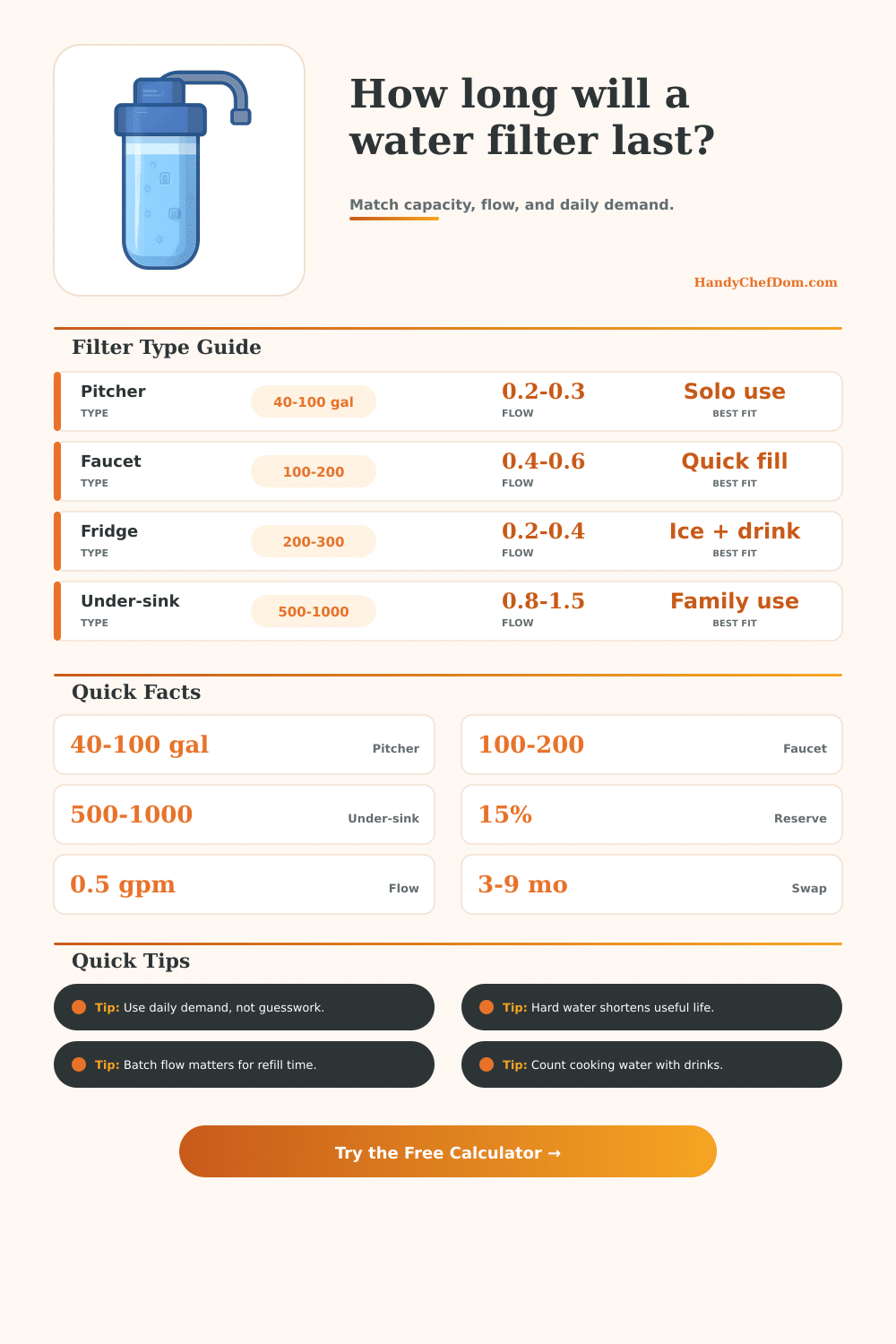
| Pitcher | 40-100 gal | 0.2-0.3 | Solo use |
| Faucet | 100-200 | 0.4-0.6 | Quick fill |
| Fridge | 200-300 | 0.2-0.4 | Ice + drink |
| Under-sink | 500-1000 | 0.8-1.5 | Family use |
| Water load | Factor | Life | Note |
|---|---|---|---|
| Soft | 1.00 | Full | Long life |
| Average | 0.92 | Normal | Typical tap |
| Hard | 0.82 | Shorter | Minerals |
| Sediment | 0.72 | Fast swap | Clogs sooner |
| Use mode | People | Daily need | Notes |
|---|---|---|---|
| Drinking | 1-2 | 0.5-1.5 gal | Light draw |
| Coffee | 1-3 | 0.6-2 gal | Small batches |
| Meal prep | 2-5 | 2-5 gal | Busy kitchen |
| Whole kitchen | 4+ | 4-8 gal | Steady use |
| Volume | Liters | Cups | Use |
|---|---|---|---|
| 0.5 gal | 1.9 L | 8 c | Pitcher |
| 1 gal | 3.8 L | 16 c | Fast fill |
| 5 gal | 18.9 L | 76 c | Stock day |
| 10 gal | 37.9 L | 152 c | Heavy use |
The capacity of an water filter is the total volume of water that can pass through the filter before the media within the filter get saturated. When the water filter has reached the capacity of the filter, the person may start to notice that the water tastes different than when the water passed through the filter initially, or the flow of the water from the water filter may slow down. The capacity of the water filter isnt just related to the amount of water that a person drinks, but also the amount of water that a person use for other tasks in the home.
For instance, many people uses the water that passes through the water filter for cooking tasks in the kitchen. Because cooking uses more water than drinking, the water filter can reach its capacity more quickly if the person use the water filter for cooking tasks. Water quality impact the lifespan of a water filter.
When to Replace Your Water Filter
Water quality is one of the main determinants of how long the water filter will last. Hard water contains many mineral that can lead to clogging of the media that is contained within the water filter. When the media becomes clogged with these minerals, the flow of water from the water filter decrease, which decreases the lifespan of the water filter.
Additionally, water that contain sediment will also lead to the water filter becoming clogged more quickly. Therefore, a person that has sediment in there water will need to replace the water filter for the home more frequent. In contrast, soft water does not tend to clog the water filter media as quickly as hard water do, so the water filter will tend to last longer if the water in the home is soft.
The size of the family can impact the amount of water that pass through the water filter, which in turn can impact how often that water filter must be replaced. For instance, a person that live alone may require a small pitcher type water filter. In contrast, a large family will require a water filter system that can handle the higher volume of water that many individual uses.
The under-sink water filter systems tend to have higher flow rates and last longer than pitcher type water filters, so these types of water filters may be better for large family. Flow rates for water filters refer to the speed at which water can pass through the water filter. Flow rates are an important factor in the design of the water filter, since higher flow rates may be more convenient for more tasks.
For instance, if a person has a water filter that has a slow flow rate, they may have to wait for the water to pass through the filter at a slow rate for certain tasks. Some water filters is designed to have high throughput of water passing through the filter. High throughput water filters are designed in such a way that they have a sturdy water filter cartridge that does not become clogged too early in the life of the water filter.
Another factor that a person must consider is the amount of water that passes through the water filter each day. The daily water usage can be calculated by adding the amount of water use for drinking to the amount of water that is used for cooking tasks. It is also helpful to add a factor of fifteen percent to this total.
This fifteen percent factor allow for room for the volume of water to pass through the water filter each day, without having to replace the water filter before the individual in the house consumes the estimated amount of water. If a person ignores the amount of water used for cooking, they will underestimate the amount of water that pass through the water filter each day, and will have to replace that water filter at a more rapid rate then they should. Another reason that a person may have to change there water filter is due to the taste of the water that passes through the filter.
Water filters tend to remove contaminants from the water, such as chlorine, which can change the taste of the water. However, the more often that the individual in the home utilizes a water filter, the less efficient the water filter can be at removing those contaminant from the water. If a person utilizes their water filter beyond the capacity for which the manufacturer rated the water filter, the water that come out of the filter may have an unpleasant taste.
In this case, the person should replace the water filter based off the total volume of water that has passed through the filter, or the number of month that the water filter has been in use. Maintaining the water filter is important for the long-term use of the water filter. For instance, the person should rinse the water filter housing with warm water, and the spare water filters should be store in a dry location.
Additionally, water filters should not become frozen, as freezing the water can lead to damage of the water filter. Thus, by tracking the amount of water that passes through the filter each day, and monitoring the quality of the water in the home, an individual can ensure that their water filter continues to provide a consistent flow and taste of water to the users in the home.