Wine Sulfite Calculator
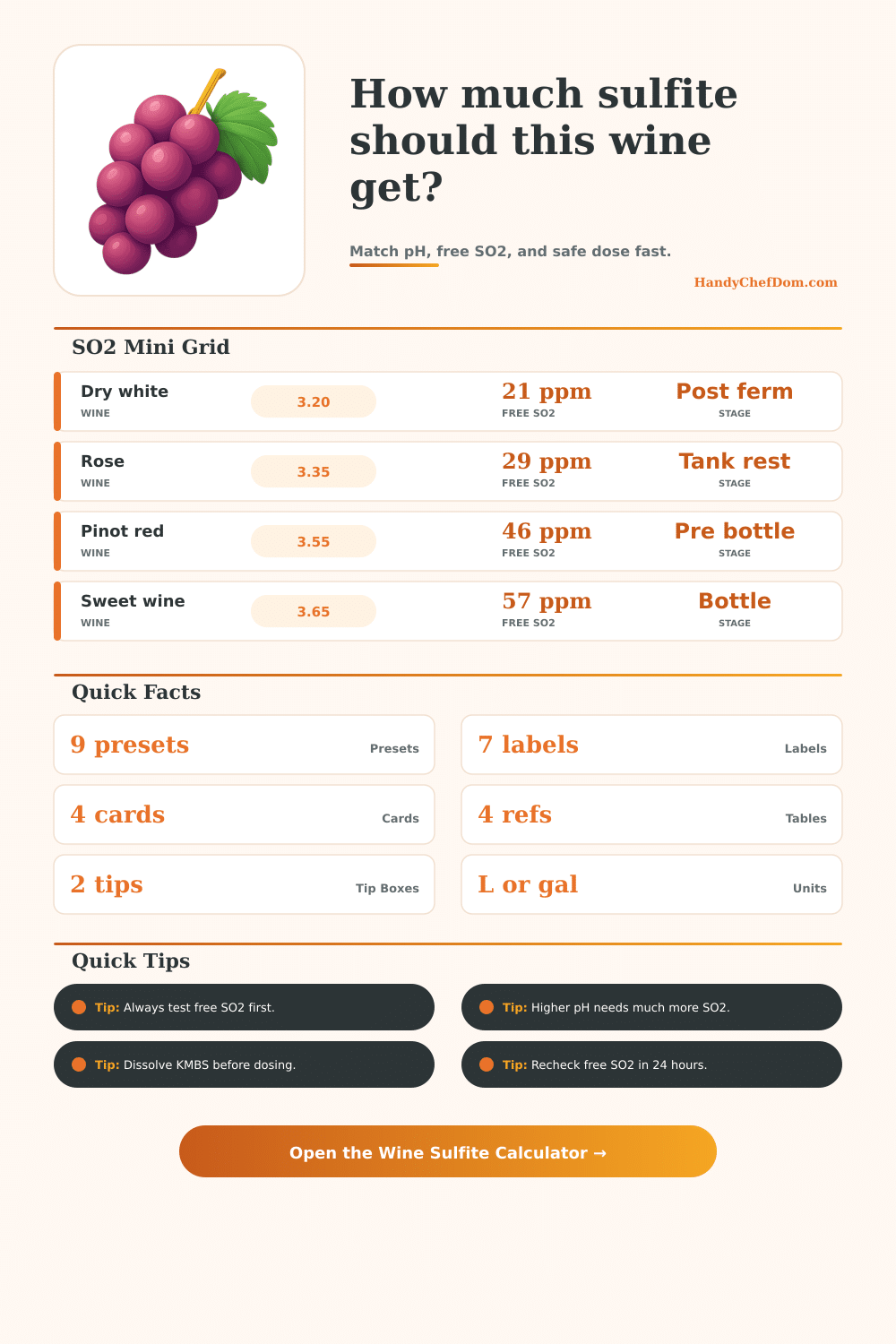
Plan accurate sulfite additions with pH-aware free SO2 targets, then convert instantly to KMBS grams or Campden tablets for cellar-ready dosing.
📌 Practical Presets
🏷 Workflow Labels
⚙ Dose Inputs
Formula: Required free SO2 = molecular target x (1 + 10^(pH - 1.8)). Calculator then adjusts for current free SO2 and stage retention.
Dose Breakdown
📊 Comparison Grid
📑 Reference Tables
| pH | Free for 0.6 | Free for 0.8 | Free for 1.0 |
|---|---|---|---|
| 3.00 | 10 ppm | 13 ppm | 16 ppm |
| 3.20 | 15 ppm | 21 ppm | 26 ppm |
| 3.40 | 24 ppm | 32 ppm | 40 ppm |
| 3.60 | 38 ppm | 50 ppm | 63 ppm |
| 3.80 | 60 ppm | 79 ppm | 99 ppm |
| Wine type | Free SO2 | Molecular | Typical stage |
|---|---|---|---|
| Dry white | 22-35 ppm | 0.6-0.8 | Tank to bottle |
| Aromatic white | 20-32 ppm | 0.5-0.7 | Cold storage |
| Rose | 22-34 ppm | 0.6-0.8 | Pre bottling |
| Light red | 18-28 ppm | 0.5-0.7 | Post MLF |
| Full red | 20-32 ppm | 0.5-0.7 | Barrel aging |
| Sweet wine | 30-50 ppm | 0.8-1.0 | Final blend |
| Source | SO2 yield | Dose note | Use case |
|---|---|---|---|
| KMBS fresh | 57% | Standard calc | Most wineries |
| KMBS older | 55% | Add a bit more | Open stock |
| SMBS food | 67% | Lower grams | Alt source |
| Campden tab | 0.44 g/tab | Small lots | Home cellar |
| Cellar stage | Retention | Dose impact | Comment |
|---|---|---|---|
| Post ferment | 78% | Higher add | More binding |
| Post MLF | 72% | Higher add | Red wine mode |
| Tank aging | 82% | Mid add | Stable period |
| Pre bottling | 88% | Lower add | Cleaner matrix |
💡 Cellar Tips
To achieve a correct balance of sulfite in the wine will affect teh aging of the wine in the tank and how the wine taste when the person opens the bottle. If you add too little sulfite to the wine, the wine will oxidize and experience microbial activity. If you add too much sulfite to the wine, the wine will have a flattened flavor and aroma with a harsh finish.
The key is to find the correct amount of protection for the type of wine being produced rather than adding the same amount of sulfite to each batch of wine. The pH of the wine will affect the amount of sulfite needed to be added to the wine. At lower pH levels, the same amount of free SO2 will offer more protection of the wine.
How to Add the Right Amount of Sulfite to Wine
Thus, if you increase the pH of the wine, you will need to add more sulfite to provide the same amount of protection as the lower pH. The calculator will allow you to mathematically determine the amount of sulfite to add to the wine. This removes the guesswork of the winemaster in determining how much sulfite to add to the wine, it employs specific numbers to calculate the amount of sulfite that will be needed.
The stage of the wine production will also impact how much sulfite is needed in the wine. Immediately after the completion of fermentation, the wine will contain a variety of compounds that will bind to the sulfite. Thus, more sulfite will be needed right after fermentation is complete.
After the malolactic fermentation stage, the composition of the wine will change, as will the requirements of how much sulfite is needed for protection. After the wine is aged in the 瓶子, the amount of sulfite that is added will need to last in the wine for a longer period of time. These percentages in the tool reflect the difference between the various stages of winemaking.
The style of the wine will influence the amount of sulfite needed for each batch of wine. Dry white wines and dry rosé wines will require a moderate amount of sulfite to be added during the winemaking process. Sweeter wines will require more sulfite to combat microbial growth.
Red wines will be somewhere in the middle of these two different types of wine. The reference tables will allow the winemaker to visually inspect the various factors that will impact the amount of sulfite that is needed in each batch of wine. These visual tables will allow the winemaker to visually determine whether or not the wine will require a large amount of sulfite to provide the needed protection.
These tables will allow for quick checks on whether or not the winemaster has correctly calculated the amount of sulfite that will be needed for each batch. These tables are not a replacement for the tests, but they will allow the winemaster to better understand the calculations that will be used for each batch of wine. One of the most common mistakes that winemasters make is treating the addition of sulfite as a one-time event.
The amount of sulfite that is added to the wine will take some time to become the free SO2 that will offer protection to the wine. Thus, it is a practice to include a safety margin in the calculations. Moreover, it is common to re-check the amount of free SO2 that is in the wine the following day.
If the measurement is still low, more sulfite can be added. If the amount is higher than expected, the winemaker can reduce the amount of sulfite to be added the following day. Another of the most common mistakes is treating Campden tablets as if they will work the same as if the sulfite was added directly as a powder.
As the tablets age, they lose some of the SO2 that will be released into the wine. The tool accounts for this by allowing the winemaker to choose between the percentages of KMBS that is standard for sulfite (as opposed to aged KMBS). Campden tablets can be used as a way to add the sulfite to the wine.
However, the use of Campden tablets can make it more difficult for the winemaker to make the needed calculations. Campden tablets are convenient for the winemaker, particularly in the treatment of small lots of wine. However, a Campden tablet will add a certain amount of sulfite to the wine that may not equal the amount calculated as needed.
The tool can calculate the amount of powder (instead of Campden tablets) that will contain the calculated amount of sulfite. Running the numbers prior to adding the sulfite is valuable. Running the numbers allows the winemaster to focus on the protection that will be added to the wine.
For example, adding 20 ppm of sulfite may be the calculations for one wine but may be too little for another wine with a higher pH. Thus, after understanding how each parameter can affect the amount of sulfite, the winemaster can add the correct amount of sulfite to each batch of wine. After adding the sulfite to the wine, the amount of sulfite can change.
For example, the temperature of the wine can change, the wine may have picked up some oxygen during the racking process, and/or the wine may have been blended with another batch of wine. Thus, while the initial calculation of the amount of sulfite was well-calculated and appropriate after the wine was produced, the amount that is added may shift. Thus, the winemaker should use regular testing to adjust the amount of sulfite to the wine batches.