🧫 Yeast Cell Count Calculator
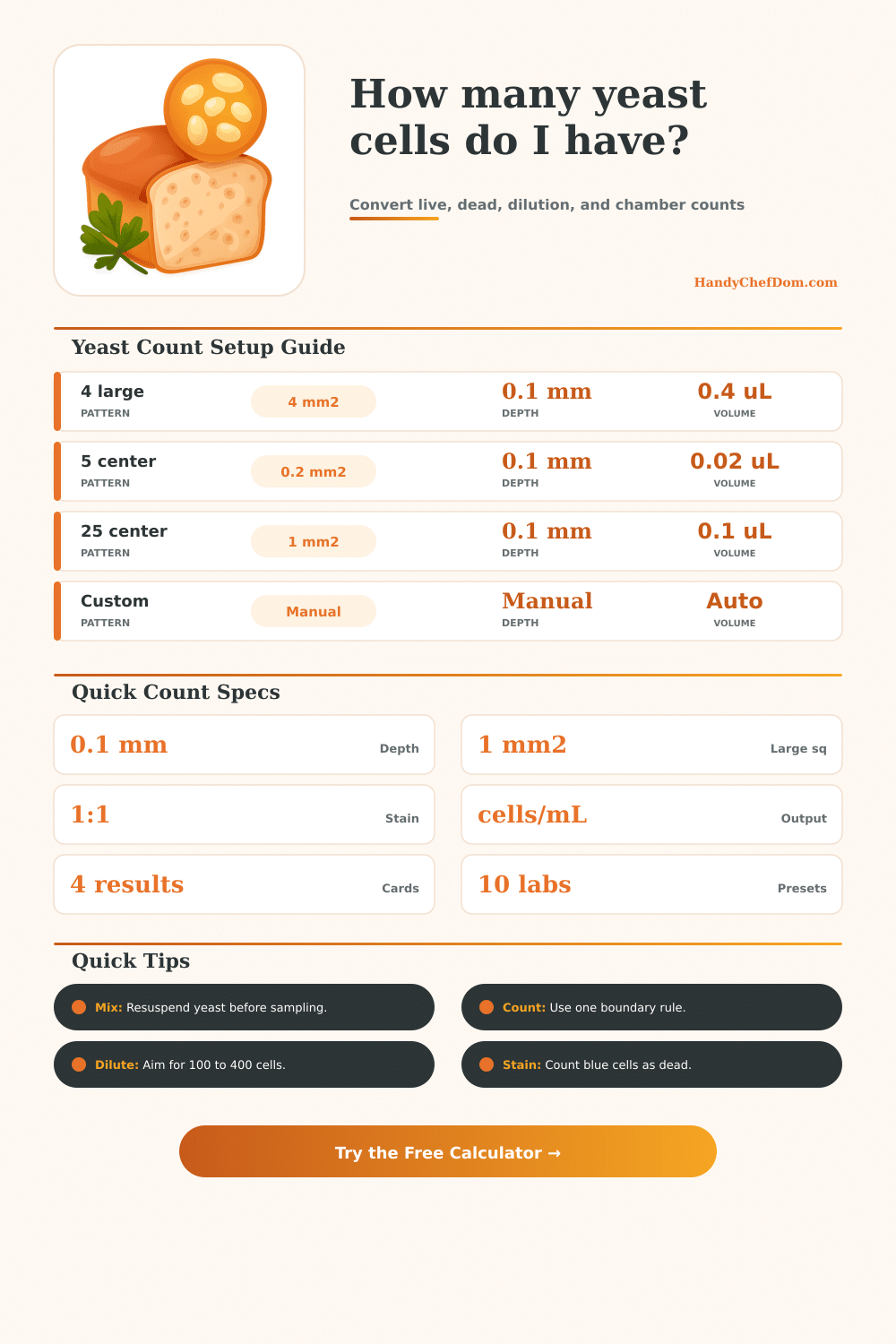
Convert hemocytometer live and dead yeast counts into cells/mL, viable cells/mL, total live cells, dilution math, count quality, and viability from chamber depth, square area, stain ratio, and sample volume.
Enter the observed live and dead yeast cells from the counted hemocytometer squares. The calculator multiplies cells per counted volume by the serial dilution and stain dilution, then converts uL to mL using the chamber geometry.
Resuspend the yeast slurry or culture immediately before taking the aliquot.
Choose a dilution that keeps the final observed count in a readable range.
Apply the selected viability stain ratio and record the added volume factor.
Fill the chamber by capillary action without bubbles or overflow.
Let cells settle long enough for an even focal plane before counting.
Use one boundary rule, such as count top and left edges only.
Record live and dead cells separately so viability is not estimated later.
Correct for counted volume, serial dilution, stain dilution, and sample volume.
| Counting area | Single square area | Common squares counted | Volume at 0.1 mm depth | Use in yeast counting |
|---|---|---|---|---|
| Large corner square | 1.00 mm² | 4 or 8 squares | 0.1 uL per square | Good for dense yeast slurries after dilution |
| Full center large square | 1.00 mm² | 1 square or 25 groups | 0.1 uL total | Useful when counting the complete center grid |
| Center medium group | 0.04 mm² | 5 or 25 groups | 0.004 uL per group | Common for concentrated yeast when cells are evenly distributed |
| Center small square | 0.0025 mm² | 16, 80, or 400 squares | 0.00025 uL each | High-magnification work or very dense samples |
| Custom chamber | Manual area | Manual count | Area x depth | Use the engraved or manufacturer geometry |
| Preparation | Sample dilution input | Stain dilution input | Total multiplier | Counting note |
|---|---|---|---|---|
| Undiluted, no stain volume correction | 1 | No stain dilution | 1x | Only for low-density cultures where viability is not stained |
| 1:10 serial dilution plus equal stain | 10 | 1 sample : 1 stain | 20x | Common when yeast slurry is too dense to count directly |
| 1:100 serial dilution plus equal stain | 100 | 1 sample : 1 stain | 200x | Useful for compacted or high-gravity yeast crops |
| 2 sample : 1 stain | Serial factor | 2 sample : 1 stain | 1.5 x serial | Less stain dilution while preserving live/dead separation |
| 4 sample : 1 stain | Serial factor | 4 sample : 1 stain | 1.25 x serial | Works when color is strong and cell density is moderate |
| Observed total cells | Quality band | Approximate random error | What to do next | Result confidence |
|---|---|---|---|---|
| Under 50 cells | Too sparse | Over 14% | Count more squares or use less dilution | Low confidence for viability and concentration |
| 50 to 99 cells | Usable with care | 10 to 14% | Add a replicate chamber or more squares | Fair for rough cell density checks |
| 100 to 400 cells | Preferred | 5 to 10% | Keep the same dilution and boundary rule | Strong practical range for yeast counts |
| 401 to 800 cells | Crowded | 4 to 5% | Dilute more if cells overlap or clump | Good only when cells are easy to separate |
| Over 800 cells | Too crowded | Low math error, high visual error | Increase dilution and recount | Risk of missed cells and poor viability split |
| Sample type | Typical concentration | Suggested dilution | Viability expectation | Calculator use |
|---|---|---|---|---|
| Actively growing liquid culture | 10 to 80 million cells/mL | 1x to 10x | Often high when fresh | Use direct or light dilution for propagation checks |
| Starter or propagation slurry | 50 to 300 million cells/mL | 10x to 100x | Depends on age and oxygen | Use live cells/mL to size the next step |
| Harvested compact yeast | 0.5 to 3 billion cells/mL | 100x to 1000x | Can drop during storage | Dilute heavily before loading the chamber |
| Rehydrated dry yeast check | 100 to 500 million cells/mL | 10x to 100x | Usually high when handled gently | Pair live count with total sample volume |
| Old or stressed culture | Variable concentration | Start 10x | May be below 80% | Focus on live cells, not just total cells |
This calculator is for yeast cell counting math from hemocytometer observations. Real counts vary with mixing, clumping, chamber loading, staining time, microscope focus, and boundary rule consistency.
Yeast cell counts are necessary for every propagation decision, yeast cell counts is necessary for every pitch rate calculation, and yeast cell counts are necessary for every harvest evaluation. If a person dont have a reliable number for the live yeast cells per milliliter, then a person will not know if the starter is ready, if the yeast crop are healthy, and if the next step requires more volume or less volume of the yeast slurry to be perform in the brewery. The process of counting the yeast cells is simple, but the process of counting the yeast cells is easy to get wrong.
The process of counting the yeast cells involve elements of geometry, dilution, staining, and the judgment of the individual who performs the task. The hemocytometer is the tool used to count the cells. A hemocytometer is a glass slide with a grid etched into the slide, and the hemocytometer has a known depth of the slide to the coverslip.
How to Count Yeast Cells
Each of the squares on the grid represent a known volume of the liquid that is loaded into the hemocytometer. The volume of each square is important. If the size of the squares change, if the depth of the hemocytometer changes, or if the number of squares that are counted changes, then the volume change.
If the volume changes, the final cell concentration must be recalculated. A calculator can adjust for these change in volume. Another change to the process is the staining of the sample.
Dyes such as trypan blue or methylene blue will stain the dead yeast cells blue so that they are easy to count and separate from the live cells in the same hemocytometer square. The addition of the stain volume to the sample require adjustment of the dilution factor. For instance, if the yeast sample is diluted one to one with sterile water, the volume of the sample doubles.
However, if the yeast slurry is four to one with the volume of sterile water, the volume of the sample increases only twenty-five percent. If the adjustment for the volume of the stain is skip, the resulting yeast cell count is incorrect. The strategy for counting the yeast cells can introduce error.
If the number of cells that are counted is too few, then the random error in counting will have a great effect on the count of the total number of live yeast cells. Counting too many yeast cells can also introduce error. If the yeast cells are too close together on the slide, it is not possible to determine which yeast cells belongs to which squares on the hemocytometer.
The number of yeast cells that are counted should of been between one hundred and four hundred yeast cells. Another strategy is to use replicate sample. If two chambers of the hemocytometer are loaded with the same sample and the yeast counts are averaged, it is less likely that the error in one of the chambers will affect the validity of the reported concentration of live yeast cells.
The error in the reported yeast counts will decrease with more replicates. If the counts for the two replicates are not similar to each other, then the yeast sample may have become unevenly mix after transferring portions of the slurry to containers or after loading the chambers with the hemocytometer. The type of slurry of yeast that is to be counted can change the result of the hemocytometer.
If the yeast was recently propagated in oxygenated wort, the yeast will be strong and fresh with high viability. However, yeast that has been harvested from the brewery and stored in a cold environment for several days may contain more dead yeast and may clump together. Dry yeast that has been rehydrated may contain high densities of yeast, but the viability of those yeast cells can drop if the yeast was not rehydrated proper.
Each of these types of yeast require different dilutions prior to using the hemocytometer. The rule for the cells that are counted can also change the resulting measurement of the live yeast cells. Some individuals will only count the yeast cells that touch the top and left sides of the squares in the hemocytometer.
Other individuals will count only the yeast cells that touch any of the four sides of the squares. Each of these rules will provide a similar count if applied to each sample the same way. Using different rules for the same sample will increase the chance of error in that sample.
After the yeast cells are counted, those numbers can help to make decisions regarding volume. For instance, if the target live yeast cells per milliliter is known, the volume of yeast slurry and volume of wort to be pitched can be determined from that number of live yeast cells. Furthermore, the measured live yeast cells can be compared to the target live yeast cells; the calculator can make that comparison for the individual who counts the cells.
However, the person who performs the task must interpret the results of that comparison. Some of the most common mistakes for those who count live yeast cells include forgetting to adjust for the volume of the stain, treating the number of counted cells as if they were in milliliters rather than microliters, and entering the dilution factor as the reciprocal rather than the multiplier. Another common mistake is to only count the live yeast cells and to skip counting the dead yeast cells.
If the number of dead yeast cells is not counted, then no viability percentage can be reported for the yeast sample. The geometry of the chamber is a factor that the individual who counts the cells must account for. For instance, when counting yeast cells, a depth of 0.1 millimeters is use for the hemocytometer.
The depth of 0.1 millimeters means that each square millimeter of the hemocytometer is 0.1 microliters of the yeast slurry. If a depth of 0.2 millimeters is use, the volume of each square is doubled. If the volume is doubled, the calculated number of yeast cells per milliliter will be halved.
The calculator will automatically make the volume adjustment if a different depth is chosen for the hemocytometer. Finally, the accuracy of the count of live yeast cells is only as good as the quality of the sample that is loaded into the hemocytometer. If the yeast slurry was not mixed well before taking samples of the slurry, if the tip of the pipette had picked up some of the foam that was created when the yeast slurry was agitated, or if the sample of yeast slurry used for dilution was not representative of the total volume of yeast slurry, the yeast count will reflect incorrect information.
Thus, the best quality yeast counting begins before the hemocytometer is loaded with yeast samples. The calculator can report the number of live yeast cells per milliliter; however, the accuracy of those reported numbers is only as good as the accuracy of the individual who performs the task.