🍞 Fresh to Active Dry Yeast Calculator
Convert fresh yeast to active dry yeast with exact ratios, packet counts, and dough adjustments for bread, pizza, and buns.
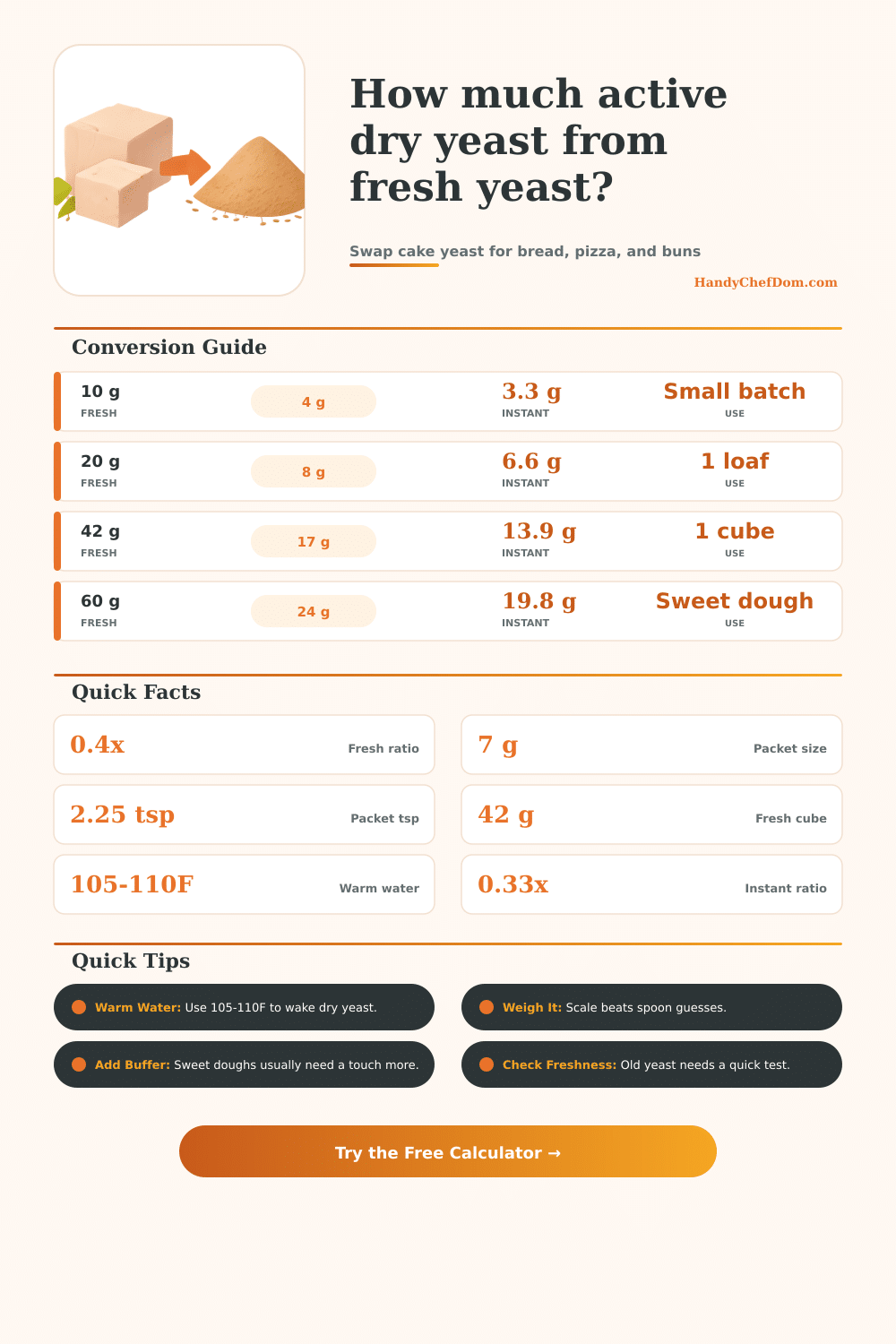
Fresh yeast is converted with a 0.4 factor for active dry yeast, then adjusted for flour type, dough style, fermentation timing, and buffer.
| Fresh | Active Dry | Instant | Note |
|---|---|---|---|
| 10 g | 4 g | 3.3 g | Test batch |
| 20 g | 8 g | 6.6 g | Small loaf |
| 42 g | 17 g | 13.9 g | 1 cube |
| 60 g | 24 g | 19.8 g | Sweet dough |
| 80 g | 32 g | 26.4 g | Big batch |
| 100 g | 40 g | 33 g | Bakery run |
| Flour Type | Factor | Use | Note |
|---|---|---|---|
| Bread | 1.00x | Lean loaves | Standard base |
| AP | 1.02x | Everyday dough | Close to bread |
| Whole wheat | 1.08x | Heavier dough | Needs more lift |
| Rye | 1.12x | Dense loaves | Fast fermentation |
| Spelt | 1.06x | Soft dough | Gentle handling |
| GF mix | 1.15x | Blend dough | Lower gas hold |
| Dough Style | Factor | Target | Note |
|---|---|---|---|
| Lean bread | 1.00x | Balanced rise | Direct swap |
| Pizza | 0.95x | Slow crust | Less yeast |
| Enriched | 1.06x | Soft crumb | Milk and fat |
| Sweet | 1.10x | Heavy sugar | Needs boost |
| Cold proof | 0.92x | Long rise | Retard safe |
| Hybrid | 0.90x | Flavor build | Use less yeast |
| Mix | Water | Temp | Life |
|---|---|---|---|
| Rehydrate | 4-5x | 105-110F | 10 min |
| Cool room | Direct | 68-70F | Slower rise |
| Standard | Direct | 72-75F | Balanced |
| Warm room | Direct | 78-80F | Faster rise |
| Packet | 7 g | 2.25 tsp | Common size |
| Cube | 42 g | 3 tsp | Fresh block |
In order to substitute active dry yeast for fresh yeast, a person must use a specific conversion ratio. Fresh yeast are a soft product with a high amount of moisture while active dry yeast has less moisture in its composition. In order to compensate for this, a person must use active dry yeast at 40 percent of the weight of the fresh yeast.
For instance, if the recipe call for 42 grams of fresh yeast, a person would need to use 17 grams of active dry yeast. This amount of active dry yeast can be measured by teaspoons or active dry yeast packets since 17 grams is a small amount. However, there are a few variable that will affect the activity of the active dry yeast.
How to Replace Fresh Yeast with Active Dry Yeast
One of these variables is the type of flour that a person is to be used in the recipe. Different types of flour will hold the gases created by the active dry yeast differently. For instance, flours like whole wheat and rye will hold the gases more differently than bread flour, therefore, altering the amount of active dry yeast that is needed for these types of recipes.
Another variable is the style of dough that will be used. Doughs like pizza dough takes longer to rise while doughs containing a significant amount of sugar will slow the activity of the active dry yeast. Another factor that will impact the activity of active dry yeast is the temperature of the kitchen in which the active dry yeast will be baking.
Active dry yeast will work faster in warm areas of the kitchen while it will work slow in areas that are cold. It is essential for a person to know that fresh yeast contains 70 percent water by volume while active dry yeast dont. Since active dry yeast does not contain water, it must be rehydrated before its used in baking recipes.
In order to rehydrate active dry yeast, the baker must mix the active dry yeast with warm water between the temperature of 105 and 110 degrees Fahrenheit. Additionally, the warm water should contain a pinch of sugar in order to activate the active dry yeast. If the active dry yeast creates foam when it is mixed with warm water and sugar, this indicate that the active dry yeast is alive and active and ready to be used in a recipe.
Another factor that will impact the amount of active dry yeast to be used in a recipe is the level of sugar that will be contained in the recipe. If the recipe contains a high amount of sugar, this will slow the fermentation process of the active dry yeast. In this case, 10 percent more active dry yeast would be needed for recipes with a high amount of sugar.
The other factor that will impact the activity of active dry yeast is the temperature of the active dry yeast. If the kitchen in which the active dry yeast will be baking is hot, less active dry yeast should be used. This is to avoid overproofing the dough.
If a person is baking in a cold kitchen, active dry yeast would need to be increased in order to maintain the speed in which the dough should rise. Another variable to consider when baking with active dry yeast is the type of flour that will be used in the recipe. Flours with a high protein content like bread flour will set the gases from the active dry yeast into dough better than gluten-free flour mixes.
Because of this, less active dry yeast is needed for bread flour as opposed to gluten free flour mixes. Additionally, because rye flour contains enzymes that will initiate the fermentation process in the flour itself, less active dry yeast would need to be used in recipes that utilize rye flour. Another important detail regarding active dry yeast is that it should be weighed rather than measured with teaspoons or packets.
This is because a teaspoon of active dry yeast may contain more or less active dry yeast depending on how the active dry yeast is store. Weighing the active dry yeast will provide more consistent results in each batch of baked goods that are prepare. Finally, another crucial detail regarding active dry yeast is that the baker should test the active dry yeast prior to add it to flour.
In order to test the active dry yeast, the active dry yeast should be mixed with warm water and sugar. If the active dry yeast does not bubble within ten minutes, it should be discarded as it is no longer active and potent.