Yeast Nutrient Per Gallon Calculator
Size nutrient additions for mead, wine, cider, beer wort, and rescue ferments with product-specific dosing
Use the style selector as your baseline. The calculator then nudges the dose for gravity, temperature, yeast condition, and feed schedule.
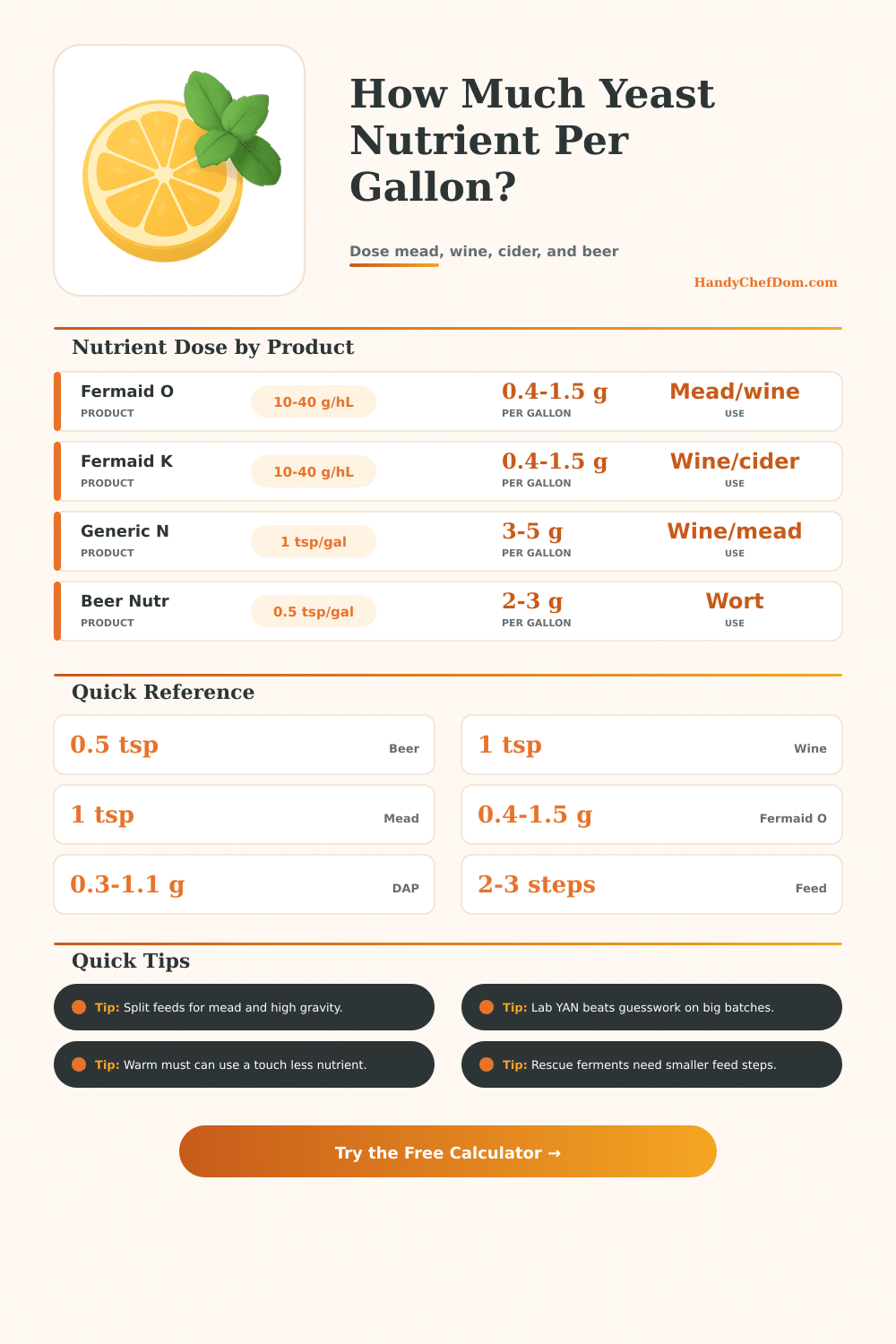
| Product | Rate | Per Gal | Best Use |
|---|---|---|---|
| Fermaid O | 10-40 g/hL | 0.4-1.5 g | Mead |
| Fermaid K | 10-40 g/hL | 0.4-1.5 g | Wine |
| Generic N | 1 tsp/gal | 3-5 g | Wine |
| DAP | 0.3-1.1 g | 0.25-0.8 g | Rescue |
| Style | Base Dose | SG | Feeds |
|---|---|---|---|
| Beer wort | 0.5 tsp | 1.050 | 1 |
| Cider | 0.8 tsp | 1.055 | 2 |
| Wine | 1.0 tsp | 1.085 | 2 |
| Mead | 1.0 tsp | 1.100 | 3 |
| Condition | Factor | Effect | Use |
|---|---|---|---|
| Low gravity | 0.95x | Lower need | Clean wort |
| Normal | 1.00x | Base dose | Standard |
| High SG | 1.12x | More need | Big must |
| Hot ferment | 1.10x | Stress up | Warm room |
| Plan | Feeds | Timing | Note |
|---|---|---|---|
| Single | 1 | At pitch | Beer wort |
| Two-step | 2 | Pitch + 24h | Cider/wine |
| Three-step | 3 | 0/24/48h | Mead |
| Rescue | 3 | Smaller splits | Stuck batch |
Yeast require nutrients to complete the fermentation process, but yeast requires nutrients because yeast do not just consume sugar. Yeast also requires other nutrients, such as nitrogen, vitamins, and mineral. Without nitrogen, vitamins, and minerals for yeast, the fermentation process will slow down or stop entirely.
If the fermentation process stop before the yeast consumes the sugar, then the resulting beverage will contain sugar but will not have fermented to produce an alcoholic beverage. To avoid this outcome, add yeast nutrient to the fermentation liquid to provide the yeast with the nutrients it require. The amount of nutrient to add depends on a type of base material used.
Why Yeast Need Nutrients and How Much to Add
Ingredients like honey contain very few nutrients, meaning that beverages like mead will require more yeast nutrient than other type of alcoholic beverages. Fruit juices contain more nutrients than honey but still may require some yeast nutrient. Beer wort contains many amino acid from the malt used to make beer, so the brewer requires less yeast nutrient in beer fermentation than in other beverages.
The amount of nutrient required also depends on the fermentation temperature. If the fermentation temperature is below 62 degrees Fahrenheit, the yeast will work slow and require more nutrients to initiate the fermentation process. If the temperature is above 74 degrees Fahrenheit during fermentation, the yeast will be stressed out and may require additional nutrients to prevent the creation of unpleasant flavor during the fermentation of the beverage.
The health of the yeast also affects the amount of yeast nutrient required for fermentation. If the yeast is healthy, it will ferment with the basic level of nutrients. However, stressed yeast may consume more nutrients to recover from a stressful environment.
A variety of yeast nutrient are available. Organic nutrients release nitrogen slowly into the beverage. The nutrients may be more appropriate for more delicate beverages.
Pure diammonium phosphate release nitrogen quickly into the fermentation process. However, if added in excess, it can create unpleasant flavors in the beverage. Generic yeast nutrients work best with wine, cider, and beer.
When adding yeast nutrient to alcoholic beverages, measure the nutrient for weight and equivalent per gallon rather than measuring by volume. Split feeding yeast nutrient means adding the nutrient in more than one instance during the fermentation process. Adding the nutrient at 24 hours and 48 hours, for instance, can allow for the yeast to acclimate to the liquid, especially in the creation of high sugar meads.
Additionally, split feeding can aid in rescuing fermentation in situations where the yeast has been struggling to ferment the sugar. Split feeding allow for the yeast to recieve the nutrient steadily throughout the process. Another factor that affects the required amount of yeast nutrient is the sugar content of the beverage being made.
If the beverage has low sugar content (low gravity) like light cider, then less yeast nutrient are required. High-gravity beverages such as mead require more nutrient because the yeast have to work harder to ferment the sugar to produce alcohol. Therefore, the higher the sugar content, the more nutrient required.
For example, if one gallon of beer requires half a teaspoon of generic yeast nutrient, then twice that amount could be required for mead. Adding too much or too little yeast nutrient will create problems during fermentation. Adding too much nutrient can lead to harsh flavor in the finished beverage.
Too little nutrient may result in a stalled fermentation process. To avoid these outcomes, dissolve the nutrient in a small amount of the beverage before adding it to the fermentation container. This ensure that the yeast nutrient does not clump together or create hot spots in the fermentation vessel.
Not all beverages require the same amount of yeast nutrient. Beer wort requires the least amount because the malted ingredients contain nutrients that support the yeast. Cider requires some nutrients because fruit juice contains some of the needed element.
Dry wines require nutrients throughout fermentation, but mead requires the most nutrient because honey contains very few. By understanding which beverages require what amount of nutrient, brewers can successfully add the appropriate amount to ensure that the yeast can complete the fermentation process and produce the desired beverage. If the brewer adds the correct amount of nutrient at the proper time, the yeast will successfully complete the fermentation process to produce an alcoholic beverage.