Yeast Packet Calculator
See how many grams, teaspoons, and loaf batches are inside a yeast packet.
The packet weight is the actual yeast mass. Use the flour amount to see how far one packet can stretch in a dough batch.
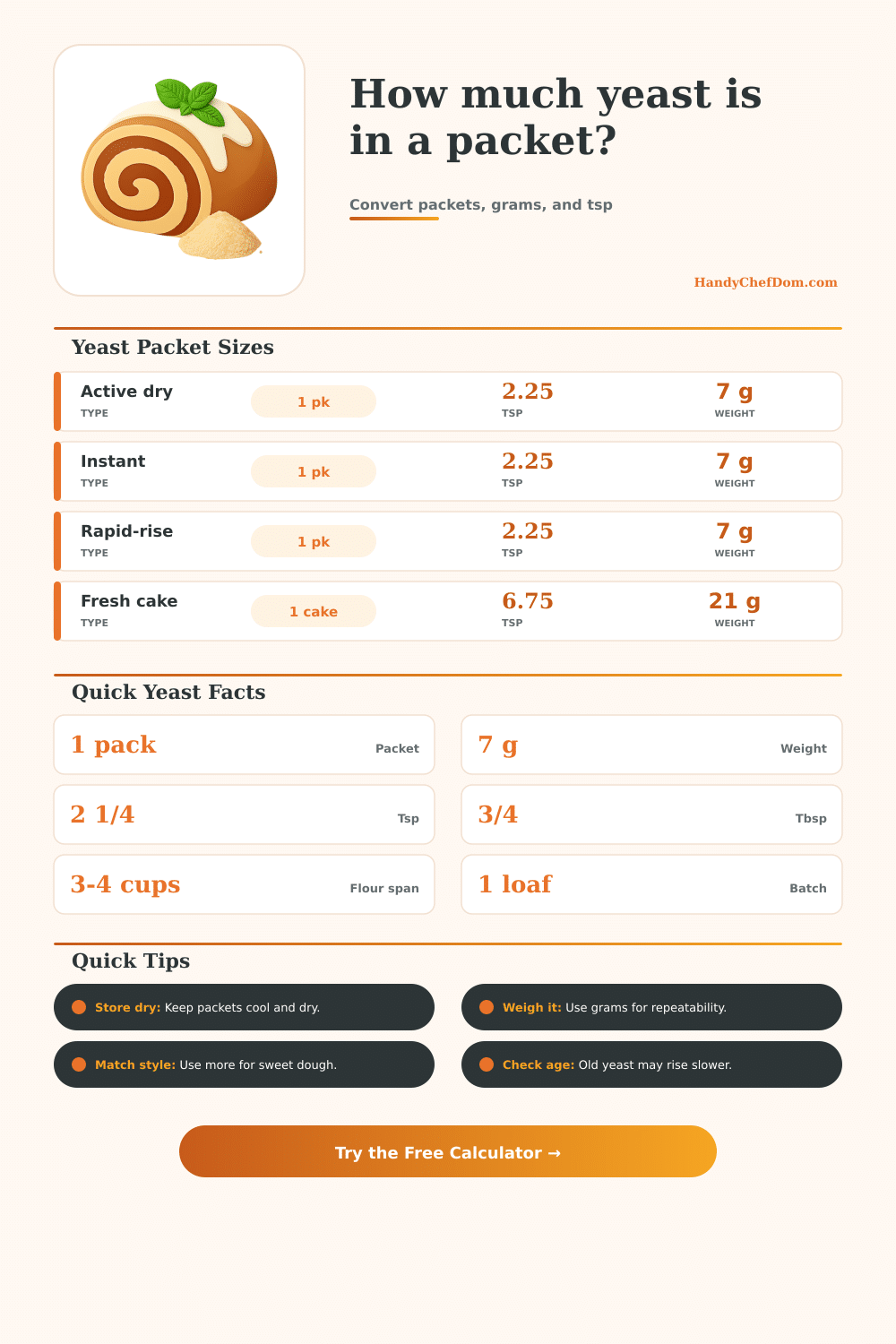
| Yeast Form | Packet | Tsp | Weight |
|---|---|---|---|
| Active dry | 1 packet | 2 1/4 | 7 g |
| Instant | 1 packet | 2 1/4 | 7 g |
| Rapid-rise | 1 packet | 2 1/4 | 7 g |
| Fresh cake | 1 cake | 6 3/4 | 21 g |
| Packets | Grams | Tsp | Tbsp |
|---|---|---|---|
| 1 | 7 g | 2.25 | 0.75 |
| 2 | 14 g | 4.5 | 1.5 |
| 3 | 21 g | 6.75 | 2.25 |
| 4 | 28 g | 9.0 | 3.0 |
| Dough Style | Flour/Packet | Use | Rise |
|---|---|---|---|
| Lean bread | 500 g | Loaves | Normal |
| Pizza | 375 g | Pies | Steady |
| Rolls | 320 g | Tray | Soft |
| Enriched | 275 g | Brioche | Slow |
| Sweet | 240 g | Rolls | Slow |
| Focaccia | 430 g | Pan | Fast |
| Temp | Factor | Effect | Note |
|---|---|---|---|
| 68 F | 1.15x | Slower | Cool kitchen |
| 72 F | 1.00x | Baseline | Room temp |
| 78 F | 0.92x | Faster | Warm dough |
| 85 F | 0.82x | Fast | Watch it |
A single packet of yeast contain a specific amount of yeast, and that amount of yeast is the amount that is used to make the dough rise. Most yeast packets contains approximately seven grams of yeast, which is roughly equivalent to two and one-quarter teaspoons of yeast. Furthermore, yeast are used in the dough to create an carbon dioxide (CO2) bubbles that allow the dough to rise.
The yeast consume the sugars that are naturaly present in the flour, and the CO2 bubbles produced by the yeast allow the dough to expanding and rise. The amount of yeast that is used in a particular batch of dough must be matched to the type of dough that is to be made. Lean doughs, which contain only flour, water, salt, and possibly oil, require less yeast than enriched doughs, which contains ingredients like eggs, butter, and sugar.
How Much Yeast to Use
For instance, recipes that contains ingredients like brioche or dinner rolls require more yeast than recipes for baguettes. The sugar in dough act as a brake on the yeast, so more yeast must be added to dough that contain a high level of sugar. Furthermore, the temperature at which the dough will be made will also impact the amount of yeast that needs to be use.
Yeast work best at a baseline speed at temperatures of approximately 72 degrees Fahrenheit. If the kitchen in which the dough is to be made is cool, the yeast will work at a slower rate, so more yeast will have to be added. If the kitchen is warm, however, the yeast will work at a faster rate, so less yeast should be added.
Finally, the method in which the dough ferment may also impact the amount of yeast that should be added; overnight fermentations in cold temperatures will slow the yeast, requiring more yeast to be added to ensure the dough rises at the desired rately. In order to ensure that the yeast that is to be used in the dough is still active, that yeast can be proofed by adding it to warm water. If the yeast is active, the yeast will create foam.
Yeast can lose it’s vigor if it is not stored in a cool and dry place. If the yeast is old, it will rise the dough at a slower rate. If the yeast is old, therefore, the dough may not rise as much than is expected of it.
The best way to measure yeast is with a scale to measure the amount of yeast in grams, as opposed to using teaspoons to measure the yeast. A relationship do exist between yeast and flour. For lean doughs, one packet of yeast can work with approximately 500 grams of flour; for sweet doughs, however, the same packet of yeast can only work with 242 grams of flour.
The richness of the dough slow the action of the yeast. Furthermore, if too much yeast is added to the dough, the dough may contain off-flavors due to the excess alcohol created by the yeast. If, however, too little yeast is added to the dough, the dough will not volume up to the desired amount.
Thus, balancing the amount of yeast to the amount of flour and other ingredients are essential when baking bread.