☕ Arizona Green Tea Caffeine Calculator
Find out exactly how much caffeine is in any size of Arizona Green Tea
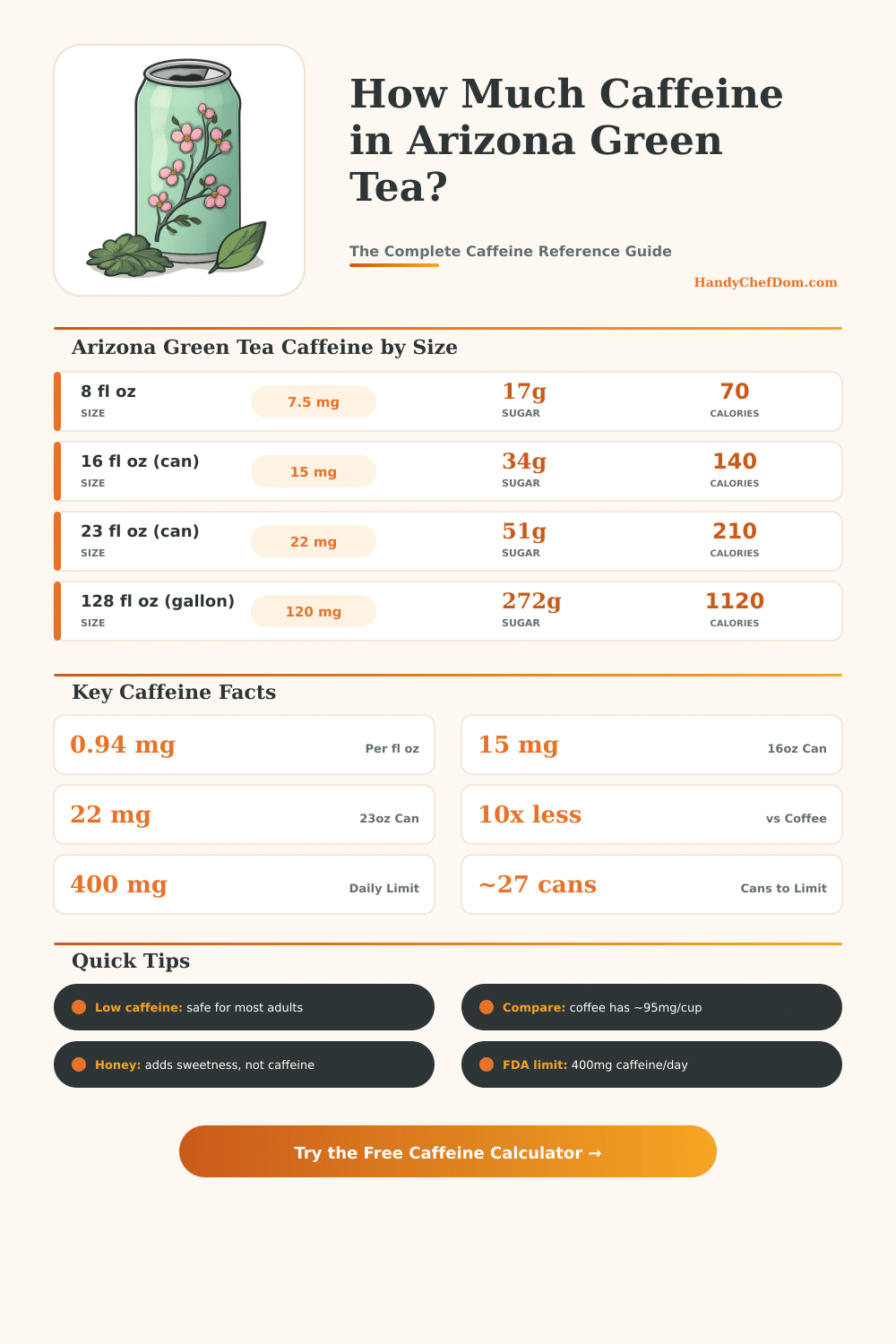
| Container Size | Caffeine (mg) | Caffeine (mg/fl oz) | Calories | Sugar (g) |
|---|---|---|---|---|
| 8 fl oz (240 mL) | 7.5 mg | 0.94 mg | 70 | 17 |
| 16 fl oz can (473 mL) | 15 mg | 0.94 mg | 140 | 34 |
| 23 fl oz big can (680 mL) | ~22 mg | 0.94 mg | 210 | 51 |
| 34 fl oz bottle (1 L) | ~32 mg | 0.94 mg | 310 | 75 |
| 64 fl oz half-gallon (1.9 L) | ~60 mg | 0.94 mg | 580 | 141 |
| 128 fl oz gallon (3.8 L) | ~120 mg | 0.94 mg | 1,120 | 272 |
| Drink | Serving Size | Caffeine (mg) | mg per fl oz |
|---|---|---|---|
| Arizona Green Tea | 23 fl oz | 22 mg | 0.94 |
| Brewed Green Tea | 8 fl oz | 28 mg | 3.5 |
| Brewed Black Tea | 8 fl oz | 47 mg | 5.9 |
| Drip Coffee | 8 fl oz | 95 mg | 11.9 |
| Espresso | 1 fl oz | 63 mg | 63 |
| Red Bull | 8.4 fl oz | 80 mg | 9.5 |
| Coca-Cola Classic | 12 fl oz | 34 mg | 2.8 |
| Arizona Arnold Palmer | 23 fl oz | 15 mg | 0.65 |
| Variant | Caffeine per 8 fl oz | Caffeine per 23 fl oz can | Calories per 8 fl oz |
|---|---|---|---|
| Green Tea w/ Honey (Original) | 7.5 mg | ~22 mg | 70 |
| Green Tea w/ Ginseng & Honey | 7.5 mg | ~22 mg | 70 |
| Diet Green Tea w/ Honey | 7.5 mg | ~22 mg | 5 |
| Green Tea w/ Mango | 7.5 mg | ~22 mg | 70 |
| Green Tea w/ Pomegranate | 7.5 mg | ~22 mg | 70 |
Green tea comes from the leaves and buds of the Camellia sinensis plant. Unlike black tea and oolong tea, it skips the steps of wilting and oxidation. During its making only minimal oxidation happens, which makes it the least oxidized between the six main kinds of tea.
Green tea first appeared in China during the first thousand years before our time, and it long was a treasure for both China and Japan. Currently it wins also fans in United States.
Green Tea and Its Benefits
Good leaves for green tea are heated or steamed just after the harvest. This way one keeps its natural color, which gives a healthy drink full of antioxidants. Special green tea uses leaves that are picked by hand and harvested at their best state in high mountain farms.
Great green tea has a smooth and fine taste, without any bitterness.
Brewed green tea is based mostly on water. It does not have fat, carbohydrates or protein. Plain green tea stores no calories.
Its famous health value comes from compounds called catechins, especially epicatechin, epicatechin-3-gallate, epigallocatechin and epigallocatechin-3-gallate, which one knows also as EGCG. Both green and black teas are seen as real teas, rather than herbal teas, and both naturally have Caffeine.
Studies show, that folks used tea for healthy causes already before 3 000 years. Green tea and its extracts are sold as food supplements for losing weight, lowering levels of cholesterol in blood and stopping chronic diseases like heart disease or cancer. Green tea is rich in antioxidants, that help the body and mind work better.
Compounds like EGCG in green tea act as prebiotics, backing good bacteria in the bowels. On the other hand, the claims about weight loss and anti-cancer efects have only few medical studies that back them, and the proof is probably not final.
Two to three cups of green tea a day are seen as a safe and healthy habit. To get the most benefit, one might need to drink three to five cups daily. One however does not suggest moer than five cups per day.
During pregnancy one should avoid high amounts of Caffeine.
Green and white tea should be brewed with cooler water than oolong and black tea. A handy rule says: one teaspoon of leaves for every sixty milliliters of water. Green tea serves also as an ingredient in cooking.
Basically, tea leaves are herbs, so one can grind them in a spice grinder and add to spice mixes. Green tea in icecream tastes well with Japanese style food, and matcha mixes well into smoothies and latte foams.