Boiling Point Elevation Calculator for Kitchen Solutions
Estimate solvent boiling temperature with colligative elevation, pressure and altitude corrections, dual-solute modeling, and kitchen-use boil cues for repeatable cooking and prep outcomes.
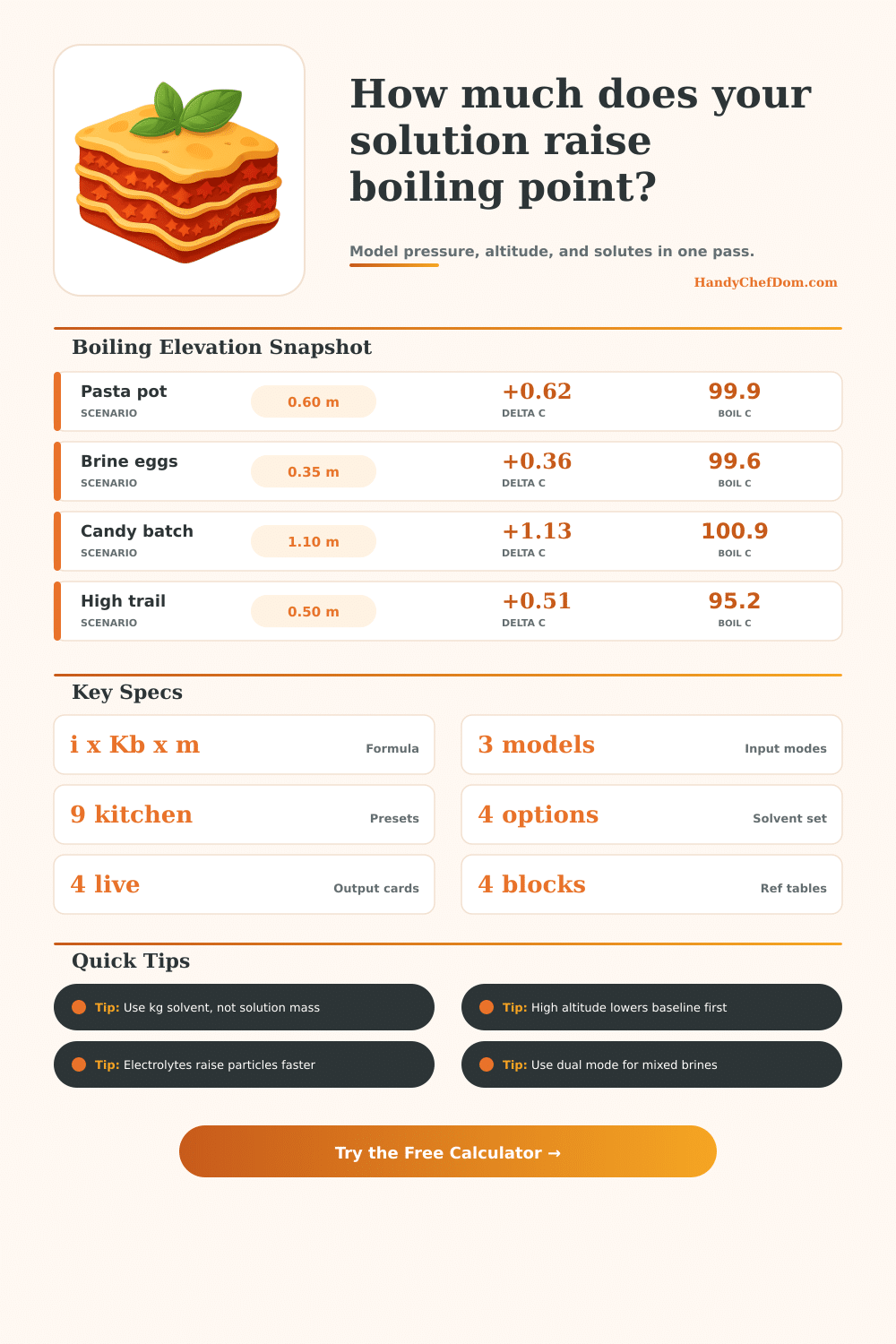
Model: site base boil + colligative elevation where delta T equals i times Kb times molality. Use direct mode for lab data, or mass and dual modes for kitchen batches.
| Solvent | Normal boil C | Kb C kg/mol | Kitchen use |
|---|---|---|---|
| Water | 100.0 | 0.513 | Pasta, eggs, blanching |
| Ethanol | 78.4 | 1.23 | Reduction and extraction |
| Ethylene glycol | 197.3 | 2.26 | Lab food simulation |
| Propylene glycol | 188.2 | 2.90 | Stable syrup trials |
| Solute | Molar mass | Ideal i | Typical role |
|---|---|---|---|
| NaCl | 58.44 g/mol | 2.0 | General brine |
| KCl | 74.55 g/mol | 2.0 | Low sodium brine |
| CaCl2 | 110.98 g/mol | 3.0 | Firming pickles |
| Sucrose | 342.30 g/mol | 1.0 | Syrups and candy |
| Glucose | 180.16 g/mol | 1.0 | Syrup texture control |
| Altitude | Meters | Baseline C | Kitchen note |
|---|---|---|---|
| Sea level | 0 | 100.0 | Recipe baseline |
| City hill | 500 | 98.4 | Longer pasta by minutes |
| Foothill | 1000 | 96.8 | Egg set slows |
| Mountain town | 1600 | 94.9 | Simmer feels weaker |
| High cabin | 2400 | 92.3 | Candy stages shift |
| Molality | Water delta C | Ethanol delta C | Read |
|---|---|---|---|
| 0.25 m | +0.13 | +0.31 | Light seasoning level |
| 0.50 m | +0.26 | +0.62 | Moderate syrup level |
| 1.00 m | +0.51 | +1.23 | Heavy concentration |
| 1.50 m | +0.77 | +1.85 | Strong elevation zone |
| 2.00 m | +1.03 | +2.46 | Concentrated process |
Boiling water dont always boil at the temperature that the recipe states it should. The boiling point of water is influenced by much factors. These factors include the substances that is placed into the water to dissolve, the altitude at which the water is boiled, and the barometric pressure.
Changes in these factors can lead to the cooking process ending in failure; pasta cooked at high altitudes take longer to cook, for instance, and candy can fail to reach the proper boiling point if the temperature of the water is incorrect. By understanding the various variable that can change the boiling point of water, cooks can better adjust the cooking time and heat levels of the boiling water. Adding substances to water can change its boiling point due to an increase in the particles that are suspended within the water.
What Affects the Boiling Point of Water
The more particles that is suspended within the water, the more higher the waters boiling point will be. The change in the temperature of the water is dependent upon the concentration of those particles, not the total mass of the substance that is being added to the water. For instance, salt and sugar will exhibit different behaviors when added to water due to the fact that salt molecules will dissociate into two ions, whereas sugar molecules will remain as a single molecule.
Thus, equal weight of salt and sugar will have a different impact upon the boiling point of water. Altitude affects the boiling point of water due to the change in atmospheric pressure. At high altitudes, the atmospheric pressure are lower.
A lower atmospheric pressure means that the water molecules has to exert less energy to create bubbles within the water. Consequently, the boiling point of the water is lower at high altitudes. A recipe written for boiling point levels found at sea level, for instance, may not work at high altitudes.
A cook can use a calculator to enter the atmospheric pressure and the altitude of the location in which the cooking is to occur. Because many cooking processes use solvents other than water, cooks may need to use a different solvent setting on the calculator. For instance, ethanol is used as a solvent in processes like reducing wine in a sauce.
Ethanol has a lower boiling point than water, and reacts to the addition of particles differently. Glycols is another solvent that may be used in syrups. Cooks may need to use glycols if they are making a syrup and need to ensure that it remains chemically stable at high cooking temperatures.
The calculator allows for cooks to choose the modes in which the ingredients are to be measured. In the mass mode, the cook will weigh the solvent and the solute. In the direct mode, the cook may already know the molality of the solution, thus eliminating the need to weight the individual variables.
Cooks preparing liquids that contain two different solute, such as a brine, can use the dual mode. Each solute will contribute to the total number of particles in the liquid, and the calculator will add these particle counts to calculate the total change to the temperature of the liquid. The ionization efficiency of the solvent can change the boiling point, but not all solute molecules will ionize when placed into the liquid.
Thus, a percentage adjustment has to be made to account for the incomplete ionization of those molecules. Changing the ionization efficiency from 100% to 92%, for instance, will alter the calculated boiling point of the mixture. Such a change in boiling point is necessary to account for the accuracy of the calculated boiling point; an inaccurate boiling point will result in bad cooking results.
The reference tables provide context for the calculation of the boiling point. The constants of the solvents explain why water is the most common solvent used, and why ethanol is used in situations like cooking. The solute table demonstrates why solvents like calcium chloride has a greater impact upon the boiling point than sodium chloride.
Finally, the altitude table demonstrates the change in temperature at high altitudes. These tables do not provide recipes for various foods. However, each of these tables explains the number that will be provided by the calculator.
Depending upon the change in the boiling point of the water, various cooking decisions can be made. For instance, if the boiling point increase by one degree, the cooking time for pasta will be shortened, and the cook can lower the heat level of the burner. However, if the water is boiling at a lower temperature due to high altitudes, more cooking time will be necessary to properly cook the pasta.
The cook-time factor adjust for these different temperatures. Many cooks may make mistakes with using the correct mass unit in the calculation. For instance, if the total weight of the dissolved solution is weighed, and that total is used as the mass of the solvent, the concentration will be weighed as being lower than it should be.
Thus, using the total mass of the solution will result in the incorrect calculation of the impact upon the boiling point. An additional potential mistake is to not account for the effect of weather on atmospheric pressure; a drop in atmospheric pressure can alter the boiling point. The main value of the model is the ability to provide repeatability in the kitchen.
If cooks understand the impact of different solutes upon the boiling point, they can provide the same results within any number of kitchen, regardless of where those kitchens may be located. The cook can establish the baseline of the boiling point, and the additional measurement of the local atmospheric pressure can help to improve cooking skills over time.