Microwave Cooking Time Converter
Convert package or recipe microwave instructions from one wattage to another, then refine the result for power level, serving size, food density, stirring, and standing time.
1Choose a real microwave preset
Start with the wattage and time printed on the package, then enter the wattage of your microwave. The converter gives a practical first timer, plus check and rest guidance.
2Enter cooking details
Your converted microwave plan
3Wattage comparison grid
4Microwave reference tables
| From | To | Use | Example |
|---|---|---|---|
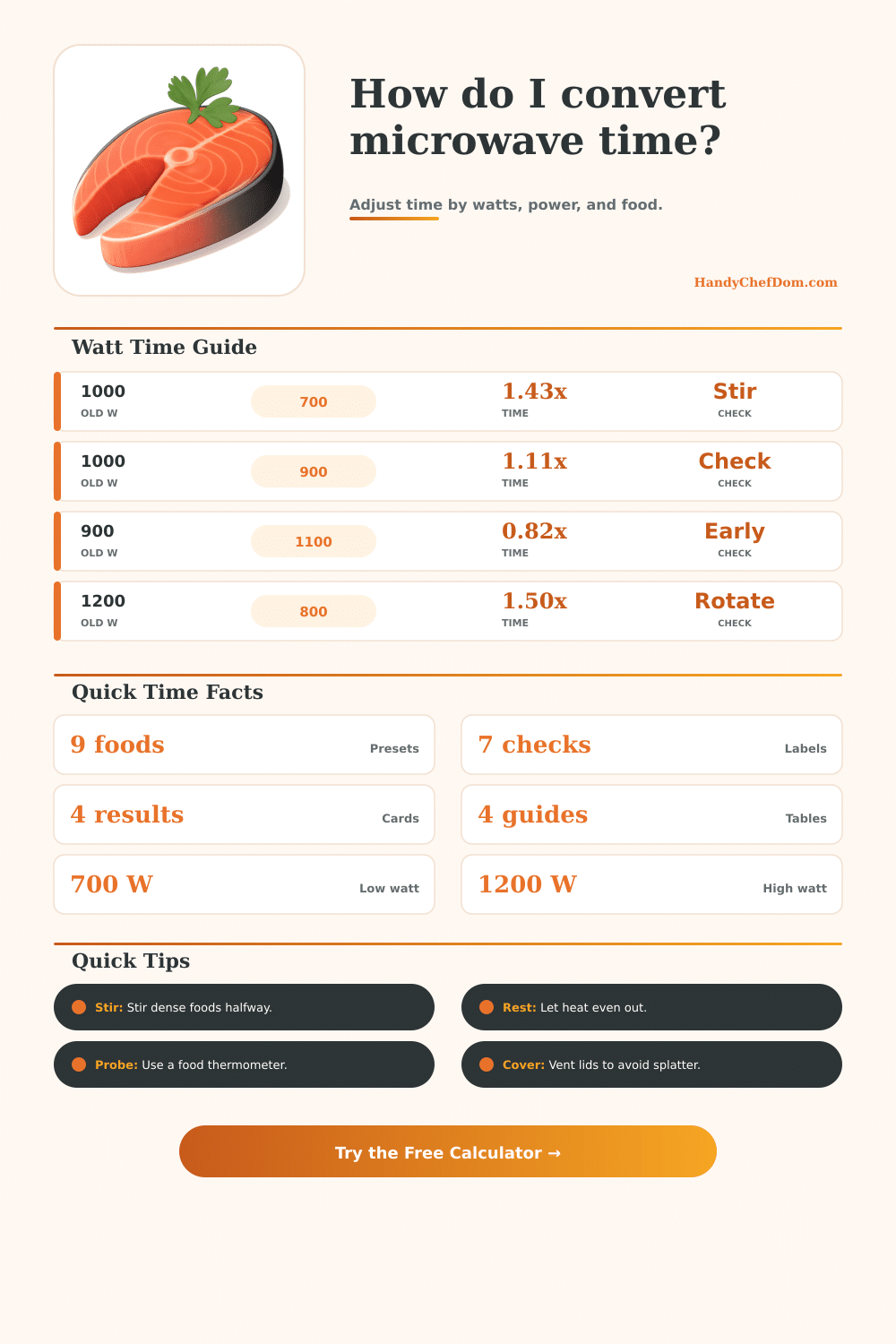
| 1000 W | 700 W | 1.43x | 4 min to 5:43 |
| 1000 W | 900 W | 1.11x | 4 min to 4:27 |
| 1000 W | 1100 W | 0.91x | 4 min to 3:38 |
| 1200 W | 800 W | 1.50x | 4 min to 6:00 |
| 700 W | 1100 W | 0.64x | 4 min to 2:33 |
| Food | Factor | Pause | Reason |
|---|---|---|---|
| Soup | 0.96x | Stir | Liquid moves heat well. |
| Rice bowl | 1.08x | Stir | Starch traps cold spots. |
| Frozen meal | 1.15x | Rotate | Ice slows the center. |
| Vegetables | 0.92x | Shake | Steam finishes quickly. |
| Potato | 1.18x | Turn | Dense whole food. |
| Mug cake | 0.90x | Watch | Overcooks fast. |
| Task | Power | Rest | Best move |
|---|---|---|---|
| Reheat plate | 70-100% | 1-2 min | Cover and vent. |
| Melt butter | 30-50% | 0 min | Use short bursts. |
| Defrost meat | 30-40% | 5 min | Separate pieces. |
| Cook potato | 100% | 3-5 min | Turn halfway. |
| Warm bread | 50-70% | 0 min | Wrap lightly. |
| Food | Target | Check | If cold |
|---|---|---|---|
| Leftovers | 165 F | Center | Stir, add 30 sec. |
| Poultry dish | 165 F | Thick part | Rest, then reheat. |
| Soup | Steaming | Stirred spoon | Heat 20 sec. |
| Egg dish | Set center | No runny spots | Use low bursts. |
| Frozen meal | Package temp | All sections | Rotate tray. |
This microwave cooking time converter works best when you treat the result as the first timer to try. Start with the lower converted time, check texture and temperature, then add short bursts if the middle still needs heat.
Power levels matter because many microwaves cycle full power on and off instead of making a perfectly steady lower wattage. That is why the calculator also shows a stir point, first-check time, and standing time.
Microwaves often change the way that they heat foods if the wattage or the power levels of the microwave is changed. Microwaves dont always heat food at the same rate, and the reason for this is that the microwave energy interact with the water and fat that is contained within the food. Furthermore, the shape of the container of the food also change the way that the food is heated.
Therefore, due to the interaction between the microwave energy, the water, the fat, and the container, two individuals that use the same instruction may achieve different results in the heating of the food. This is most noticeable with foods that is dense or that contain food that is frozen. In these instances, the edge of the food may become hot while the center of the food remains cold.
How the Microwave Time Calculator Works
The calculator ask for the wattage of the original microwave and the wattage of the new microwave. In addition to the wattage of the microwaves, the calculator also must determine the type of food that is to be heated. These factors is used in the calculation of the time needed for heating food because the shape of the container, the portion size of the food, and the number of times that the food should be stir will each impact the heating of the food.
For instance, deep foods will retain heat more differently than foods that are contained in shallow containers. Foods that are of a larger size with a cold center will heat differently than foods that are liquid or foods that are contained in shallow containers. Many individuals tend to focus only on the wattage of the microwaves when they enter a new kitchen or purchase a new microwave.
However, individuals often forget that the power levels of the microwave are not set to provide a steady output of energy at levels that are less than 100% of the microwave’s power. Instead, the magnetron within the microwave is set to full power but cycle on and off to provide the level of heat to the food that is set on the microwave’s control panel. For instance, 50% power on the microwave is actualy a series of short bursts of full power from the magnetron.
These cyclical functions of the magnetron are factored into the standing time for the food to cook to the temperatures required for the food. Standing time is the time in which the food is left to stand after microwaving to allow for the food to continue to cook. Standing time should not be skipped after microwaving food because the food continues to cook after the microwave is turned off.
Furthermore, standing time is essential for foods that are dense with thermal mass, such as potatoes, while foods that are thin, such as soup, may not require the same standing time to continue cooking. Standing time is therefore included in the time that is calculated in the calculator. Portion size will also impact the amount of time that the microwave take to heat the food.
If an individual doubles a recipe, for instance, the amount of time that the recipe takes to heat the food will not double; the surface area of the food impacts the amount of food that the microwave can heat, and the increased portion size will impact the amount of time required to heat the food. However, the portion size that is doubled will not require double the time to cook the food. The calculator factors in the impact of portion size on cooking time by utilizing a non-linear factor that adjusts for the portion size of the food.
The density of the food and the amount of water content within the food will also impact the amount of time that the food takes to heat. Foods that are frozen will take longer to heat than foods that are fresh, due to the amount of time for the ice to melt before the food can absorb energy from the microwaves. Furthermore, the movement of liquids allow for the heat to circulate the entire portion of food, while food that remains frozen cannot move or circulate the heat that is provided from the microwaves.
For these reasons, the calculator require individuals to select the type of food that will be heated. Many individuals tend to make mistake when heating food in the microwave. One of the most common mistakes is ignoring the time listed on the food package, and instead heating the food to the time listed on the package without considering the wattage of the microwave in which the food is being heated.
Another common mistake is to skip the stirring of food after heating, which lead to cold areas in the food. These mistakes the food heating time calculator avoids, which includes checkpoints for individuals to make small decisions about the food rather than guess at the proper cooking time and standing time. Another important reason to utilize the times that are converted by the food heating time calculator is for safety reasons.
Foods such as leftovers, poultry products, and foods that contain egg need to reach a safe internal temperature to kill the bacteria that could make individuals ill. Furthermore, the outer layer of the food may be hot to the touch after heating in the microwave, but the center of the food may not have reached the required internal temperature. In these cases, a thermometer should check food to ensure that it reaches the internal temperature that is required for safety.
Overall, the usefulness of the food heating time calculator is that it allow for individuals to account for the wattage of the microwave, the density of the food, and the portion size of the food. Additionally, the individual can further adjust the initial plan that is created by the food heating time calculator according to the amount of standing time that may be required or the additional time that may be required to cook the food to the temperature that is desired. Therefore, by using the microwave time calculator, individuals can ensure that reheating food is more consistent, as the food heating time calculator accounts for each of the variable that may impact the way that food heats in the microwave.