⚡ Nudge Caffeine Calculator
Find out exactly how much caffeine is in your Nudge drink — by flavor, serving size & daily total
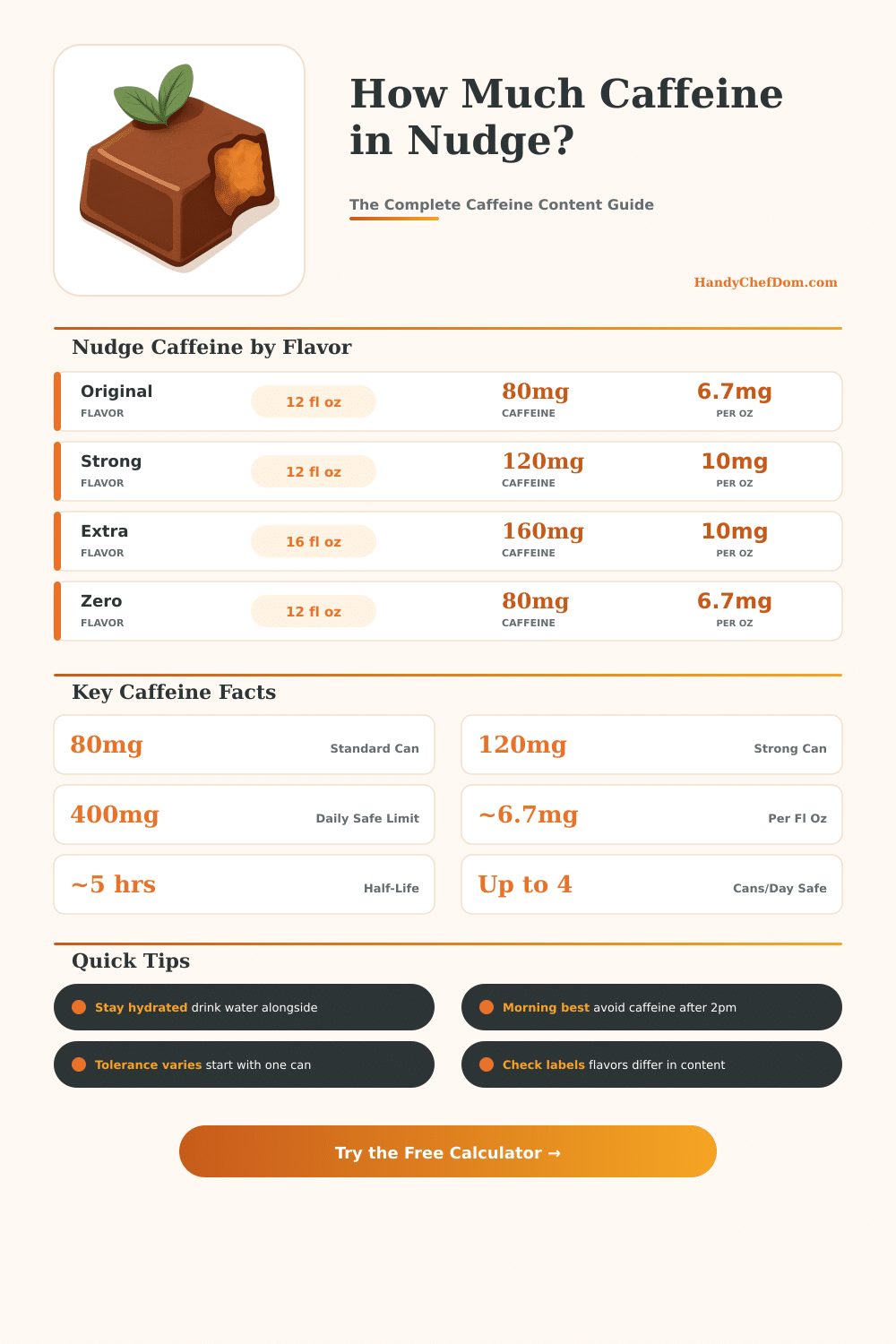
| Flavor / Variety | Serving Size | Caffeine (mg) | Caffeine per fl oz | % Daily Limit |
|---|---|---|---|---|
| Original | 12 fl oz (355 mL) | 80 mg | 6.7 mg/fl oz | 20% |
| Original | 16 fl oz (473 mL) | 107 mg | 6.7 mg/fl oz | 27% |
| Strong | 12 fl oz (355 mL) | 120 mg | 10 mg/fl oz | 30% |
| Strong | 16 fl oz (473 mL) | 160 mg | 10 mg/fl oz | 40% |
| Extra | 16 fl oz (473 mL) | 160 mg | 10 mg/fl oz | 40% |
| Zero Sugar | 12 fl oz (355 mL) | 80 mg | 6.7 mg/fl oz | 20% |
| Tropical | 12 fl oz (355 mL) | 80 mg | 6.7 mg/fl oz | 20% |
| Berry | 12 fl oz (355 mL) | 80 mg | 6.7 mg/fl oz | 20% |
| Citrus Burst | 16 fl oz (473 mL) | 120 mg | 7.5 mg/fl oz | 30% |
| Drink | Serving | Caffeine (mg) | Nudge Equivalents |
|---|---|---|---|
| Nudge Original | 12 fl oz | 80 mg | 1.0x baseline |
| Red Bull Original | 8.4 fl oz | 80 mg | 1.0x Nudge |
| Monster Energy | 16 fl oz | 160 mg | 2.0x Nudge |
| Bang Energy | 16 fl oz | 300 mg | 3.75x Nudge |
| Regular Coffee (8 oz) | 8 fl oz | 95 mg | 1.2x Nudge |
| Espresso Shot | 1 oz | 63 mg | 0.8x Nudge |
| Coca-Cola Classic | 12 fl oz | 34 mg | 0.4x Nudge |
| Green Tea | 8 fl oz | 28 mg | 0.35x Nudge |
| Group | Daily Limit | Max Nudge Originals | Source |
|---|---|---|---|
| Healthy Adults | 400 mg/day | 5 cans | FDA / Mayo Clinic |
| Pregnant Women | 200 mg/day | 2.5 cans | ACOG Guidelines |
| Teens (13–17 yrs) | 100 mg/day | 1.25 cans | AAP |
| Children (<12 yrs) | Not recommended | 0 cans | AAP |
| High Caffeine Sensitivity | 100–200 mg/day | 1–2 cans | General guidance |
Nudge is made up of tender touch or push. It points to a gentle push to some, commonly by means of the elbow, to attract the attention of that person. Even so beyond that basic meaning, the term has got a much more broad role in the way the world considers choices and processes of deciding.
Theory of nudges forms a notion in the fields of behavioural economics and social psychology. It claims that the form of the setting for deciding, or also called architecture of choices, affects the behaviour of folks and their choices. The idea is based on the principle, that folks are basically irrational.
What Is a Nudge and How It Works
One commonly chooses according to instincts instead of logical analysis, and such thought is faster. So, unfortunately, those fast decisions usually result in harmful or unhealthy results.
Richard Thaler and Cass Sunstein presented this notion to the general public through their book. It looks at how folks make decisions daily and how one can improve them. Those decisions embrace everything, from purchases or foods, to investments in money, issues about health and choices about education.
The book looks at the architecture of choices in various areas, for example how such arrangements form the way folks decide about various themes.
In practice, nudge works as an action, that gently leads folks directly to wanted activity. Indirect advice can work on reason and deciding at least just as well as direct orders. The key spot is, that nudges do not remove anybody’s options or alter economic reasons too a lot.
They stay easily available and cheap to escape. The target is, that one will form the options like this, that folks choose the most wanted, while one leaves all other chances available. The less good choices simply require a bit more mental action.
A typical example is the setup of the arrangement of foods in a cafe, to encourage healthier eating. One lays fruits at level of the eyes, while the chocolates sit a bit more hardly reached. The sweets stay available, but that setup helps folks choose more positive ways.
Serving vegetables in standard portion amount also helps boost there use. Changing the size of dishes or portions already proved, that it causes real changes in eating.
Nudges based on behaviour beat informative or emotional actions in results. They fit to lower the everyday entry of calories by around 320. According to several studies, nudges in actual everyday situations can lower the energy use by until 209 calories, what almost matches to 21 bits of sugar.
One study showed, that children took more food for themselves, when one gave to them plates of grown-up size, that had almost doubly more surface than the usual.
Apps also can serve as nudges. A short daily reminder is enough, to form habit around reading, meditation, diet orsleep.