🧄 Garlic Cloves To Teaspoons Converter
Convert fresh cloves into teaspoons of minced garlic, jarred garlic equivalents, tablespoons, milliliters, and recipe-scale amounts with size and texture adjustments.
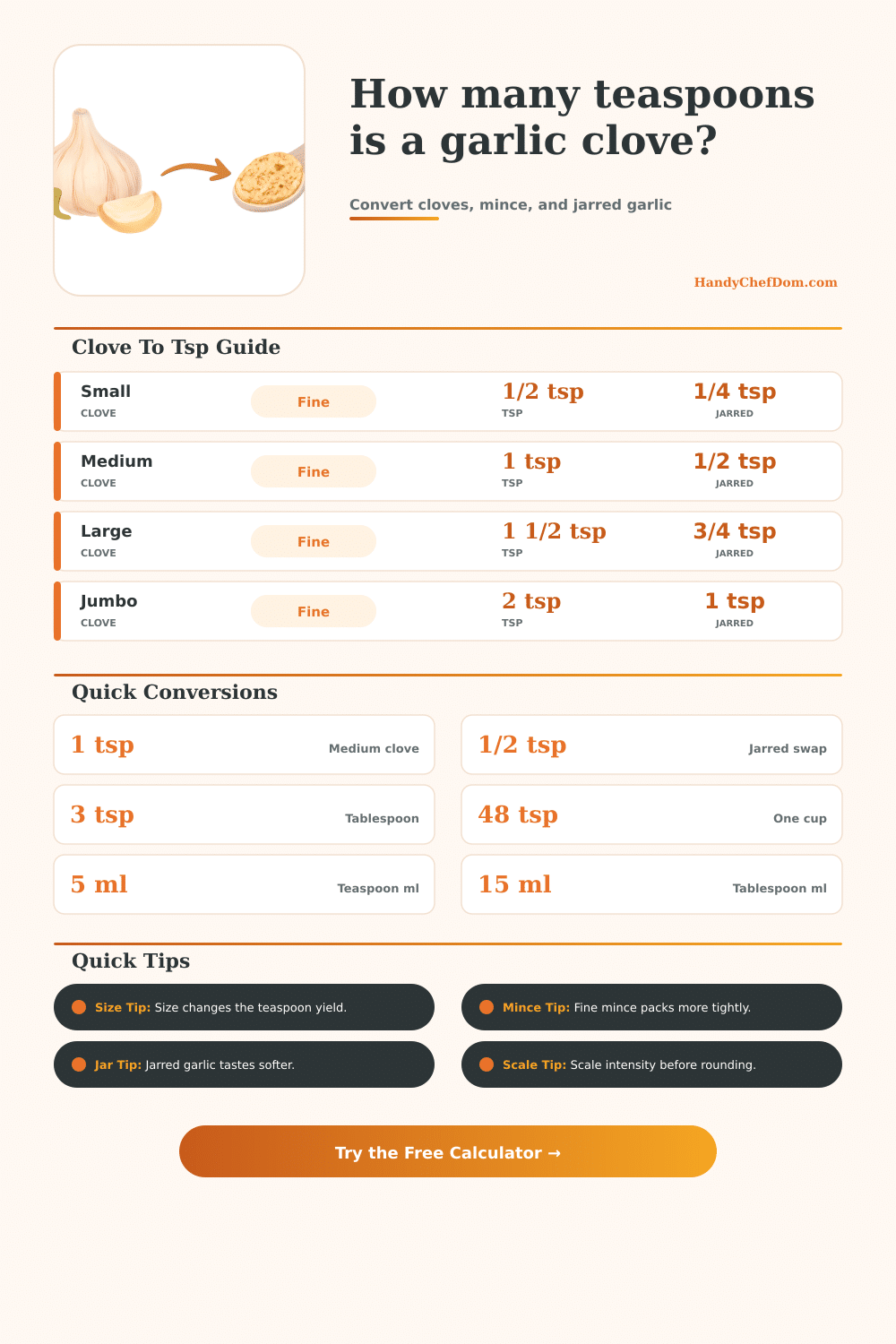
Use the standard cooking anchor of 1 medium fresh clove equaling about 1 teaspoon finely minced garlic, then adjust for actual clove size, mince texture, jarred garlic style, scaling, and intensity.
| Clove Size | Fresh Minced | Approx Grams | Best Use |
|---|---|---|---|
| Tiny | 1/3 tsp | 1 g | Light aroma |
| Small | 1/2 tsp | 1.5 g | Dressings |
| Medium | 1 tsp | 3 g | Most recipes |
| Large | 1 1/2 tsp | 4.5 g | Sauces |
| Jumbo | 2 tsp | 6 g | Garlic focus |
| Mixed | 1 tsp | 3 g | Fast prep |
| Mince Texture | Tsp Factor | Intensity | Measure Note |
|---|---|---|---|
| Paste or grated | 0.80x | 1.20x | Compact |
| Fine mince | 1.00x | 1.00x | Standard |
| Regular mince | 1.08x | 0.95x | Loose chop |
| Coarse mince | 1.18x | 0.85x | Air gaps |
| Pressed | 0.92x | 1.12x | Juicy pack |
| Thin sliced | 1.35x | 0.70x | Not minced |
| Jarred Style | Use Per Clove | Taste Fit | Conversion Note |
|---|---|---|---|
| Standard mince | 1/2 tsp | Everyday | Common label |
| Mild jarred | 3/4 tsp | Soft bite | Add more |
| Strong jarred | 1/3 tsp | Sharp | Use less |
| Roasted jarred | 1 tsp | Sweet | Milder |
| Jarred paste | 1/3 tsp | Dense | Compact |
| Oil-packed | 2/3 tsp | Round | Drained spoon |
| Recipe Need | Written Cloves | Fresh Minced | Jarred Swap |
|---|---|---|---|
| Light dressing | 1 | 1 tsp | 1/2 tsp |
| Weeknight sauce | 3 | 3 tsp | 1 1/2 tsp |
| Family pasta | 4 | 4 tsp | 2 tsp |
| Marinade bowl | 6 | 6 tsp | 3 tsp |
| Meal prep pan | 12 | 12 tsp | 6 tsp |
| Party batch | 18 | 18 tsp | 9 tsp |
IF A recipe says “three cloves of garlic,” what does that mean? The bulb in your hand could be full of some giant, and some smallish ones. And there’s probably that handy jar of pre-minced garlic sitting out on the counter. How much minced equals one clove? When should you reach for actual garlic versus the jarred stuff?
With the calculator above, those unclear directions translate to precise spoonfuls, no more (or less) garlic then intended in your meal. The number of garlic cloves you have isn’t all that matters; they comes in many sizes, ranging from a big one (which might provide up to two teaspoons of mince) to a tiny one (that’ll only give you half a teaspoon). To account for these differences, the tool let you choose how big the bulb is that you’re peeling. This makes a difference, more than you’d expect, and if your cloves are really big and you don’t compensate for it when following recipe for smaller ones, your sauce will taste like a pharmacy.
How to Measure Garlic for Your Recipes
After plugging in your chosen size and number of cloves, the calculator do the math so you don’t need to guess as you’re stirring away at stovetop. It makes such a big difference with volume as well. Coarse chopping will have air spaces in between each piece while a fine mince will pack down in teaspoon. You can also slice your garlic thin rather than mince it. This gives you less surface area exposed to the heat, so you’d of need more volume to achieve same flavor impact. Keep in mind that grated garlic paste has a denser texture than loose chopped pieces. This is why recipes sometimes don’t feel right when switching methods. The tool adjust to match.
And what about the all-important jarred garlic? Convenient, yes, but it has changed: Oil or other acidic ingredients used as preservatives will change the taste. Fortunately, the converter offers individual settings for several types of preserved garlic (from regular to strong), even roasted. You typicaly need twice as much jarred minced garlic as you would a fresh clove to get same flavor. So one clove of fresh might equal half a teaspoon of jarred. Some milder brands may need even more. The calculator can help you adjust until you hit just the right ratio so your recipe isn’t dull.
It’s also a recipe-scaling tool, which is another pitfall: If you double a batch of pasta sauce, do you really want to double the garlic? Who wants to go there? But who doesn’t balk? With this tool, you can adjust the garlic separately from amount of other ingredients. Use a slider to twist it up or down to taste, such as when serving four people instead of two. Make sure the garlic stays more like a whisper in the background than a center-stage star. It’s smart, too, to account for pungency, since different varieties and even ages of garlic may range from more aggressive to milder; newer crop cloves can be shockingly strong, and older ones mellower.
If you don’t want to fiddle with customizing everything, or simply want to know what’s most commonly used, the page provides a handy reference table that lays it all out plainly for a quick check. For common textures and sizes, they provide standard match that you can use as a good anchor point if you’re in a rush. But of course, there is no substitute for nuance in real cooking, which is why the calculator lets you layer all of these variables together. Want to account for size? No problem. Texture? Jarred swap? Intensity? Scaling? All of the above? The calculator will give you an exact teaspoon count that considers the actual garlic you’ve got on hand, eliminating the anxiety in your kitchen.
You don’t need to guess about how much of that large clove equals one teaspoon, or two. Match your actual ingredients to the recipe to see what it calls for. Once you get the garlic right, everything else follows. Whether you’re creating a bold marinade or a delicate vinaigrette, the flavor balance begin with accurately measuring. Not guessing, what’s needed here. Trust the math before trusting your nose on this one. Then adjust accordingly to fit your preference.