🍲 Water to Lentils Calculator
Estimate water cups or milliliters, cooked yield, simmer time, and salt for red, green, brown, black, or French lentils by texture, method, lid, altitude, and servings.
Enter dry lentils by cups or grams. The calculator starts with common ratios, then adjusts for lentil type, desired texture, cooking method, rinsing or soaking, salt timing, altitude, and evaporation.
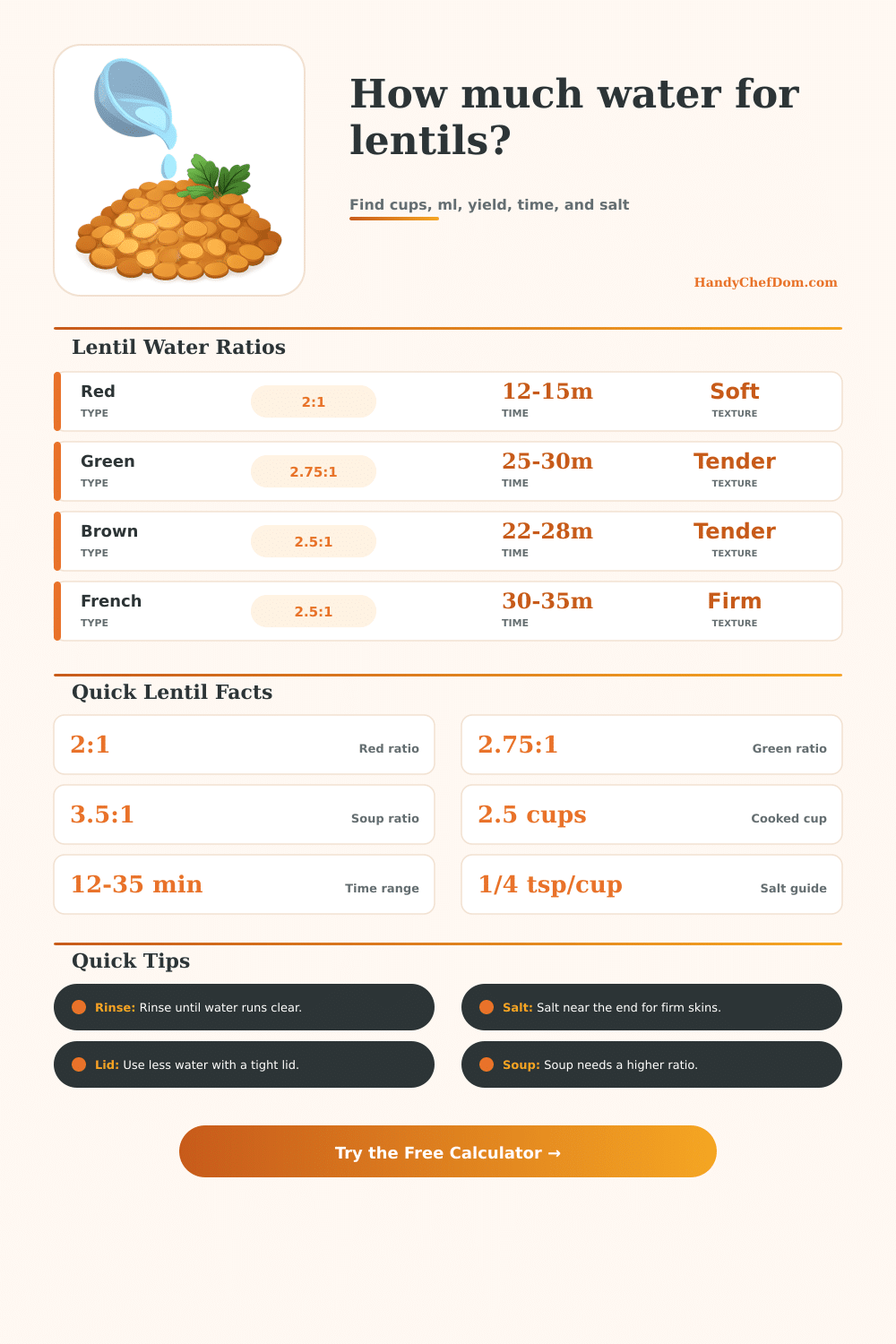
| Lentil Type | Base Water Ratio | Typical Time | Best Texture Use |
|---|---|---|---|
| Red or split red lentils | About 2 cups water per 1 cup dry lentils | 12 to 15 minutes | Soft lentils, dal-style texture, purees, and quick soups. |
| Green lentils | About 2 1/2 to 3 cups water per 1 cup dry lentils | 25 to 30 minutes | Tender side dishes that still keep some shape. |
| Brown lentils | About 2 1/2 to 2 3/4 cups water per 1 cup dry lentils | 22 to 28 minutes | Everyday bowls, meal prep, and mild soups. |
| Black beluga lentils | About 2 1/2 cups water per 1 cup dry lentils | 24 to 28 minutes | Firm salads, grain bowls, and separate lentils. |
| French green or Puy lentils | About 2 1/2 cups water per 1 cup dry lentils | 30 to 35 minutes | Firm, peppery lentils for salads or structured sides. |
| Texture Goal | Ratio Effect | Time Effect | When to Choose It |
|---|---|---|---|
| Firm for salads | Use about 8% less water than the base ratio | Shorter cook time | Choose for black, French, or green lentils that need defined grains. |
| Tender side dish | Use the base ratio for the lentil type | Standard cook time | Choose for most bowls, sides, meal prep, and warm salads. |
| Soft mashable lentils | Use about 12% more water than the base ratio | Longer cook time | Choose when red, brown, or green lentils should soften deeply. |
| Brothy soup or stew | Use about 45% more water than the base ratio | Longer cook time | Choose when extra liquid should remain in the pot after cooking. |
| Dry Lentils | Approx Weight | Cooked Yield | Serving Estimate |
|---|---|---|---|
| 1/2 cup dry lentils | About 95 g | About 1 1/4 cups cooked | 2 small side servings |
| 1 cup dry lentils | About 190 g | About 2 1/3 to 2 2/3 cups cooked | 3 to 4 side servings |
| 1 1/2 cups dry lentils | About 285 g | About 3 1/2 to 4 cups cooked | 5 to 6 side servings |
| 2 cups dry lentils | About 380 g | About 4 3/4 to 5 1/4 cups cooked | 7 to 8 side servings |
| 3 cups dry lentils | About 570 g | About 7 to 8 cups cooked | 10 to 12 side servings |
| Cooking Method | Water Adjustment | Time Pattern | Best Fit |
|---|---|---|---|
| Stovetop gentle simmer | Use the calculated standard water | Matches the classic range | Most lentils and most textures. |
| Covered stovetop simmer | Use slightly less water | Similar or a touch slower | Consistent simmer with less evaporation. |
| Pressure cooker | Use much less water | Often less than half the simmer time | Green, brown, black, or French lentils in batches. |
| Rice cooker | Use slightly more water | Similar to stovetop | Hands-off tender lentils for bowls. |
| Slow cooker | Use more water | Several times longer | Large soft batches and brothy lentils. |
Lentils requires a specific amount of water to achieve the desired texture. The amount of water you use will determine whether the lentils will end up as loose lentils, thick lentils, or stuck to teh cooking pot. People often guess the amount of water that they need to add to the lentils, but this can sometimes result in mistakes.
To prevent this from happening, you can use a calculator that will tell you how much water to use based off the type of lentil that you are using and the way that you are cooking them. The different types of lentils will require a different amount of water than others due to the way that they will absorb the water. For instance, red lentils will collapse into a soft mash quite quick when cooked, so they will require less water than other types of lentils.
How Much Water to Cook Lentils
Green lentils and brown lentils will retain their structure when cooking, so they can absorbs more water. Black beluga and French lentils will also retain their structure, but they will require precise amount of water to ensure that they maintain there structure during the cooking process. The texture that you would like your lentils to have will change the amount of water that you will need to add to the lentils.
If you want your lentils to be firm for use in a salad, you will have to use less water. If you are cooking lentils that will be used in a soup, you will have to use more water. The calculator will adjust the amount of water based on the texture that you would like your lentils to have.
The method in which you cook your lentils will change the amount of water that they will require. For instance, if you use a pressure cooker to cook your lentils, you will need to use less water and it will take less time to cook the lentils than if you cooked them with another method. Slow cookers usually come uncovered, so they will require more water than other method of cooking lentils.
If you use a rice cooker, you will have to add a small amount of extra water to the lentils. Furthermore, the higher the altitude at which you are cooking the lentils, the more water will be required for them to cook to the desired doneness. This is due to the fact that water boils at a lower temperature at high altitude.
The timing in which you add salt to the lentils will change the texture of the lentils. Adding salt early to lentils will create tough skin on the lentils, while adding salt late will preserve the texture of the lentils. The calculator will show you how late or early you should add salt so that the texture of the lentils isnt compromise.
If you rinse or soak your lentils prior to cooking, this will change the amount of water that you will need. Rinsed lentils will absorb water at a more predictable rate. If the lentils have been soaked prior to cooking, they will have already absorbed some of the water they require.
Thus, less liquid will be required when cooking soaked lentils. If you dont rinse your lentils prior to cooking, the lentils will add some of the starch to the water and change the amount of foaming that occur in the pot. The amount of lentils that you will cook will determine the yield of the lentils.
One cup of lentils will not yield one cup of cooked lentils. Depending on the type of lentil that you use and the amount of water that you use to cook the lentils, the yield will change. The calculator will show you the total yield of the lentils that you will cook and the number of serving that the cooked lentils will provide.
There are some common mistake made with lentils. One of the most common is treating all lentils the same way, regardless of the type of lentil that you are using. Another common mistake is not considering the use of a lid when cooking lentils.
If you use a tight lid, it will reduce the amount of water that is required to cook the lentils. If you use an uncovered pot, you will have to add more water to the pot to cook the lentils. Make sure to check the lid setting on the calculator to ensure that the amount of water that is suggested will be the correct amount for your cooking vessel.
You should of checked the settings first to make sure your lentils dont turns into mush.