🍞 Yeast to Sourdough Conversion Calculator
Convert commercial yeast to sourdough starter with exact flour & water adjustments
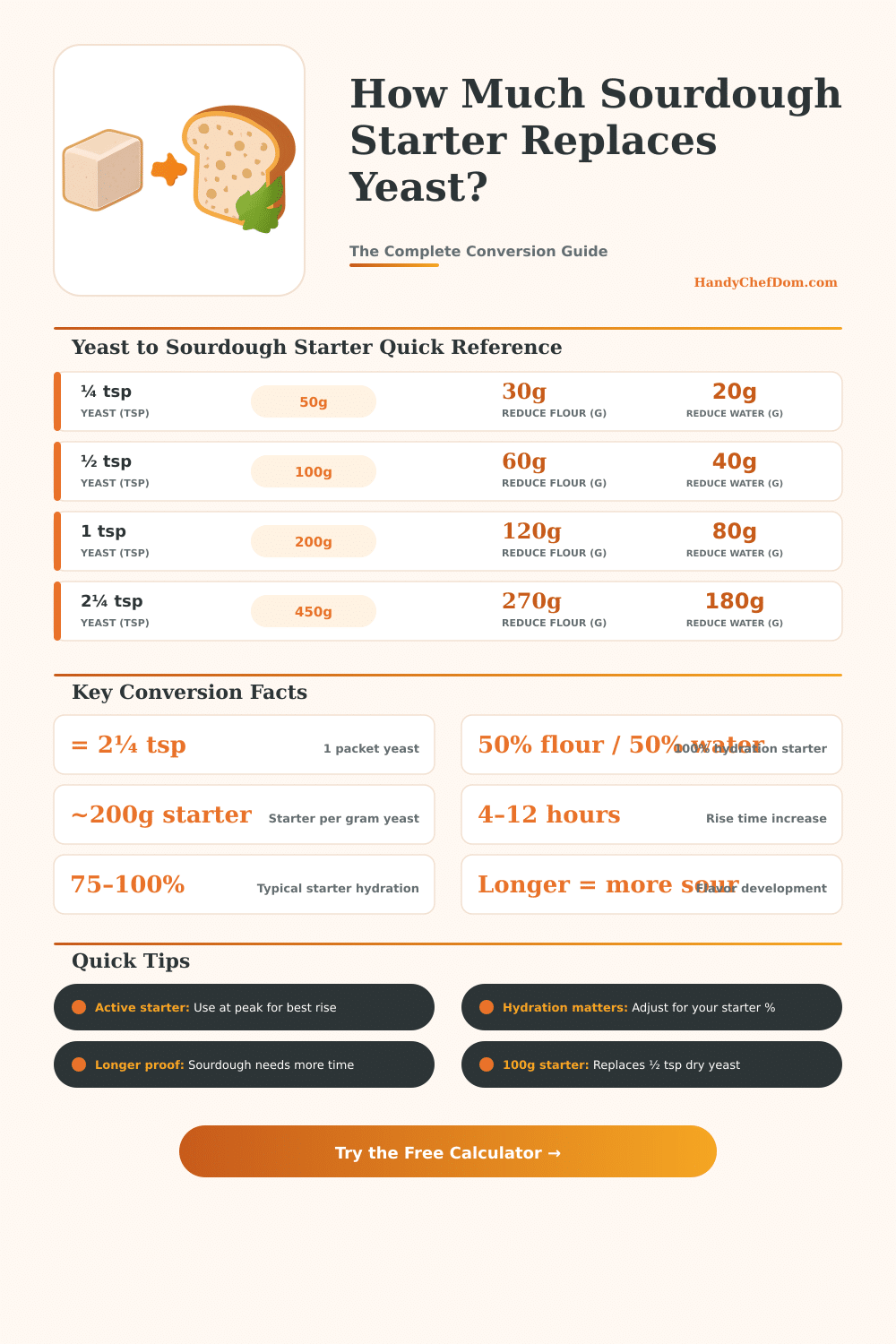
| Yeast Amount | Yeast Type | Starter Needed (100%) | Reduce Flour By | Reduce Water By |
|---|---|---|---|---|
| ¼ tsp (1g) | Active Dry | 50g (1.8 oz) | 25g | 25g |
| ½ tsp (1.5g) | Active Dry | 100g (3.5 oz) | 50g | 50g |
| 1 tsp (3g) | Active Dry | 200g (7 oz) | 100g | 100g |
| 1½ tsp (4.5g) | Active Dry | 300g (10.5 oz) | 150g | 150g |
| 2¼ tsp (7g) | Active Dry (1 pkt) | 450g (15.9 oz) | 225g | 225g |
| 1 tsp (3g) | Instant | 200g (7 oz) | 100g | 100g |
| 7g | Fresh / Cake | 150g (5.3 oz) | 75g | 75g |
| 14g | Fresh / Cake | 300g (10.6 oz) | 150g | 150g |
| Starter % of Flour | Room Temp (70°F / 21°C) | Warm (78°F / 26°C) | Result Profile |
|---|---|---|---|
| 5–10% | 12–16 hrs | 8–12 hrs | Mild sour, open crumb |
| 10–20% | 8–12 hrs | 5–8 hrs | Balanced flavor, standard |
| 20–30% | 5–8 hrs | 3–5 hrs | Faster rise, less sour |
| 30–50% | 3–5 hrs | 2–3 hrs | Quick rise, yeast-like |
| 50%+ | 2–4 hrs | 1–2 hrs | Very quick, mild flavor |
| Active Dry Yeast | Instant Yeast | Fresh Yeast | Sourdough Starter (100%) |
|---|---|---|---|
| 1 tsp (3g) | ¾ tsp (2.3g) | 8.4g | 200g |
| 2¼ tsp (7g) / 1 pkt | 1¾ tsp (5.5g) | 21g | 450g |
| 1 tbsp (9g) | 2¼ tsp (7g) | 25g | 600g |
| ½ oz (14g) | 3½ tsp (11g) | 42g | 900g |
Sourdough bread is made of dough, that rises naturally. Instead of store Yeast or chemicals like baking-powder or baking-soda, one depends on Sourdough culture for the rise. Sourdough culture is a live mix of flour and water that ferments the dough without any bought Yeast.
Naturally happening Yeast and bacteria of the type lactobacillus help in the rising to raise the dough. To create such culture, one needs both Yeast and those bacteria. Really, Yeast are fungi, not bacteria.
How to Make Sourdough Bread
During the rising, one produces lactic acid, what gives the bread its special flavor. The culture spreads by means of Yeast and bacteria, that float in the air of the kitchen.
Various kinds of culture mixes exist. One can prepare them at home, buy or receive from another baker. Making one from nothing is fully possible, or taking from a friend works well.
That forms a great way to launch the different experiences with Sourdough bread.
In Sourdough bread, the rising forms the main part. Getting the Yeast right takes around eighty percent of the whole work. If one cares about the Yeast, the loaves always come out good.
More simple are the steps of folding, shaping and gluten building. The Yeast itself are the hard element, that requires truth in the learning.
A base recipe for Sourdough bread relies mostly on flour for bread, with a bit of whole wheat or whole grain flour. Adding whole grains brings extra taste and detail. Such recipe adapts easily according too the available flours.
Newcomers benefit from using strong white flour for bread, that forms a reliable base.
Sourdough focaccia ranks among the simplest recipes for Sourdough bread. It needs basic ingredients, some folds and enough time to rise. One can use the Sourdough culture for more than only bread.
Muffins, crepes and cakes serve as chances to grow the baking options.
Sourdough bread entertains us. It is like a science test in the home kitchen. The process itself motivates quite a lot to try.
Carefully feed the culture, mix the dough and watch the rise in the bowl forms joyful life. Every person fits to Sourdough bread, even if one never baked before. The most hard step in its preparation is simply learning the secrets.
After one understands, thebaking itself becomes much more easy.
Good Sourdough bread should taste mildly sour and be chewy. The culture will have a sour smell, but that is normal. For a reason one called it Sourdough bread.