🍞 Sourdough Starter Calculator
Calculate how much starter to keep, discard, flour to add, water to add, target hydration, feed ratio, room-temperature peak time, fridge hold, and levain build amount.
Enter the levain you need for dough plus a reserve to keep. The calculator works backward from the final starter amount, your seed starter hydration, and the selected feed strength.
Fast counter feed for an already active starter, usually ready the same day.
Reliable default for bread formulas when you want clean lift and mild acidity.
Larger feeding slows the build, stretches the schedule, and keeps acidity softer.
Feed, allow activity to begin, then chill for a weekly maintenance jar.
Good for daily refreshes and quick same-day baking.
Default levain build for predictable timing.
Useful when the kitchen is warm or timing is longer.
Milder flavor and a longer peak window.
Lower hydration, firmer texture, slower acid development.
Looser starter that ferments quickly and pours easily.
Whole grain feeding wakes up a chilled or sleepy starter.
Tiny seed amount keeps discard low between bakes.
| Feed ratio | Hydration | Typical use | Room peak at 72-76 F | Flavor cue |
|---|---|---|---|---|
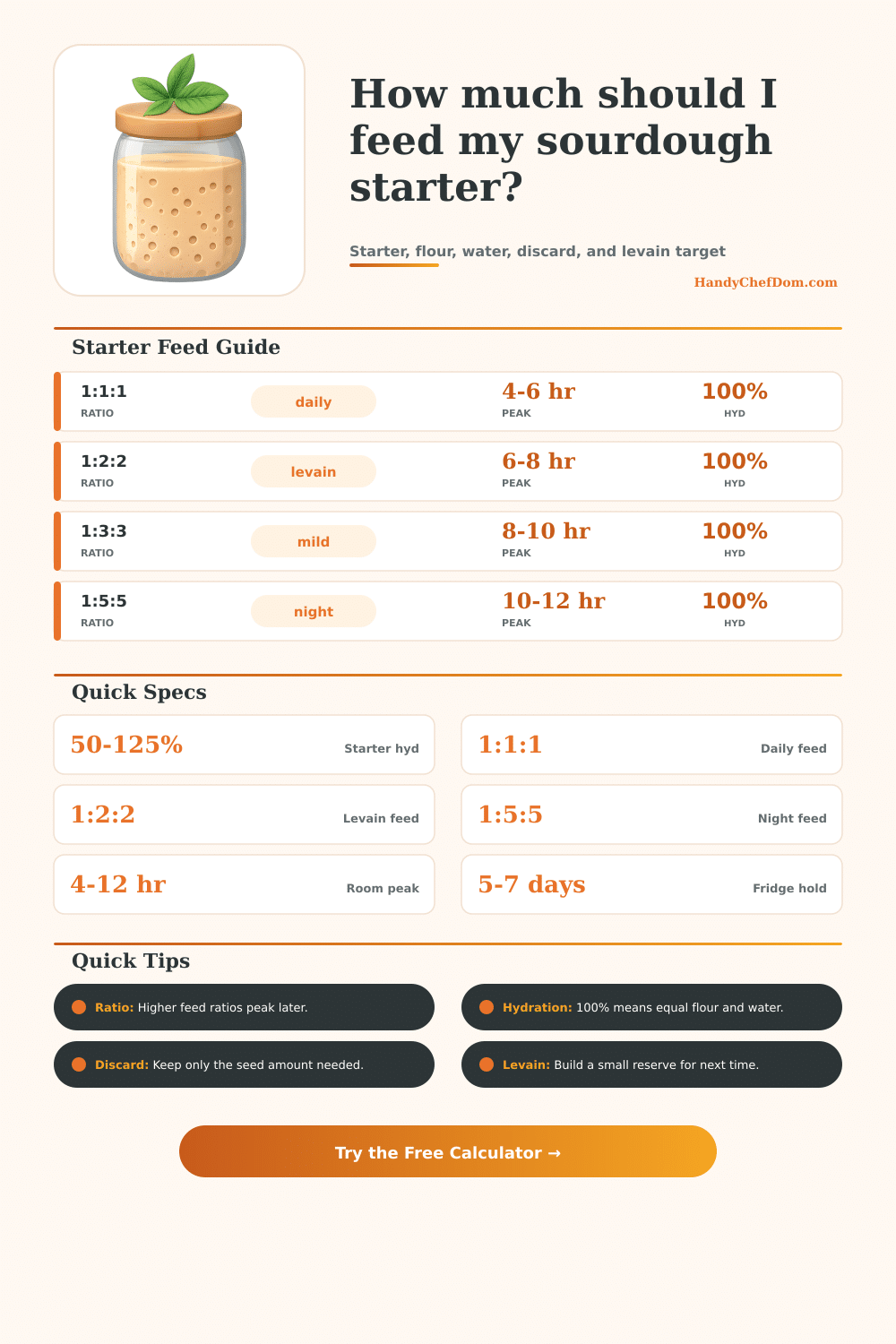
| 1:1:1 | 100% | Daily refresh or same-day bake | 4 to 6 hours | More starter-forward aroma |
| 1:2:2 | 100% | Balanced levain for most dough | 6 to 8 hours | Clean, mild sourdough note |
| 1:3:3 | 100% | Warm kitchen or longer timing | 8 to 10 hours | Softer acidity |
| 1:5:5 | 100% | Overnight levain or mild build | 10 to 12 hours | Mildest when used near peak |
| 1:2:1 | About 60% | Stiff starter or sweet dough levain | 7 to 10 hours | Less tang and firmer texture |
| Room temp | Activity speed | Best feed range | Schedule note |
|---|---|---|---|
| 60 to 64 F | Slow | 1:1:1 to 1:2:2 | Expect a long rise or use warmer water |
| 65 to 70 F | Moderate | 1:2:2 to 1:3:3 | Good overnight range for many kitchens |
| 71 to 76 F | Balanced | 1:2:2 to 1:5:5 | Standard levain timing window |
| 77 to 82 F | Fast | 1:3:3 to 1:5:5 | Use a larger feed to avoid early peak |
| 83 F plus | Very fast | 1:5:5 or stiff | Watch closely and use before collapse |
| Plan | Feed ratio | Room rest | Fridge hold | Refresh cue |
|---|---|---|---|---|
| Weekly jar | 1:3:3 | 1 to 2 hours | 5 to 7 days | Refresh when aroma turns sharp |
| Backup jar | 1:5:5 | 1 hour | 7 to 10 days | Use a small clean jar |
| Stiff storage | 1:2:1 | 1 to 2 hours | 7 days | Knead into a firm paste |
| Pre-bake wakeup | 1:2:2 | Until doubled | Skip fridge | Feed again if sluggish |
| Dough batch | Levain target | Reserve | Total build | Suggested ratio |
|---|---|---|---|---|
| One small loaf | 100 to 150 g | 15 to 25 g | 125 to 185 g | 1:2:2 |
| One large loaf | 180 to 240 g | 20 to 30 g | 215 to 285 g | 1:2:2 or 1:3:3 |
| Two loaves | 300 to 450 g | 25 to 40 g | 340 to 515 g | 1:3:3 |
| Overnight batch | 200 to 500 g | 25 to 50 g | 240 to 580 g | 1:5:5 |
To scale a sourdough starter, you must calculate how much flour, water, and sourdough starter culture are needed for a specific goal. Most people will attempt to guess the amount of each ingredient needed to scale the sourdough starter. However, guessing at the amount of ingredient will inevitablly lead to mistake.
To scale a sourdough starter correctly, you must determine the amount of active sourdough culture that you want to be present at a specific time and the amount of sourdough culture that you want to keep for your next feeding. Using these two amounts and your desired feeding ratio will allow you to calculate the total amount of sourdough starter that you will have. The feeding ratios for your sourdough starter is critical in determining both how fast your sourdough starter will peak and the flavor of your sourdough starter.
How to Measure and Feed Your Sourdough Starter
If you want your sourdough starter to peak quickly, use a large feeding ratio. If you want to slow the peak of your sourdough starter, use a small feeding ratio. The type of flour and the temperature of the sourdough starter will also affect the feeding ratio that you use.
You must account for these variables when calculating the feeding ratios of your sourdough starter. The online sourdough starter calculator will ask you for the amount of levain that you want to create, the amount of seed starter that you want to keep, and your feeding ratio. You will also have to input the current hydration of your sourdough starter.
The hydration of your sourdough starter will ultimately affect the hydration of your sourdough starter mixture. Furthermore, the online sourdough starter calculator accounts for a buffer that is added to your sourdough starter. This small amount of sourdough starter is added to account for the amount of sourdough starter that will stick to the spoon used to transfer your sourdough starter from it’s jar.
The buffer ensures you do not end up with too little sourdough starter once you transfer it from the jar. Most people will consider the amount of sourdough starter that is discarded as waste. However, this portion of the sourdough starter is the amount of sourdough starter that is not needed for the current recipe that is being prepared.
If you accurately weigh the amount of seed starter that you add to the sourdough starter, you can calculate the amount of sourdough starter that will be discarded. You can use this discarded portion of sourdough starter for other recipes or you can choose to discard it altogether. Your decision will be based off the weight of the sourdough starter calculated by the online sourdough starter calculator.
The temperature of the room in which you will leave your sourdough starter to peak and the schedule that you follow will affect the rate at which your sourdough starter peaks. If the room in which you leave your sourdough starter to peak is warm, the sourdough starter will reach its peak faster. Conversely, if the temperature of the room is cool, the sourdough starter will take longer to reach its peak.
The sourdough starter calculator will ask for the temperature of the room in which you will leave the sourdough starter. It will also ask for the number of hours that you will be available for feeding your sourdough starter. Using this information, the sourdough starter calculator will provide you with a suggested schedule for feeding your sourdough starter to ensure that it is ready when you need it.
The type of flour that you use in your sourdough starter will also affect how fast the sourdough starter reaches its peak. If you use whole grain flour or rye flour, your sourdough starter will reach its peak faster then if you used only white bread flour. This is due to the fact that whole grain and rye flours contains more minerals and enzymes than do white bread flours.
The sourdough starter calculator will ask for the type of flour you will be using. This will help to provide you with an accurate estimate of the time that it will take for your sourdough starter to peak. When storing your sourdough starter in the refrigerator, you will have to follow a different set of maintenance routines than you would follow with sourdough starter that is kept at room temperature.
You must provide your sourdough starter with enough food to maintain its health while it is stored in the refrigerator. However, you do not need to provide it with enough food to make the sourdough starter reach its peak. Using a moderate feeding ratio with a short rest for your sourdough starter at room temperature will allow your sourdough starter to be stored safely for five to seven days in the refrigerator.
However, if you intend to store your sourdough starter in the refrigerator for extended periods, the sourdough starter may become very acid. Acidic sourdough starter may require extra feedings to become as strong as it should of been again. The most common mistake when feeding your sourdough starter involve not weighing the seed starter and not feeding a buffer to the sourdough starter.
If you do not weigh the seed starter, you will end up with an inaccurate feeding ratio. Using an inaccurate feeding ratio can cause the sourdough starter to become too large or too small. Furthermore, not feeding a buffer to the sourdough starter can also cause you to end up with too little sourdough starter.
Some of the sourdough starter may stick to the tools used to feed the sourdough starter. Using the sourdough starter calculator, you will know how much flour, water, and sourdough starter to discard. However, you are still responsible for feeding your sourdough starter to ensure that it is ready to use.
To determine if your sourdough starter is ready, you must observe it. When the sourdough starter is ready, it will be domed and expanded. If the sourdough starter has collapsed or smells very sharp, it may not be ready yet.
While the sourdough starter calculator can provide you with a plan based on mathematics, you will have to use your sourdough starter observations to determine if your sourdough starter is ready to use.