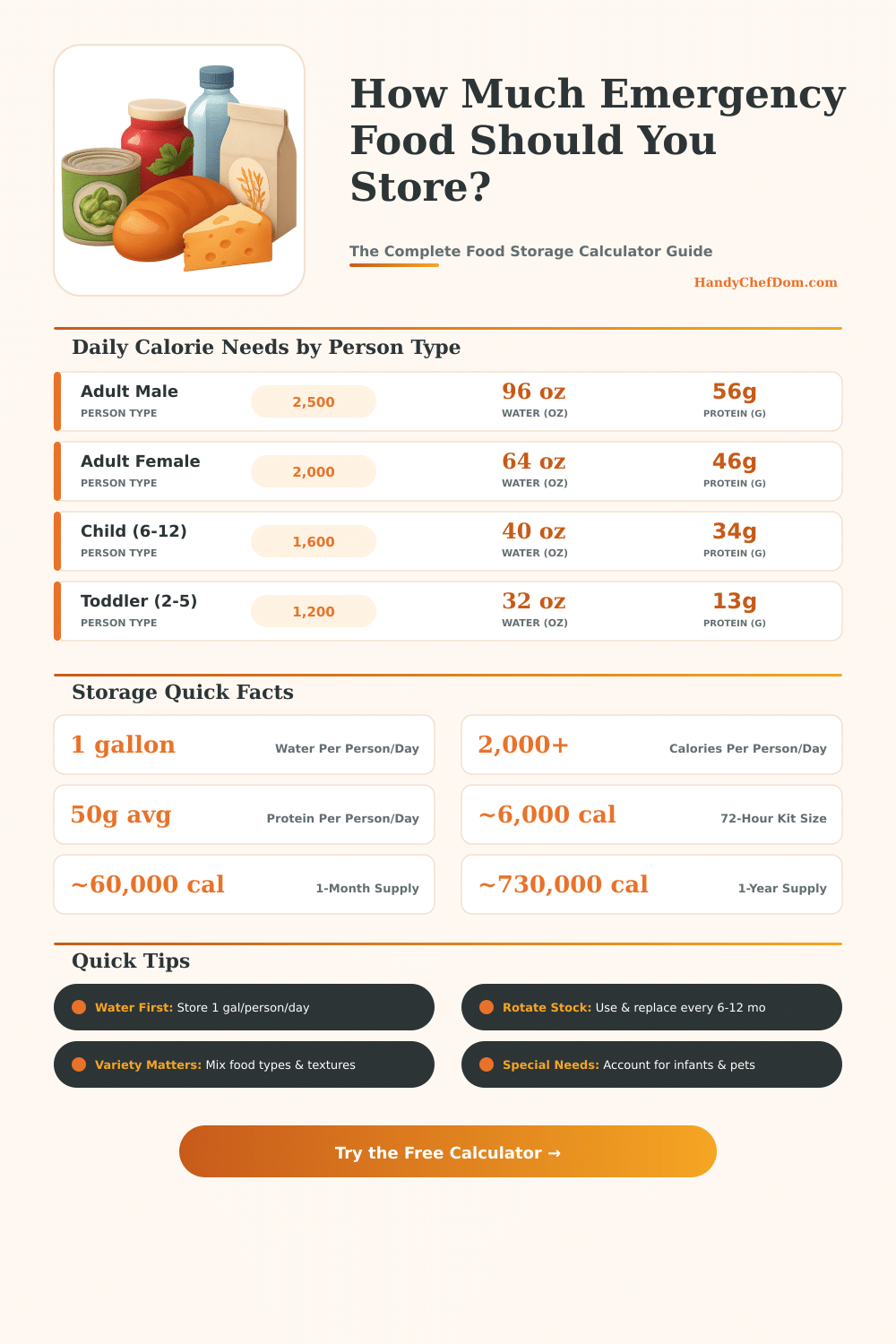
🥫 Emergency Food Storage Calculator
Calculate exactly how much food & water your household needs for any emergency duration
| Person Type | Calories/Day | Protein (g) | Water (oz) | Water (liters) | Activity Adj. |
|---|---|---|---|---|---|
| Adult Male (19–50) | 2,500 | 56g | 101 oz | 3.0 L | +300–600 cal |
| Adult Female (19–50) | 2,000 | 46g | 74 oz | 2.2 L | +200–400 cal |
| Elderly Male (65+) | 2,000 | 56g | 84 oz | 2.5 L | +100–200 cal |
| Elderly Female (65+) | 1,600 | 46g | 64 oz | 1.9 L | +100–200 cal |
| Child (6–12 yrs) | 1,600 | 34g | 57 oz | 1.7 L | +150–300 cal |
| Toddler (2–5 yrs) | 1,200 | 13g | 40 oz | 1.2 L | +100 cal |
| Infant (<2 yrs) | 800 | 11g | 25 oz | 0.75 L | — |
| Food Category | Amount (lbs) | Amount (kg) | Calories | Shelf Life |
|---|---|---|---|---|
| Grains (rice, wheat, oats) | 25 lbs | 11.3 kg | ~37,500 | 25–30 yrs |
| Legumes (beans, lentils) | 5 lbs | 2.3 kg | ~7,700 | 25–30 yrs |
| Canned Vegetables | 6 lbs | 2.7 kg | ~1,800 | 3–5 yrs |
| Canned Fruits | 4 lbs | 1.8 kg | ~2,400 | 3–5 yrs |
| Canned / Dried Meat | 5 lbs | 2.3 kg | ~5,600 | 2–5 yrs |
| Fats & Oils | 2 lbs | 0.9 kg | ~7,000 | 1–4 yrs |
| Sugars & Honey | 3 lbs | 1.4 kg | ~5,400 | Indefinite |
| Dairy (powdered milk) | 3 lbs | 1.4 kg | ~4,800 | 2–5 yrs |
| Salt & Seasonings | 0.5 lbs | 0.23 kg | — | Indefinite |
| Multivitamins | — | — | — | 1–2 yrs |
| Duration | Total Calories (1 adult) | Water – 1 Person (gal) | Grains (lbs) | Protein Foods (lbs) |
|---|---|---|---|---|
| 72 Hours | 6,000 | 3 gal | 1.5 lbs | 0.75 lbs |
| 1 Week | 14,000 | 7 gal | 3.5 lbs | 1.75 lbs |
| 2 Weeks | 28,000 | 14 gal | 7 lbs | 3.5 lbs |
| 1 Month | 60,000 | 30 gal | 25 lbs | 7.5 lbs |
| 3 Months | 180,000 | 90 gal | 75 lbs | 22.5 lbs |
| 6 Months | 360,000 | 180 gal | 150 lbs | 45 lbs |
| 1 Year | 730,000 | 365 gal | 300 lbs | 90 lbs |
Dangerous food storage deals with planning for moments when everything fails. Situations like power cuts, little flooding or strong snowstorms can isolate folks from the outside during one or two days. The basic advice for dangerous supply of food and water is enough for three days so 72 hours.
Even so some plans surpass that minimum.
Emergency Food: What to Store and How to Use It
The 3-month dangerous food storage kit from Ready Hour gives more than 2 000 calories daily to stay alive. It stores 22 different meals, packed in sturdy, very rugged tins designed for long emergencies. Readywise offers also 30-day supply with 296 rations in two buckets, including freeze-dried protein-rich meals and up to 25 years of shelf life.
Wise Company has another option, that provides to one person 1 800 calories a day during 30 days, with 298 rations entirely and 50 grams of protein daily.
Cooking is mostly easy. Most of those kits simply require adding water. Popular choices are beef lasagna, morning breakfast and spring soup.
Varieties play a big role. From morning breakfasts and cereal mixes until tasty dinners like macaroni with chili or teriyaki chicken, everything that helps to escape tiredness of the appetite, which can become a danger in long survival situations.
Not each one chooses the freeze-dried mode. Collecting canned foods, dry mixes and basic stuff, that does not require a fridge or kitchen, makes sense after a catastrophe. Canned vegetables, fish, fruits, beans and fast noodles easily last.
Dried grains like rice, barley, chopped oats, soup, beans, lentils and meat jerky also have really long shelf life, if one keeps them well.
The main point is buy foods with long shelf life, that one eats commonly and rotate the stocks. One sometimes calls that deep food storage. Whatever food one preserves, it must taste well and be easily kept.
Even if one advertises more than 25 years of shelf life, one requires good conditions for storage. Practicing to eat dangerous food once a month from the supplies helps to control, weather it really pleases.
Dehydrated food even so still has a bit of moisture, that allows bacteria to grow over time. Dehydration only slows the decay, but does not halt it fully. Freeze-dried food usually stays much more long.
Cooking in emergency forms another problem. When electricity lacks or natural gas is not available, having a mode to prepare the stored foods becomes key. Widely, foods in emergency kits should be ready to eat without cooking.
Even so adding soups and warm cocoa can help keep the body heat in good state. The Program of Dangerous Food Help is a federal effort, that backs the feeding of poor folks by means of free dangerous food.
The Banquet of Chef offers a 30-day plan with shelf life of 10 until 30 years, according to the kind of food. How much food one buys, depends onthe people and personal needs.