Fat Per Food Calculator
Switch between portion planning, fat target planning, and batch yield planning to estimate food fat, serving balance, and raw-to-cooked needs with one workflow.
📌Quick Presets
📊Food Fat Snapshot
⚙Calculator Inputs
Pick a food profile and planning mode, then estimate total fat and portion balance with yield and prep loss included.
Atlantic salmon fat snapshot
Values combine food density, serving plan, trim loss, and raw-to-cooked yield for practical kitchen prep.
📐Serving Size Grid
📋Yield and Quantity Tables
Raw-to-Cooked Yield Reference
| Food | Yield | Fat/100g | Std Serve |
|---|---|---|---|
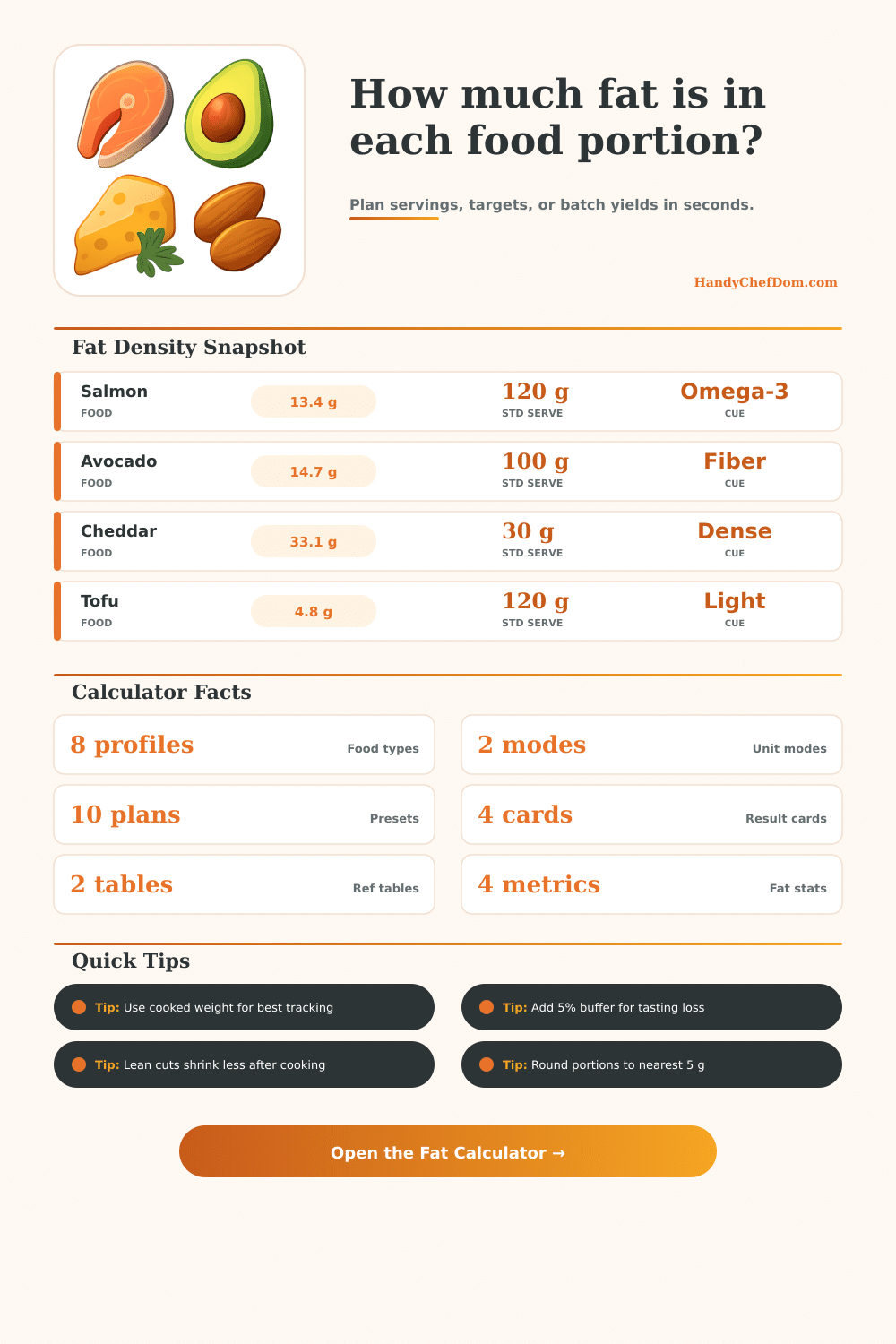
| Atlantic salmon | 0.86x | 13.4 g | 120 g |
| Ground beef 80% | 0.74x | 21.8 g | 100 g |
| Chicken thigh | 0.77x | 10.9 g | 130 g |
| Pork shoulder | 0.70x | 18.6 g | 110 g |
| Avocado flesh | 0.98x | 14.7 g | 100 g |
| Almonds | 1.00x | 49.9 g | 30 g |
| Cheddar cheese | 1.00x | 33.1 g | 30 g |
| Firm tofu | 0.94x | 4.8 g | 120 g |
Common Group Quantities
| Group size | Lean fish | Poultry | Rich food |
|---|---|---|---|
| 4 people | 480 g cooked | 520 g cooked | 360 g cooked |
| 6 people | 720 g cooked | 780 g cooked | 540 g cooked |
| 12 people | 1.44 kg cooked | 1.56 kg cooked | 1.08 kg cooked |
| 25 people | 3.00 kg cooked | 3.25 kg cooked | 2.25 kg cooked |
🧪Nutrition Grid
💡Tips
Planning meals around fat content requires understanding how fat content can change during a cooking process. Fat content change due to food losing moisture and fat during the cooking process, and fat content changes due to the need to trim fat from food prior to cooking. For instance, salmon will lose a considerable amount of it’s raw weight during the cooking process due to the fat content and the loss of moisture from the salmon fillets.
However, almonds will not lose any of there raw weight during the cooking process. Understanding how fat content can change during the cooking process will allow for people to understand how to hit the nutritional targets that they desires for there meals, as well as to avoid buying too much or too little food for those meals. Many meal planners makes the mistake of planning meals according to the weight of the food when it is cooked.
How Cooking Changes the Fat and Weight of Food
However, people must also take into consideration the raw weight of the food. For instance, the raw weight of a cut of pork may change once it has cooked through the braising process, but the raw weight of an avocado will not change once it is prepare for cooking. In order to take into consideration the changes in raw weight of food that will be cooked, a meal planning calculator can be used.
Using such a calculator allow for people to avoid the guesswork in meal planning. There are two main ways that people can plan for the fat content of food that will be cooked for individuals. The first is known as portion planning, wherein people decide on the size of portion that they would like to provide to the individuals that will eat the prepared meals.
With portion planning, people can calculate how much fat will end up on the plates of those individuals. The second method for planning meals for fat content is target planning, wherein people decide how many gram of fat they would like to provide to each individual, and then they can calculate the amount of the food that will contain that amount of fat when it is cooked. Both of these methods are effective methods of meal planning for foods that contains fat.
Adjustment profiles are necessary for food preparation plans to account for the fact that kitchens are not always perfectly efficient in there food preparation. An adjustment profile of five percent may account for the food that sticks to the cutting board, or the amount of food that is tasted during the cooking process. In settings like buffets, however, an adjustment profile that is more larger than five percent may be required, as customers will take larger portions of food at a buffet setting, as well as take second helpings of food.
In ignoring the adjustment profiles when preparing meals, cooks may find themself with insufficient food to prepare for all of the individuals that are to taste the meals. Foods change in different ways when heat is applied to those foods. For instance, meats that contains more fat will shrink less than proteins that contain less fat.
Additionally, the lean proteins will contain less fat per gram of that protein when it is cooked. Thus, cooks can choose between buying lean proteins to reduce the fat content of their meals, or buying proteins that contain more fat so that each individual eats enough fat with each meal. The method in which a food is cooked can change the fat content of that food.
For instance, braising a pork shoulder will result in the pork shoulder losing less moisture than if the pork is roasted. In contrast, dry-roasting almonds will not lead to the almond losing any of its moisture. Thus, changing the food in the meal planning calculator will change the effect that heat has upon those foods.
Batch planning is not the same as portion planning. Batch planning calculates the raw weight of food that will be needed for a group of individuals. For instance, the raw weight of tofu will be less than the raw weight of beef for a group of twelve individuals, since tofu will lose less raw weight during the cooking process than beef has for its fat density.
Different foods behave differently when heat is applied to the food. Thus, cooks may need to recognize these differences in order to make a decision as to whether to change the menu items for the kitchen, or to buy more of a specific food item. Common mistakes when meal planning include treating each food the same way.
People often do not consider that the raw weight of the food may not be the same as its cooked weight. For instance, the raw weight of cheese may not be the same as the cooked weight of salmon. Thus, cooks that do not consider the yield that each food will produce will either find that the fat content of the meal is too richly, or that they will find that they have exhausted their protein supplies before all of the individuals in the kitchen have had a chance to eat.
Simply by plugging the numbers into the meal planning calculator, cooks can find various patterns within the meal planning process. For instance, if the numbers are run with an balanced adjustment, and then again with a much larger adjustment, cooks can see the difference in the raw weights of the food that they need to purchase. These differences can help cooks to determine if there is any buffers in the shopping list for the kitchen, or if they are underbuying food for those large groups of individuals that are to taste the meals.
Additionally, cooks may eventually find patterns in which different foods require adjustments to there raw weights, such as almonds or pork shoulder. Thus, cooks will eventually be able to adjust their shopping lists to provide the proper amount of each food.