🌡️ Convection Oven Converter
Convert conventional oven temperature & cooking time to convection oven settings instantly
| Conventional (°F) | Convection Temp (°F) | Original Time | Convection Time | Reduction |
|---|---|---|---|---|
| 275°F | 250°F | 90 min | 67–68 min | –25% |
| 300°F | 275°F | 75 min | 56–57 min | –25% |
| 325°F | 300°F | 60 min | 45 min | –25% |
| 350°F | 325°F | 45 min | 34 min | –25% |
| 375°F | 350°F | 30 min | 22–23 min | –25% |
| 400°F | 375°F | 25 min | 19 min | –25% |
| 425°F | 400°F | 20 min | 15 min | –25% |
| 450°F | 425°F | 15 min | 11–12 min | –25% |
| 475°F | 450°F | 12 min | 9 min | –25% |
| 500°F | 475°F | 10 min | 7–8 min | –25% |
| Conventional (°C) | Convection Temp (°C) | Original Time | Convection Time | Reduction |
|---|---|---|---|---|
| 140°C | 125°C | 90 min | 67–68 min | –25% |
| 150°C | 135°C | 75 min | 56–57 min | –25% |
| 160°C | 145°C | 60 min | 45 min | –25% |
| 170°C | 155°C | 50 min | 37–38 min | –25% |
| 180°C | 165°C | 45 min | 34 min | –25% |
| 190°C | 175°C | 35 min | 26–27 min | –25% |
| 200°C | 185°C | 30 min | 22–23 min | –25% |
| 210°C | 195°C | 25 min | 19 min | –25% |
| 220°C | 205°C | 20 min | 15 min | –25% |
| 230°C | 215°C | 15 min | 11–12 min | –25% |
| °F | °C | Gas Mark | Description |
|---|---|---|---|
| 275°F | 135°C | Gas 1 | Very Low / Slow |
| 300°F | 150°C | Gas 2 | Low |
| 325°F | 163°C | Gas 3 | Moderately Low |
| 350°F | 177°C | Gas 4 | Moderate |
| 375°F | 191°C | Gas 5 | Moderately Hot |
| 400°F | 204°C | Gas 6 | Hot |
| 425°F | 218°C | Gas 7 | Hot |
| 450°F | 232°C | Gas 8 | Very Hot |
| 475°F | 246°C | Gas 9 | Very Hot |
| 500°F | 260°C | Gas 10 | Extremely Hot |
A convection oven recipe tool is a practical aid that allows you to change recipes originally done for regular ovens so that they work for convection ovens. In convection ovens warm air moves around, which means that cooking food happens more quickly and more evenly than in regular ovens. That moving heat also helps to better browning of the surface and to a more juicy result.
Some foods even stay more well kept when you cook like this.
How to change recipes for a convection oven
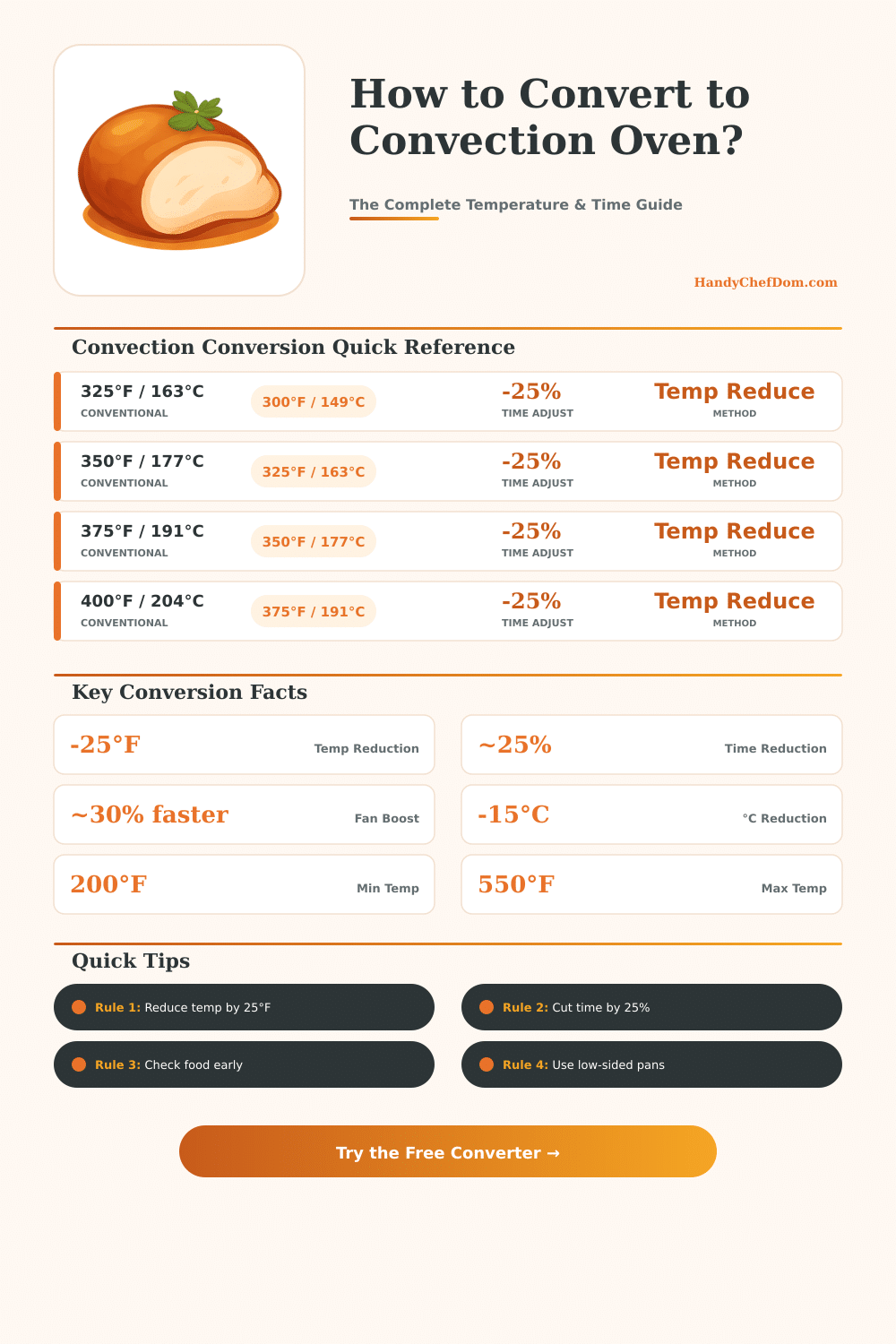
The main idea for changing recipes is quite easy. You can either lower the heat or shorten the time of cooking. The most used advice is to lower the temperature of the oven by 25 degrees Fahrenheit.
Like this, if a recipe says to cook at 350 degrees in a normal oven, for a convection oven you use 325 degrees. For breads, cakes and similar sweets, lower the heat by 25 degrees while you leave the time unchanged, commonly works well.
You can also keep the same heat, but shorten the time for cooking. Check the food at three quarters of the orginal time. Some foods need 20 to 40 percent less time.
Vegetables usually need a bigger cut, while meats only a bit. Always watch the cooking, so that it browns evenly, because in a convection oven food can burn more quickly.
Also, you can do the opposite change. To change a recipe from convection oven to standard oven, simply add 25 degrees Fahrenheit too the temperature. This does not need complex science.
Online there are calculators for convection oven conversion that automatically do the math. You just enter the original heat and time, and the program gives the new values. Some new ovens have a built-in automatic adapter for temperature.
For instance, one model from GE costs 50 dollars more than similar ones, only because of the automatic conversion for convection oven mode, that changes the heat for regular recipes.
Ovens with a fan, convection ovens and air fryers are basically similar. When you switch from a fan oven to a simple one, the general advice is to add 15 to 20 degrees Celsius to the temperature. Convection ovens have a system with a fan that blows warm air around, which boosts the heat on the surface and gives food an extra crusty texture.
Even so each oven differs a bit. The rule of 25 degrees is only a rough guide. It helps well for stuff with long cooking, like sweet breads.
But for quickly cooked items, it maybe does not work. Always check the food 5 to 10 minutes before the end of thetime. That helps to avoid overcooking, while you learn how your particular convection oven works.