🍺 Homebrew Carbonation Calculator
Calculate priming sugar & keg pressure for perfect CO₂ carbonation in your beer, cider, or soda
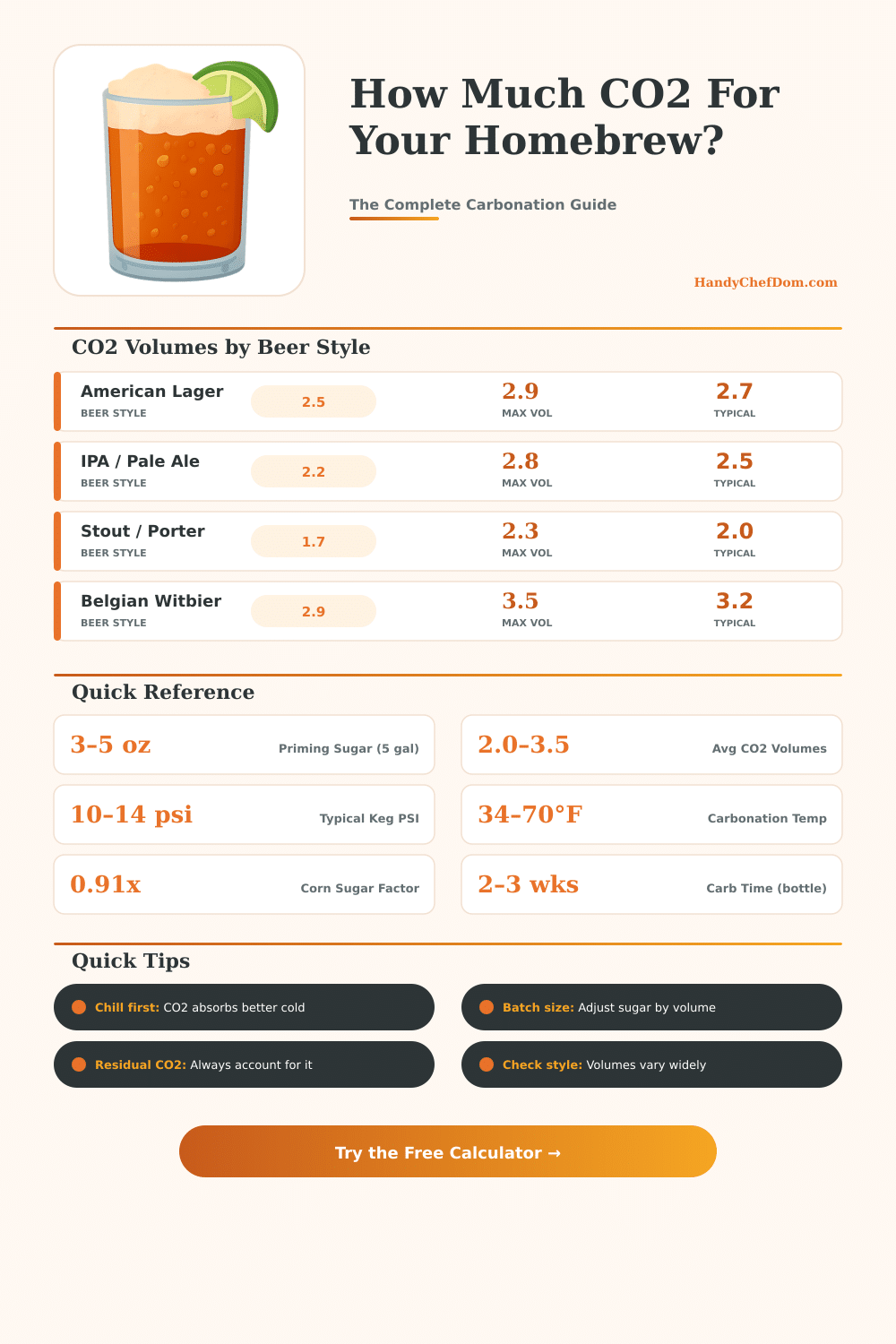
| Beer Style | Min Volumes | Max Volumes | Recommended |
|---|---|---|---|
| American Lager / Lite Beer | 2.5 | 2.9 | 2.7 |
| IPA / American Pale Ale | 2.2 | 2.8 | 2.5 |
| English Bitter / Mild | 1.5 | 2.1 | 1.8 |
| Stout & Porter | 1.7 | 2.3 | 2.0 |
| Hefeweizen / Wheat Beer | 2.7 | 3.5 | 3.1 |
| Belgian Witbier | 2.9 | 3.5 | 3.2 |
| Belgian Tripel / Strong | 3.0 | 3.8 | 3.4 |
| Saison / Farmhouse | 3.0 | 3.5 | 3.2 |
| Lambic / Gueuze | 3.0 | 4.5 | 3.8 |
| Hard Cider | 2.5 | 3.5 | 3.0 |
| Homebrew Soda | 3.5 | 4.5 | 4.0 |
| CO₂ Volumes | PSI (at 38°F) | PSI (at 40°F) | PSI (at 34°F) |
|---|---|---|---|
| 1.8 vol | 4.5 psi | 5.6 psi | 2.9 psi |
| 2.0 vol | 6.2 psi | 7.5 psi | 4.4 psi |
| 2.3 vol | 8.8 psi | 10.4 psi | 6.7 psi |
| 2.5 vol | 10.8 psi | 12.6 psi | 8.4 psi |
| 2.7 vol | 12.8 psi | 14.9 psi | 10.1 psi |
| 3.0 vol | 15.7 psi | 18.1 psi | 12.8 psi |
| 3.5 vol | 21.3 psi | 24.3 psi | 17.8 psi |
| Sugar Type | Relative Factor | oz per 5 gal (2.5 vol) | g per 19L (2.5 vol) |
|---|---|---|---|
| Corn Sugar (Dextrose) | 1.00x (baseline) | 4.1 oz | 116 g |
| Table Sugar (Sucrose) | 0.91x | 3.8 oz | 107 g |
| Honey (raw) | 1.33x | 5.5 oz | 154 g |
| Dry Malt Extract (DME) | 1.54x | 6.3 oz | 178 g |
| Brown Sugar | 0.93x | 3.8 oz | 108 g |
| Maple Syrup | 1.56x | 6.4 oz | 181 g |
| Temperature °F | Temperature °C | Residual CO₂ (vol) | Notes |
|---|---|---|---|
| 32°F | 0°C | 0.85 | Near freezing |
| 38°F | 3°C | 0.75 | Fridge temp |
| 45°F | 7°C | 0.65 | Cold ale temp |
| 55°F | 13°C | 0.55 | Cellar temp |
| 60°F | 16°C | 0.50 | Basement |
| 65°F | 18°C | 0.46 | Room – cool |
| 68°F | 20°C | 0.44 | Typical ale ferment |
| 72°F | 22°C | 0.41 | Warm room |
| 75°F | 24°C | 0.39 | Warm ale / saison |
Homebrew is one of those words whose meaning changes according to the listener. Depending on the situation, it can mean home beer brewing, a package manager for Mac and Linux systems, amateur creations for tabletop games like D&D or even new games on old game consoles. Every kind has its own loyal fans and separate charm.
In the software world operates Homebrew, open-source, free package manager that simplifies the install of programs on macOS and Linux. The name itself shows its point: it allows you to add programs to your Mac as you wish, shaped for your needs. Basically it adds everything that is missing in your system originally.
Different Types of Homebrew
Based on Git and Ruby, it fits well with GitHub, so you can adjust it freely. It targets mainly developers that work in the terminal. Here the best part: everything takes less than 100 MB on a new Mac.
On top of that, Homebrew runs as nonprofit, backed only by volunteers that depend on gifts to pay licenses, hosting costs and server care.
Installing and launching Homebrew is easy, one command in the terminal downloads it from GitHub. It works on macOS and Linux currently. After install, you can add many tools: tools for command lines of Amazon Web Services, better auto-complete for teh terminal, calculators, file keys, whatever you want.
We pass to the real home brewing now. It deals with beer, wine, cider and mead. Newcomers commonly start with malt extract, that truly gives good beer without much effort.
Complete starter kits are available at stores like Northern Brewer or Austin Homebrew. One can start small with a one-gallon malt kit or go directly to specific ingredients in bags. Many home brewers choose a batch of around 19 liters, that matches 5 American gallons, because it fits ideally in Cornelius kegs, which many favor for storage of beer.
The hobby truly saves money over time, although it means expenses four ingredients and equipment. One can start for under 100 dollars. There are calculators for yeast readings and starters, that help with second fermentation, liquid yeast, slurry or homemade starters.
Programs like Brewer’s Friend offer tools to create recipes, count and plan days for specific beer.
Many people enter home brewing because of very different reasons. Some target contests and want to perfectly reach a certain style. Others do that because buying average beer costs too much.
Some simply want to create something entirely original. Whatever is your motivation, everything starts with a good recipe. Online groups and forums are worth gold for sharing ideas and solving problems with fermentation or tools.
For tabletop gaming, homebrew means custom creations; for example backgrounds, magic objects, monsters and spells from D&D 5th edition, designed by anyone. A good starting point is to take a spell that already is almost perfect, compare it with similar ones, then adjust it to your idea.
Home video games on old devices is another topic. It concerns the experience of entirely new games on ancient gear, from earlybuilds to finished physical copies.