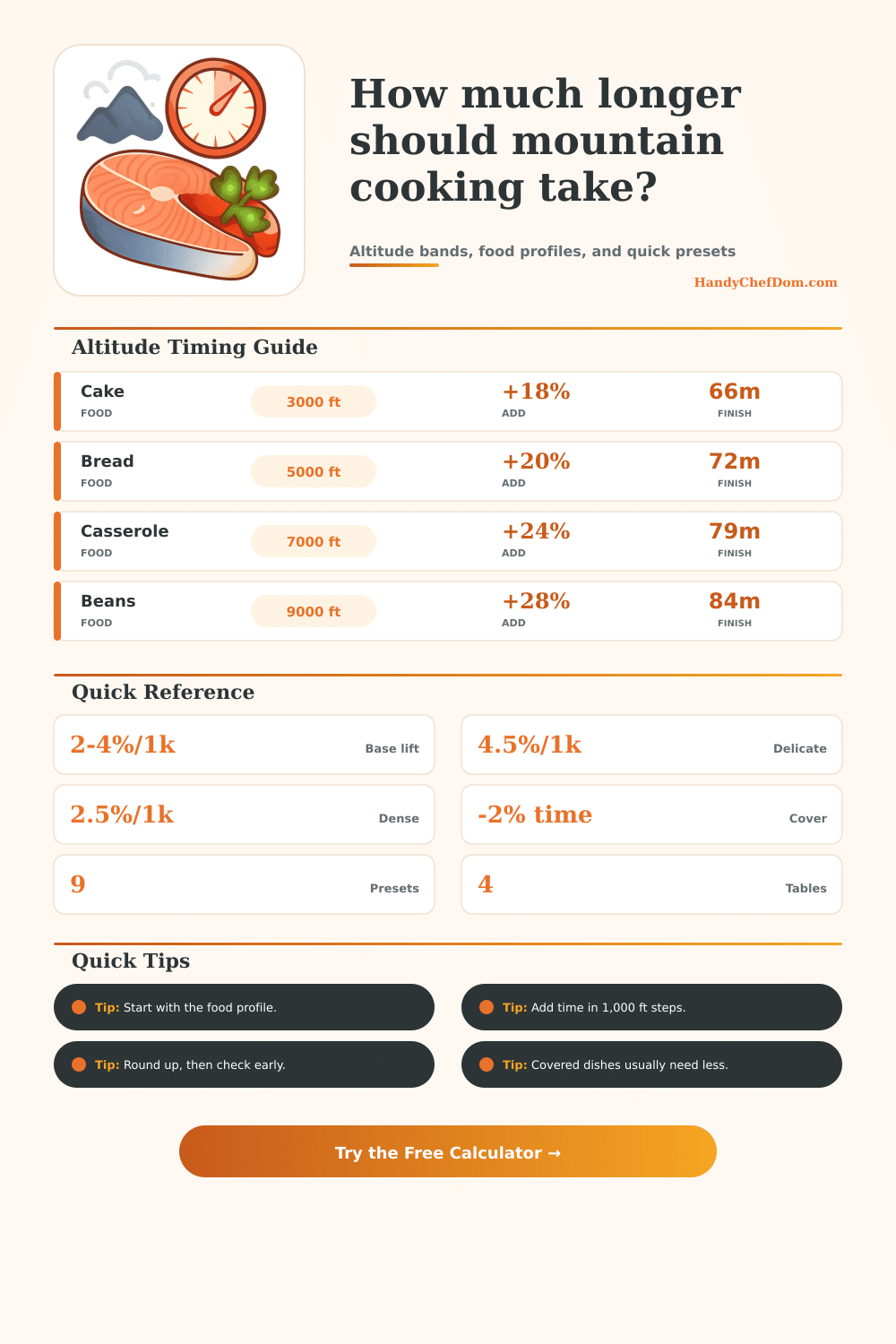
High Altitude Cooking Time Adjustment Calculator
Estimate how much extra time a recipe needs at elevation, then fine-tune the result for cover, batch size, and food style.
Choose the food profile, base time, altitude, and dish style. The calculator turns those details into a mountain-friendly cooking window.
Mountain timing snapshot
See the base time, altitude lift, batch load, and early-check window in one clear view.
| Band | Typical | Delicate | Dense |
|---|---|---|---|
| 0-2000 ft | 0-6% | 4-8% | 0-4% |
| 2000-4000 ft | 6-12% | 8-15% | 4-8% |
| 4000-6000 ft | 12-18% | 15-22% | 8-12% |
| 6000+ ft | 18-28% | 22-35% | 12-18% |
| 9000+ ft | 24-32% | 28-40% | 16-22% |
| 12000+ ft | 28-36% | 32-45% | 18-25% |
| Profile | Rate | Cover | Note |
|---|---|---|---|
| Layer cake | 4.5% | -1% | Soft crumb |
| Quick bread | 4.0% | -1% | Fast lift |
| Loaf bread | 3.6% | -1% | Needs gas |
| Casserole | 3.0% | -2% | Moist dish |
| Roast | 2.5% | -2% | Dense cut |
| Beans | 3.8% | -2% | Long simmer |
| Condition | Adj. | Use | Effect |
|---|---|---|---|
| Open dish | 0% | Light bake | Full lift |
| Foil tent | -1% | Mid bake | Gentler |
| Covered | -2% | Moist dish | Less loss |
| Lid on | -3% | Closed pan | Slow hold |
| Small pan | 0% | Thin layer | Quick set |
| Deep pan | +6% | Heavy fill | More time |
| Preset | Base | Alt | Finish |
|---|---|---|---|
| Sea Level Casserole | 45m | 0 ft | 45m |
| Denver Cake | 38m | 5200 ft | 55m |
| Aspen Bread | 52m | 7800 ft | 70m |
| Rockies Beans | 68m | 9000 ft | 88m |
| Lake Tahoe Roast | 95m | 6200 ft | 115m |
| Summit Rice | 32m | 10400 ft | 43m |
Cooking at high altitude require an understanding of the effect of atmospheric pressure on food. Cooking at high altitude also require adjustments to the cooking times and temperatures of food. When cooking at high altitudes, the atmospheric pressure surrounding the food is lower then at sea level.
Lower atmospheric pressures causes water to boil at lower temperatures. Because cooking liquids boil at lower temperatures at high altitudes, moisture from food evaporate more quick. The rapid evaporation of moisture from food causes the exterior of food to cook more quick than the interior of food.
How to Cook at High Altitude
The effect of atmospheric pressure on food isnt the same for all types of foods. For instance, cakes are a type of food that is delicate to high temperatures because the leavening agents in cakes can cause the cakes to collapse when exposed to high temperatures. Foods like dense meats and legumes requires high cooking temperatures to denature the proteins in those foods, so cooks must make an adjustment to the cooking times for these foods at high altitudes to account for the lower boiling point of water.
Cooking calculators can assist cooks in adjusting cooking times for high altitudes by first prompting the cooks to select the type of food that they are preparing. Different types of food require different amounts of time to fully cook, so cooks needs to account for these differences. Cooking calculators use the elevation of the cooks kitchens to calculate the amount of adjustment that must be made to the cooking times of specific food profiles.
Additionally, cooks can use different methods of covering the food that they are preparing. For instance, if a cook covers food with a lid or foil tent, the steam trapped beneath the lid will help to prevent moisture loss from the food. By trapping steam, covering food will reduce the cooking times for food prepared at high altitudes.
Maintaining moisture during the cooking process will ensure that roasts, for instance, will remain juicy rather than dry. Another adjustment that must be made to cooking processes at high altitudes is in the amount of time that cooks should prepare deep pans of food. Deep pans of heavy casseroles contains more thermal mass than smaller amounts of food.
Because of the thermal mass of deep pans of casseroles, cooks must prepare deep pans of food for longer periods of time than cooks preparing smaller portions of the same food. If cooks dont adjust for the deep pans of food, the centers of the casseroles will remains cold. Another cooking tool that can be used when preparing food at high altitudes is using a thermometer to measure the internal temperatures of the food.
Thermometers allow cooks to accurately prepare food to their specifications. It is common for cooks to attempt to prepare food by increasing the cooking temperature of the food, but increasing the cooking temperature of the food will often result in the exterior of the food being cooked while the interior of the food is raw. Instead of increasing the cooking temperatures of the food, cooks should adjust the cooking times of the food.
Additionally, cooks should use the thermometer to monitor the cooking of the food because the food may burn if cooked too long. Therefore, cooks should use the thermometer to ensure that the food is fully cooked after cooking for the times calculated by the cooking calculator but also to ensure that the food does not burn. Cooking at high altitudes requires cooks to manage the moisture and the pressure in the environment where they cook.
To manage the moisture in the food being prepared, cooks can cover their dishes with lids or foil tents. To manage the atmospheric pressure in the cooking areas, cooks can use cooking calculators to calculate the adjustments to the cooking times that cooks should make at different altitudes. By making these adjustments to the cooking process, cooks will experience the same results from their cooking at high altitudes as they do at sea level.