Moka Pot Ratio Calculator
Match coffee, water, and brewed yield across 1-cup to 12-cup moka pots, then tune the ratio for a stronger, softer, or brighter cup.
📌Preset Brews
⚙Brew Settings
The calculator uses grams and milliliters internally, then converts the display when you flip the unit mode.
Moka brew snapshot
See the coffee-to-water ratio, then compare the brew yield against your cup target and basket limit.
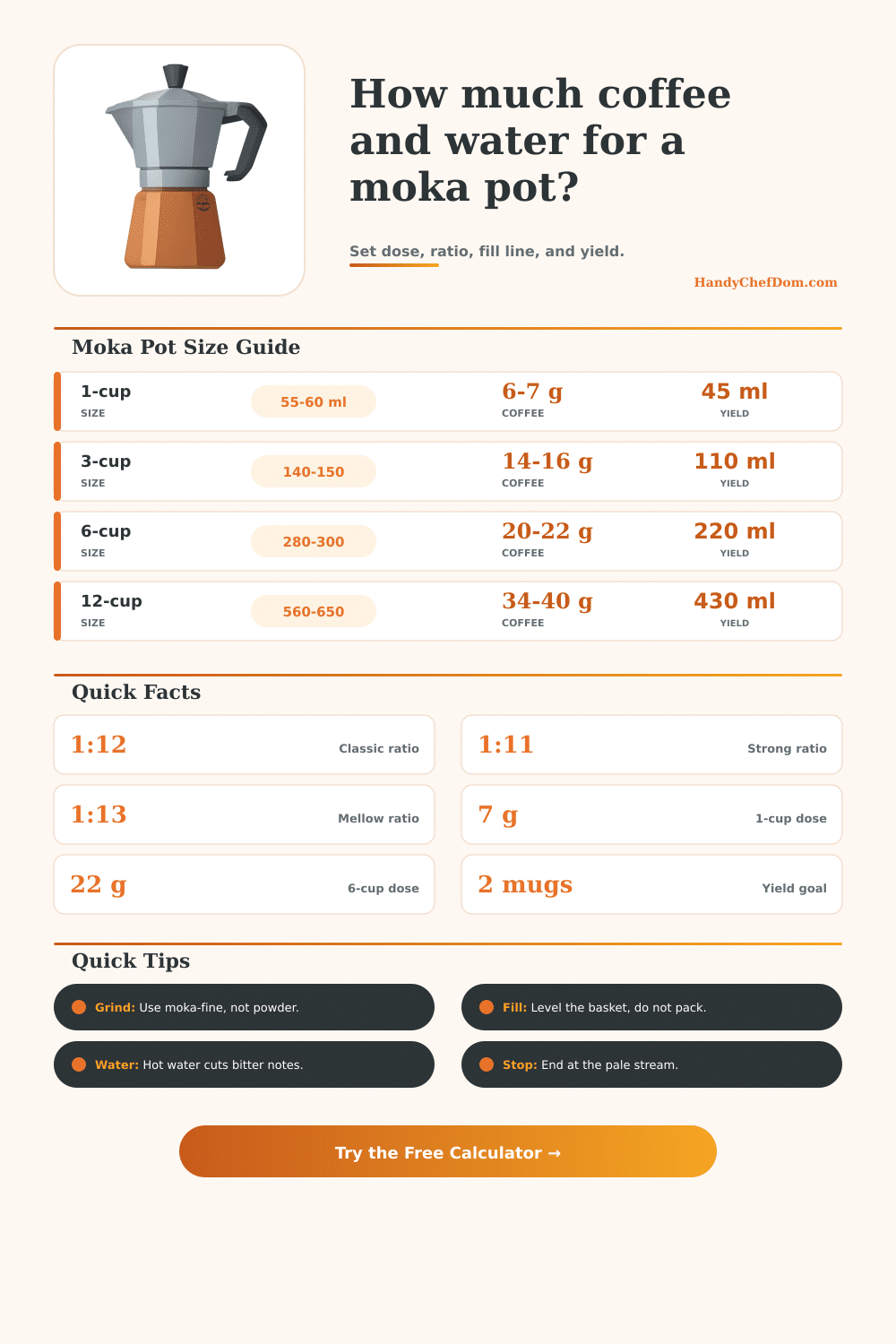
📑Pot Size Guide
| Pot | Water | Basket | Yield |
|---|---|---|---|
| 1-cup | 60 ml | 7 g | 40 ml |
| 3-cup | 150 ml | 14.5 g | 100 ml |
| 6-cup | 300 ml | 22 g | 200 ml |
| 12-cup | 650 ml | 40 g | 430 ml |
| Style | Ratio | Feel | Use |
|---|---|---|---|
| Classic | 1:12 | Balanced | Daily cup |
| Strong | 1:11 | Dense | Short pour |
| Mellow | 1:13 | Softer | Long cup |
| Bright | 1:12.5 | Clear | Light roast |
| Grind | Flow | Heat | Result |
|---|---|---|---|
| Extra fine | Slow | Low | Rich body |
| Moka-fine | Even | Medium | Classic cup |
| Balanced | Open | Med-high | Cleaner cup |
| Slightly coarse | Fast | Low | Brighter |
| Yield | Moka cups | Small mugs | Use |
|---|---|---|---|
| 90 ml | 1.5 | 0.5 | Solo |
| 150 ml | 2.5 | 0.8 | Two share |
| 220 ml | 3.6 | 1.2 | Family sip |
| 430 ml | 7.1 | 2.4 | Big pot |
🔬Equipment Map
💡Tips
A moka pot is a tool that brew coffee on the stovetop. It use the steam pressure to push the water through the coffee grounds in the pot. To brew coffee successfully in a moka pot, one must understand how water, coffee grounds, heat, and coffee grounds grind size relates to brewing coffee perfectly.
If these variables are not managed correct when brewing coffee in a moka pot, the coffee can become either too bitter or too weak. Ratios is essential when brewing coffee in a moka pot. The ratio compares the weight of the coffee grounds to the weight of the water that will brew the coffee.
How to Make Good Coffee in a Moka Pot
The ratio of 1:12 means that 12 grams of water will be used for every 1 gram of coffee grounds. For individuals who prefers stronger brewed coffee, changing the ratio to 1:11 will create a stronger taste. For those who prefer milder coffee, using a ratio of 1:13 will help to achieve that flavor preference.
The size of the moka pot determine how much coffee and water will be used in brewing the coffee. For example, a 1-cup moka pot uses 60 ml of water. In comparison, a 12-cup moka pot uses 650 ml of water.
Another essential factor in brewing coffee in a moka pot is the grind size for the coffee grounds. The grind size should be more fine than drip coffee but coarser than espresso powder. Coffee grounds that are too coarse will allow the water to pass through the grounds too quickly, resulting in weak brewed coffee.
Coffee grounds that are too fine will prevent the water from properly moving through the coffee grounds, resulting in brewed coffee that taste bitter. The roast of the coffee beans also impacts how one uses the moka pot. With light roast coffee beans, more water must be used to extract the flavor of the coffee beans.
With dark roast coffee beans, the flavor extracts quickly, so fewer water will be used to brew the coffee. The way that the coffee basket is filled also plays an important role in the brewed coffees quality. The coffee basket must be filled correctly to allow the steam to push the water through the grounds correctly.
Coffee grounds should be added until they are level with the top of the basket but not packed or tamped down into the basket. If the grounds are packed into the basket, the steam will not be able to push the water through the grounds. The water reservoir in the moka pot should also be filled correctly.
It should be filled up to the safety valve but may be filled with less water if using the brewed coffee to make iced coffee. Controlling how hot the moka pot reaches is necessary to ensure that the brewed coffee is not too bitter. Using water from a kettle to fill the moka pot ensures that the water is hot and reduces the amount of time that the coffee sits on the stove.
If the coffee sits in the moka pot for too long, the brewed coffee will taste too bitter. Using the medium flame setting ensures that the coffee brews at the proper rate. Using a flame that is too low will brew the coffee too slow.
Using a flame that is too high will brew the coffee too quickly. When brewing coffee, ensure that the moka pot is removed from the stove when the gurgling sound is heard from the pot. This sound indicate that the water has brewed through the coffee grounds.
Many people make mistakes when brewing coffee in a moka pot. Two of the most common mistake are the coffee grounds grind size and the heat level of the stove. Some people mistakenly believe that the number of “cups” listed on the moka pot represent the amount of mugs of coffee by which the moka pot can produce coffee.
The “cups” on a moka pot represent small shot of coffee. To brew coffee, people will have to adjust the variables of coffee strength such as changing the coffee ratio, changing the coffee grounds grind size, or changing the heat level of the stovetop where the moka pot is placed. By adjusting these variables, people can ensure that the coffee brewed in a moka pot is the same flavor every time that the moka pot is used.
You’ll find that if you dont manage these variables, you could of made a bad cup of coffee. It is alot of work but it is worth it.