🦫 Homebrew Yeast Calculator
Calculate exact pitch rates, cell counts & starter sizes for any beer style
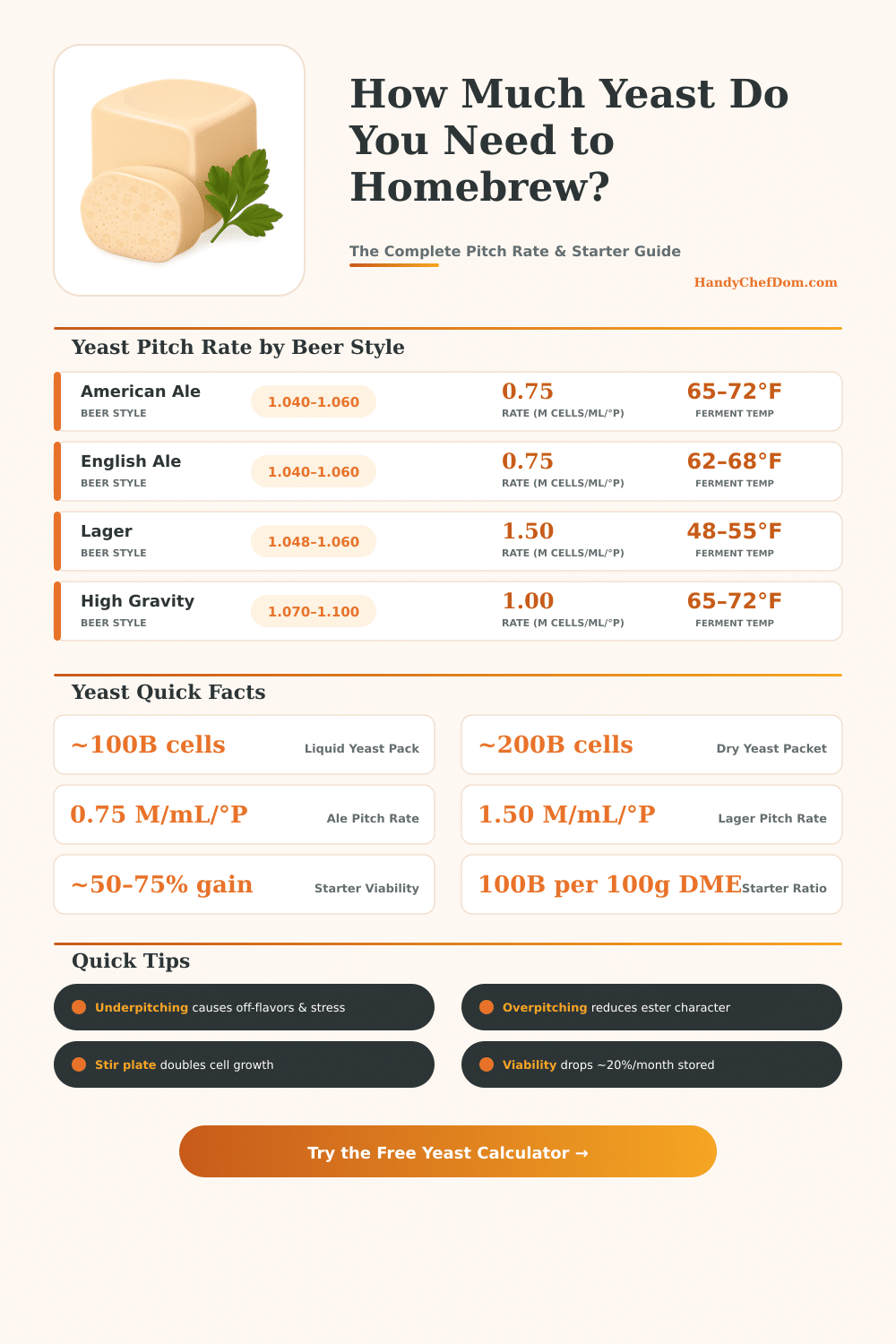
| Beer Style | OG Range | Pitch Rate (M/mL/°P) | Cells Needed (5 gal) | Ferment Temp |
|---|---|---|---|---|
| American Ale / Pale | 1.040–1.060 | 0.75 | 155–230B | 65–72°F / 18–22°C |
| English Ale / ESB | 1.040–1.065 | 0.75 | 155–250B | 62–68°F / 17–20°C |
| Wheat Beer | 1.044–1.056 | 0.75 | 170–215B | 62–75°F / 17–24°C |
| IPA / DIPA | 1.060–1.085 | 0.75–1.00 | 230–325B | 65–72°F / 18–22°C |
| Stout / Porter | 1.045–1.070 | 0.75 | 175–270B | 62–72°F / 17–22°C |
| Lager / Pilsner | 1.044–1.060 | 1.50 | 340–460B | 48–55°F / 9–13°C |
| Saison | 1.048–1.070 | 0.75 | 185–270B | 68–85°F / 20–29°C |
| High Gravity Ale | 1.080–1.100 | 1.00 | 308–385B | 65–72°F / 18–22°C |
| High Gravity Lager | 1.070–1.090 | 2.00 | 539–692B | 48–55°F / 9–13°C |
| Yeast Format | Fresh Cell Count | 4 Weeks Old | 8 Weeks Old | 12 Weeks Old |
|---|---|---|---|---|
| Liquid Pack (standard) | 100B | 79B | 62B | 50B |
| Liquid Pack (XL / Pro) | 150B | 119B | 94B | 75B |
| Dry Packet (5–11g) | 200B | 196B | 192B | 188B |
| Dry Packet (large, 11g+) | 350B | 343B | 336B | 329B |
| Slurry (cup from prev. batch) | ~1,700B | — | — | — |
ℹ️ Liquid yeast viability decreases ~21% per month from manufacture date. Dry yeast retains viability much longer when stored cold and sealed.
| Starter Volume | DME Needed | No Stir Plate | With Stir Plate | Gravity of Starter |
|---|---|---|---|---|
| 500 mL | 50g (1.8 oz) | +46B cells | +92B cells | ~1.037 |
| 1,000 mL (1L) | 100g (3.5 oz) | +89B cells | +178B cells | ~1.037 |
| 1,500 mL | 150g (5.3 oz) | +130B cells | +260B cells | ~1.037 |
| 2,000 mL (2L) | 200g (7.1 oz) | +169B cells | +338B cells | ~1.037 |
| 2,500 mL | 250g (8.8 oz) | +208B cells | +416B cells | ~1.037 |
| 3,000 mL (3L) | 300g (10.6 oz) | +246B cells | +492B cells | ~1.037 |
ℹ️ Cell growth estimates use the Jamil / Mr. Malty growth model. A stir plate roughly doubles cell production. Use light DME (dry malt extract) for starters.
| Original Gravity (OG) | °Plato (approx.) | Beer Strength | Typical Style |
|---|---|---|---|
| 1.030 | 7.6°P | Session (~3% ABV) | Light Lager, Session Ale |
| 1.040 | 10°P | Low (~4% ABV) | Kolsch, Hefeweizen |
| 1.050 | 12.4°P | Standard (~5% ABV) | APA, Amber Ale |
| 1.060 | 14.7°P | Medium (~6% ABV) | IPA, ESB |
| 1.070 | 17°P | High (~7% ABV) | DIPA, Bock |
| 1.080 | 19.3°P | Strong (~8% ABV) | Strong Ale, Doppelbock |
| 1.090 | 21.6°P | Very Strong (~9% ABV) | Imperial Stout, Barleywine |
| 1.100 | 23.8°P | Extra Strong (~10%+ ABV) | Imperial Stout, Barleywine |
The homebrew yeast used for brewing is the most overlooked from the four main ingredients of beer: hops, malt, water and the homebrew yeast itself. Without it, one would get only bitter juice from grains that never would become real drink. The scientific name of the homebrew yeast for brewing is Saccharomyces cerevisiae.
This is a tiny fungus of one cell. This species played a lead role in winemaking, baking and brewing already from ancient times.
What Is Homebrew Yeast and How to Use It
For home brewers, the homebrew yeast comes in two forms: liquid and dry. Both forms work well and give good beer, if one cares about it and applies it properly. In liquid form there are more many strains than in dry.
Between popular dry species mention Safale US-05, Safale S-04 and SafLager W-34/70. When talking about liquid homebrew yeast, commonly chosen are Wyeast 1056 and WLP001. These strains. US-05, Wyeast 1056 and WLP001, are alike to one another from the view of taste, even so US-05 reaches bigger weakening on average.
Choosing the right strain of homebrew yeast, one cares about the quality of the final beer. Various styles of beer require different species. For instance, Lalbrew Belle Saison is homebrew yeast for Belgian ale, chosen because of its special talent to produce beers in style Saison.
That homebrew yeast makes esters, that well agrees with the aroma of hops, forming notes of tropical fruits, that strenghtens the typical character of hops. Moreover, it fits to create natural haze and soft, cushion feeling in the mouth.
One packet of dry homebrew yeast weighs around 11 grams. That usually suffices for ale beers of middle weight. The content of liquid homebrew yeast packets varies, and for some ale beers you need two of them.
For lager beers you need double, because they ferment at low temperature. They officially suggest two packets of dry homebrew yeast for lager. Packets of dry homebrew yeast store around 18 billions of homebrew yeast cells each gram and come in sizes of 5 grams and 11,5 grams.
The best way to make sure that the homebrew yeast works and is ready for fermentation is to prepare a starter from it. Starters that one does two or three days before and keeps in the fridge, count only four short time. By means of a microscope and a bit of gear it is possible to even gather wild homebrew yeast, grow them and separate the wanted strains through some cycles on Petri plates, to get pure culture.
Some store bought beers are conditioned in bottle, and that one usually mentions on the label. The deposit in the bottom of the bottle is made up of homebrew yeast. In theory one can use bread yeast to prepare beer, but the tastes that it creates commonly do not match with beer style.
It better works for drinks like mead. Adding bread yeast as food during the boil can create bad flavors, if something from it stays alive and ferments the wort. When itcomes to beer, always more wise to choose real homebrew yeast for brewing.