🌿 Dried Thyme Per Fresh Sprig Calculator
Convert fresh thyme sprigs into dried teaspoons with adjustments for sprig size, variety, recipe style, crush level, herb age, simmer time, and batch scaling.
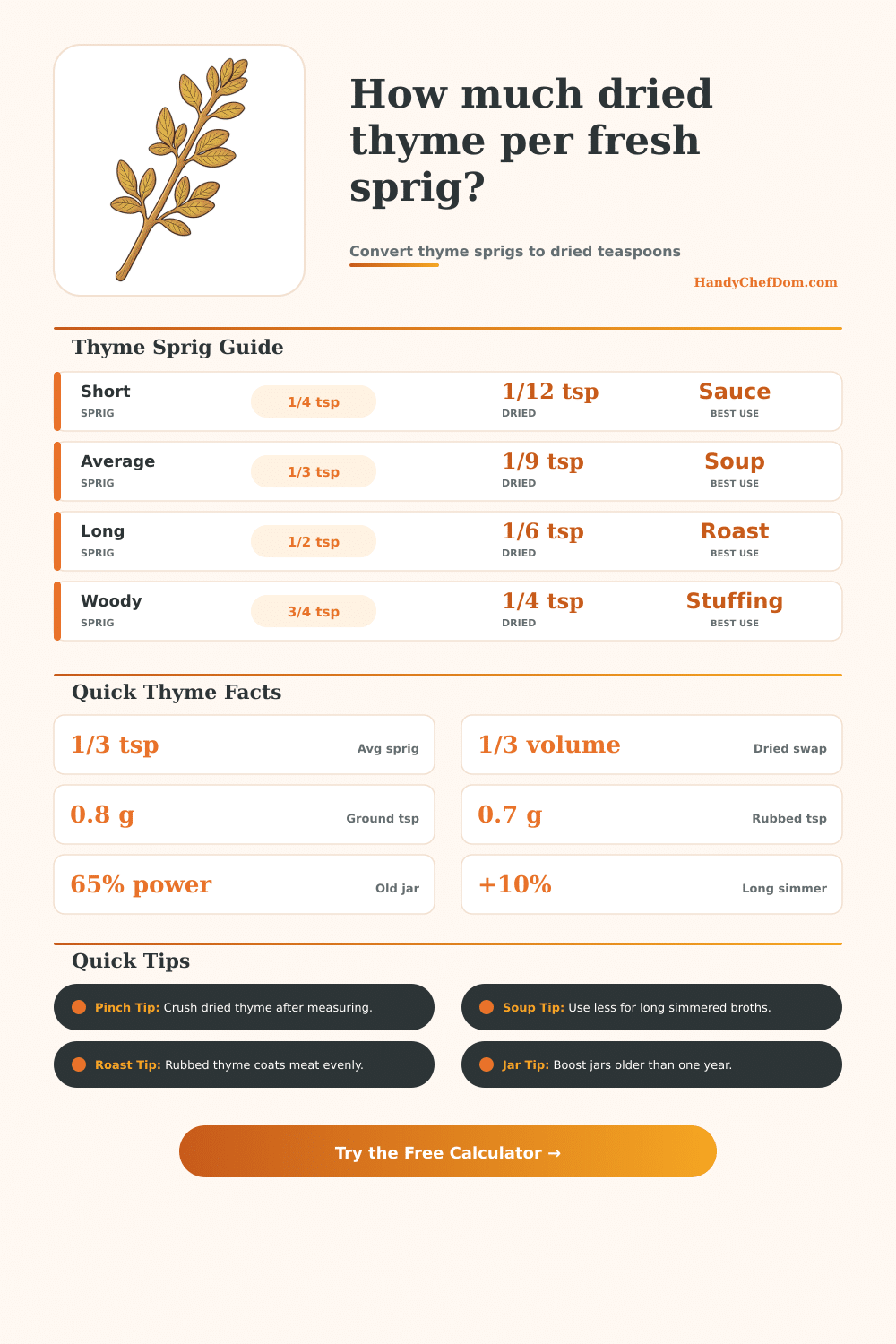
A common thyme sprig yields about 1/4 to 1/2 teaspoon fresh leaves. This calculator starts from sprig count and length, estimates fresh leaves, then applies the usual dried replacement of roughly one third of fresh volume.
| Sprig Size | Typical Length | Fresh Leaves | Dried Equivalent |
|---|---|---|---|
| Tiny garnish sprig | 1 to 2 in | 1/8 tsp | Scant pinch |
| Short tender sprig | 2 to 3 in | 1/4 tsp | 1/12 tsp |
| Average kitchen sprig | 3 to 5 in | 1/3 tsp | 1/9 tsp |
| Long leafy sprig | 5 to 7 in | 1/2 tsp | 1/6 tsp |
| Woody market stem | 7 to 9 in | 3/4 tsp | 1/4 tsp |
| Bunched uneven stems | Mixed | Measure leaves | Use 1/3 fresh |
| Fresh Thyme | Standard Dried | Gentle Dried | Bold Dried |
|---|---|---|---|
| 1/4 tsp leaves | 1/12 tsp | 1/16 tsp | 1/8 tsp |
| 1/2 tsp leaves | 1/6 tsp | 1/8 tsp | 1/4 tsp |
| 1 tsp leaves | 1/3 tsp | 1/4 tsp | 1/2 tsp |
| 1 tbsp leaves | 1 tsp | 3/4 tsp | 1 1/2 tsp |
| 1/4 cup leaves | 4 tsp | 1 tbsp | 2 tbsp |
| 1 cup leaves | 1/3 cup | 1/4 cup | 1/2 cup |
| Recipe Type | Adjustment | Why It Changes | Measuring Cue |
|---|---|---|---|
| Roast or sheet pan | 1.10x | Dry heat softens aroma | Rub into fat |
| Soup or stew | 0.92x | Long liquid extraction | Add early |
| Sauce or gravy | 0.85x | Small volume carries herbs | Start light |
| Stuffing or dressing | 1.18x | Bread absorbs fragrance | Mix evenly |
| Quick skillet | 1.00x | Short contact time | Bloom briefly |
| Marinade | 0.95x | Resting spreads flavor | Crush first |
| Herb | Fresh to Dried | Strength Pattern | Swap Caution |
|---|---|---|---|
| Thyme | 3:1 | Earthy and steady | Easy to layer |
| Rosemary | 3:1 | Piney and assertive | Chop fine |
| Oregano | 3:1 | Sharp and peppery | Use less in sauce |
| Marjoram | 3:1 | Sweet and soft | Add near end |
| Sage | 3:1 | Warm and savory | Can dominate |
| Parsley | 3:1 | Fresh and grassy | Dried is mild |
When a person substitutes dried thyme for fresh thyme, the person must take into account several different variable associated with dried thyme and fresh thyme since the two types of thyme dont behaves in the same manner. One of the main variables associated with thyme is it physical form; thyme can be added to a recipe in both sprig form (fresh thyme) or in powdered and leaf form (dried thyme). Each of these forms contain different amount of thyme and have different level of flavor intensity.
Therefore, a calculator can assist the chef who must substitute dried thyme for fresh thyme. The chef can input the length of the fresh thyme sprig and the number of sprigs that is required for the recipe, and the calculator will provide an indication of the amount of dried thyme that should be used in the recipe instead. Another of the variables that can impact the flavor of the recipe is the age of the dried thyme.
How to Use Dried Thyme Instead of Fresh Thyme
Because dried thyme often loses its fragrance with time, a portion of dried thyme that is sitting in a cabinet for several month will contain less of the flavor of dried thyme than dried thyme that was opened recently. Thus, an age adjustment is made to the calculation of the amount of dried thyme that is require for the recipe. An additional variable is the preparation of the dried thyme; crushed dried thyme will contain more flavor potency than dried thyme leaf that are whole.
Thus, the cook can make adjustments to account for either crushed dried thyme or whole dried thyme leaves. Additionally, the methods in which the thyme is to be cooked will impact the amount of dried thyme that is required. For instance, if the recipe is for a soup that simmers for several hours, the amount of dried thyme will be less than that which would be required for a pan sauce that is cooked for only a few minutes.
Additionally, roasted vegetable will lose some of there aroma during the roasting process, so additional dried thyme will be required in recipes that call for the vegetables to be roasted. Stuffing may require either a moderate amount of dried thyme since the bread will absorb some of the fragrance of the dried thyme, yet the larger surface area of the stuffing will allow for more dried thyme to be use. The type of thyme that is used also has an impact on how much dried thyme should be used in the recipe.
For instance, lemon thyme contain a bright flavor to its herbs, so less of the herb will be used compared to dried thyme with a more moderate flavor. Additionally, varieties of dried thyme that contain more flavor than common garden thyme will require larger amounts of that thyme when cooking foods like beans or dishes that simmer for long period of time. The duration of the cooking of the recipe and the batch size will impact the amount of dried thyme that is required.
A roast that simmers for forty-five minutes will have different dried thyme requirement than a stew that simmers for two hours. Additionally, if a recipe is to be scaled up to prepare for a large crowd, the cook must make adjustments for these variables. The reference tables provided on this page may assist the chef in understanding the different amounts of fresh thyme that may be used in recipes and the ratios of fresh to dried thyme.
These tables indicate the amounts of dried thyme that should be used in recipes that are gentle, standard, or bold in there flavor. These tables allow the chef to determine whether the recipe use a restrained amount of dried thyme or a bold flavor of dried thyme. While many cooks understand that dried thyme loses its potency when time passes, they may not be aware of the impact of the physical state of the thyme, the method in which it is to be cooked, or the age of the thyme itself on the flavor of the final dish.
The calculator accounts for these three variable so that the measurement of dried thyme that is calculated is accurate for the specific recipe. Finally, once the calculator calculates the amount of dried thyme, the chef should crush the dried thyme between the fingers before being added to the pot. By crushing the dried thyme, some of the remaining fragrance is released from the dried thyme leaves, which adds to the flavor of the dried thyme compared to the fresh herb.