🧪 CO2 Fermentation Calculator
Estimate CO2 production, ethanol yield & carbonation volumes from sugar fermentation
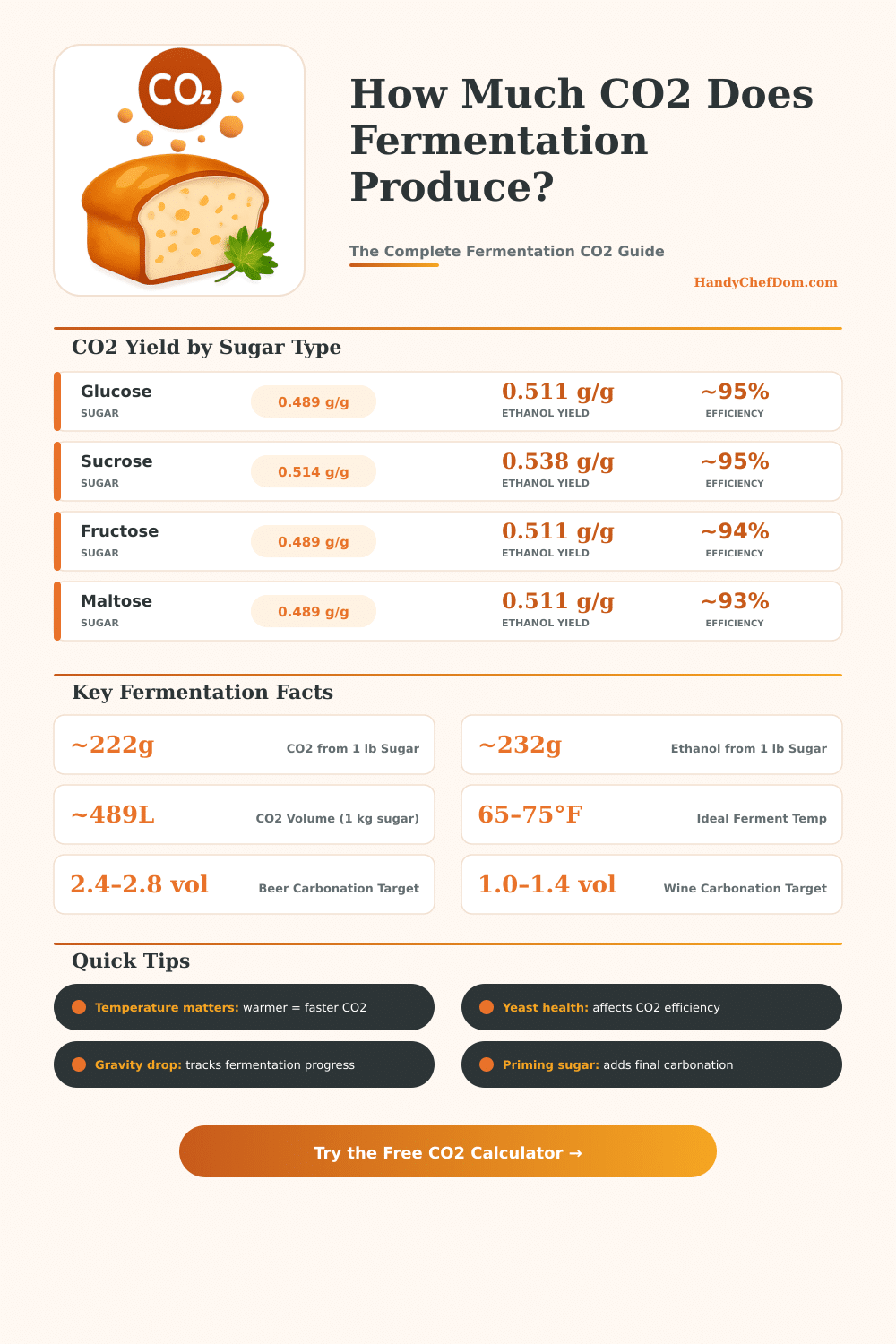
| Sugar | CO2 Yield (g/g) | Ethanol Yield (g/g) | Fermentability | Common Use |
|---|---|---|---|---|
| Glucose (Dextrose) | 0.489 | 0.511 | 100% fermentable | Priming, Adjunct |
| Sucrose (Table) | 0.514 | 0.538 | 100% fermentable | Winemaking, Cider |
| Fructose | 0.489 | 0.511 | 100% fermentable | Honey, Fruit Wines |
| Maltose | 0.489 | 0.511 | ~95% fermentable | Beer (from grain) |
| Lactose | 0 | 0 | 0% (non-fermentable) | Milk Stout (body) |
| Honey (~80% sugars) | ~0.411 | ~0.430 | ~80% fermentable | Mead |
| Dry Malt Extract | ~0.367 | ~0.383 | ~75% fermentable | Homebrewing |
| Beverage | CO2 Volumes (v/v) | PSI at 38°F | Priming Sugar (oz/gal) |
|---|---|---|---|
| Ale / IPA | 2.2 – 2.7 | 7 – 12 psi | 0.85 – 1.1 oz |
| Lager / Pilsner | 2.4 – 2.8 | 9 – 14 psi | 0.95 – 1.15 oz |
| Wheat Beer / Hefe | 3.3 – 4.5 | 18 – 28 psi | 1.3 – 1.8 oz |
| Stout / Porter | 1.7 – 2.3 | 4 – 8 psi | 0.65 – 0.9 oz |
| Hard Cider | 2.4 – 3.0 | 9 – 16 psi | 0.95 – 1.2 oz |
| Still Wine | 1.0 – 1.4 | N/A | N/A |
| Sparkling Wine | 5.0 – 6.5 | 35 – 50 psi | 2.0 – 2.6 oz |
| Kombucha | 2.5 – 3.5 | 10 – 20 psi | 1.0 – 1.4 oz |
| Fermented Soda | 3.0 – 4.0 | 16 – 24 psi | 1.2 – 1.6 oz |
| Mead | 1.5 – 2.2 | 3 – 8 psi | 0.6 – 0.85 oz |
| Yeast Strain | Attenuation | CO2 Efficiency | Optimal Temp |
|---|---|---|---|
| Ale Yeast (S. cerevisiae) | 73 – 77% | ~95% | 60 – 75°F |
| Lager Yeast (S. pastorianus) | 73 – 77% | ~94% | 48 – 58°F |
| Wine Yeast | 80 – 95% | ~95% | 60 – 70°F |
| Champagne / EC-1118 | 90 – 95% | ~96% | 50 – 86°F |
| Wild / Sourdough | 60 – 75% | ~80% | 70 – 85°F |
At the heart of fermentation, it is a process of metabolism, in that glucose and other molecules divide without need of oxygen. That is an anaerobic process, everything happens without air. What pushes it to work is the break of organic substances, especially sugars.
The electrons of them transfer to other organic structures and one produces ATP (the cellular energy) together with by-products as carbon dioxide and ethanol.
What Is Fermentation?
That is not a new discovery. We talk about at least 10 000 years of human history. Ancient folks already used cultures to preserve foods, prepare alcoholic drinks and improve nutrition in products from yoghurt to tempeh.
They did not need to know the chemistry… It was enough that they saw that it works.
Bacteria and fermentation is the real main players in the fermentation process. They divide food elements and create new flavors, together with useful substances. For instance in baking: fermentation alters a dense, sad lump of dough into a puffy and fancy mass.
It consumes sugars and starches, converting them into simpler form, carbon dioxdie, that blows upward the bread, and ethanol, that adds taste.
Here is where fermentation differs from decay. In fermented foods one uses particular, carefully chosen types of bacteria, funguses or yeast, that we know to be safe. When food naturally spoils, anything can grow there, and that is a way too food sickness.
Real fermentation is controlled and intended. The right germs in the right foods.
Fermentation covers more than only pickling. Breads, soy sauce, cheeses, all of them pass through chemical reactions with bacteria. The prize is change in taste, texture and longer shelf life.
That sharp bitterness in sauerkraut and kimchi? That is fermentation in action.
Pushing fermentation in industrial uses makes it important. Large production of fermented foods and drinks became possible, naturally, but also making of chemicals as acetic acid, citric acid and ethanol. Modern biotechnology reached such level, that scientists can observe germs with wonderful accuracy.
That precise access to fermentation creates ingredients for foods, proteins, vitamins and fibers, that before briefly seemed as science fiction.
Your belly also takes part. The gut microbiome ferments dietary fiber and produces helpful substances, included butyric acid and propionic acid. Only warning, some by-products of fermentation can cause gases.
On the other hand, fermentation can release nutrients, that your body otherwise would lose, for instance when fermented millet lowers phytic acid, pushing minerals more available. Two mainstream ways of fermentation exist: alcohol fermentation and lactic fermentation. In alcohol fermentation, pyruvate turns into carbon dioxide and ethanol.
Basically, fermentation allows your cells to produce energywithout oxygen, something very practical for both baking and drink making.