🥚 Egg White to Whole Egg Calculator
Convert egg whites to whole eggs (and back) with volume & nutrition breakdown
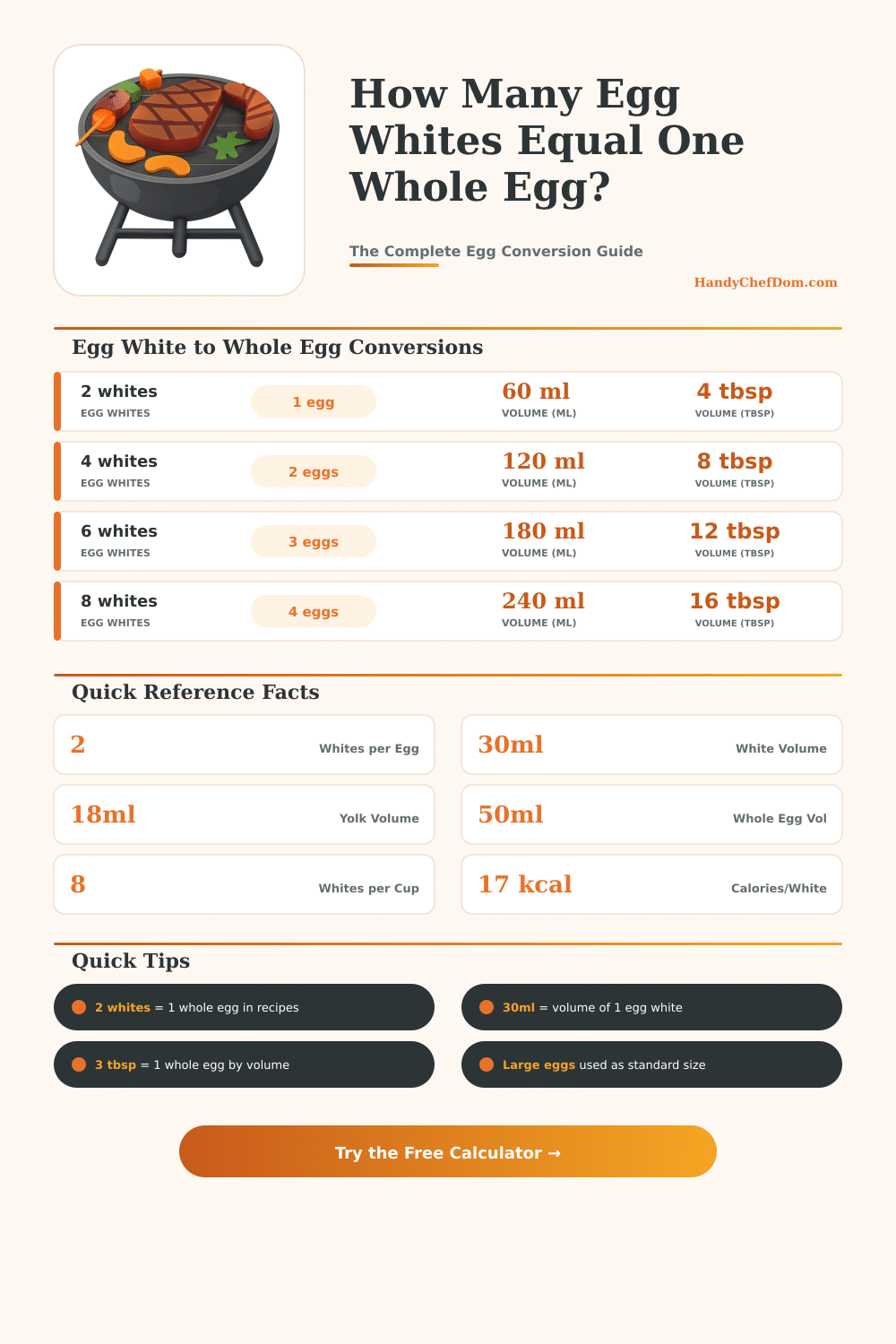
| Egg Whites | Whole Eggs | Volume (ml) | Volume (tbsp) | Volume (fl oz) |
|---|---|---|---|---|
| 1 white | ½ egg | 30 ml | 2 tbsp | 1 fl oz |
| 2 whites | 1 egg | 60 ml | 4 tbsp | 2 fl oz |
| 3 whites | 1½ eggs | 90 ml | 6 tbsp | 3 fl oz |
| 4 whites | 2 eggs | 120 ml | 8 tbsp | 4 fl oz |
| 6 whites | 3 eggs | 180 ml | 12 tbsp | 6 fl oz |
| 8 whites | 4 eggs | 240 ml | 16 tbsp | 8 fl oz |
| 10 whites | 5 eggs | 300 ml | 20 tbsp | 10 fl oz |
| 12 whites | 6 eggs | 360 ml | 24 tbsp | 12 fl oz |
| Egg Size | Total Weight | White Weight | Yolk Weight | White Volume |
|---|---|---|---|---|
| Small | 38g (1.3 oz) | 23g | 15g | 23 ml |
| Medium | 44g (1.6 oz) | 27g | 17g | 27 ml |
| Large | 50g (1.8 oz) | 30g | 18g | 30 ml |
| Extra Large | 56g (2.0 oz) | 34g | 19g | 34 ml |
| Jumbo | 63g (2.2 oz) | 38g | 21g | 38 ml |
| Volume | Egg Whites (Large) | Whole Eggs (Large) | In Tablespoons |
|---|---|---|---|
| 30 ml (1 fl oz) | 1 white | ½ egg | 2 tbsp |
| 60 ml (2 fl oz) | 2 whites | 1 egg | 4 tbsp |
| ¼ cup (59 ml) | ~2 whites | 1 egg | 4 tbsp |
| ½ cup (118 ml) | ~4 whites | 2 eggs | 8 tbsp |
| 1 cup (237 ml) | ~8 whites | 4 eggs | 16 tbsp |
bbq has many names. One commonly sees it written as Bar-B-Q, BarBQ, Bar-B-Que or even Bar-B-Que, everything depends on the author. At its base it deals with cooking by means of live flame and smoke to reach that special taste and look, that makes your mouth water.
In Australia or New Zealand one simply says “barbie” or “barby”. Funny about the Australian way is, how freely one dropped the strict rules (steaks), sausages, lamb chops, hamburgers, everything grilled on bbq or above open flame outside.
BBQ Basics and How to Plan One
Here is where it becomes tricky: the exact meanings range strongly according to the place. Some insist, that real bbq is only direct cooking above open flame, even though that sounds very loose for a meaning. According to the region, folks get heated arguing, what truly deserves the name “bbq”.
Another cause is the endless talk about the limit between bbq and simply grilling. It always coems back.
In United States good bbq menus usually include beef brisket, pork ribs, beef ribs, chicken, pulled pork and hot dogs. The most become smoked or slowly cooked, later one serves it as sandwiches or plates. As sides we have baked beans, coleslaw, potato salad, vegetables, pasta salad, stuffed eggs and creamy pasta with cheese.
Grilled corn on the cob with butter and bbq rub? Perfect idea. Also, grilled fruits like pineapple, papaya and mango go surprisingly well with pork, chicken or fish.
Planning bbq, think about portions. An adult normally eats around one pound of food entirely. Regular meet forms the main part, so plan on half to three quarter pounds each person.
Children eat less, near a quarter pound. For wings alone I noticed, that seven to ten pieces per person quickly go. Ribs work more well at around five or six each person, if other foods are on the table.
Here the key with brisket: it lost around 30 to 50 percent of weight during smoking, so buy more than needed. Wise advice? Keep hamburger patties, brats or hot dogs in the fridge for surprise guests or picky eaters.
Smoking of meat requires patience. A regular brisket of 16 to 18 pounds requires around 18 hours to finish well. Boston butt in the range of 12 to 15 pounds?
Plan about 12 hours. Wrong guesses leave you with raw meat. That is embarrassing.
The world of bbq has an active community. Discussion forums have more than 900,000 messages, everything dedicated to bbq. Folks discuss everything, from low and slow smoking methods to detailed comparison of tools.
Newcomers ask questions always freely, without fear of criticism. There are even special sections for talk about bbq contests, for fans and professionals. Nice bonus?
bbq does not have a season outside. Grilling when it iscold outside takes only a moment.