Cold Brew French Press Ratio Calculator
Dial in coffee grounds, water, steep time, and final yield for a clean cold brew batch in a French press.
The calculator treats French press immersion as a full soak, then backs into the bean dose after brew loss and optional dilution.
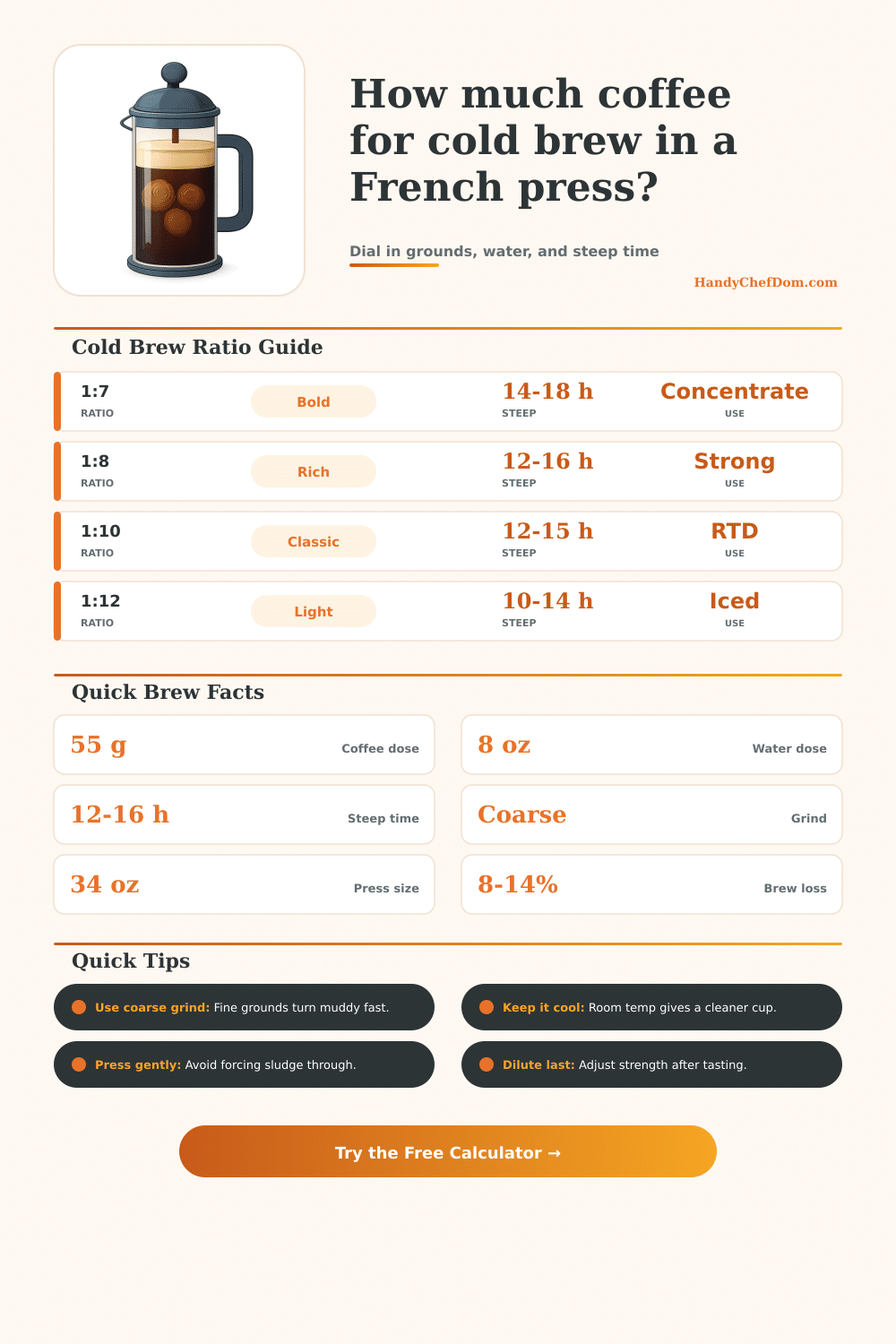
| Ratio | Strength | Steep | Best For |
|---|---|---|---|
| 1:7 | Very bold | 14-18 h | Concentrate |
| 1:8 | Strong | 12-16 h | Over ice |
| 1:10 | Classic | 12-15 h | Daily cup |
| 1:12 | Light | 10-14 h | Breakfast |
| 1:14 | Bright | 8-12 h | Soft cup |
| 1:16 | Very light | 8-10 h | Milk drink |
| Grind | Flow | Risk | Note |
|---|---|---|---|
| Extra-coarse | Fast | Low grit | Cleanest cup |
| Coarse | Steady | Low | Best balance |
| Med-coarse | Medium | Some fines | Full body |
| Medium | Slow | More sludge | Not ideal |
| Press Size | Volume | Batches | Use |
|---|---|---|---|
| 12 oz | 1.5 cups | 1-2 | Single cup |
| 17 oz | 2.1 cups | 1 | Travel |
| 34 oz | 4.2 cups | 2-3 | Classic press |
| 51 oz | 6.4 cups | 3-4 | Family batch |
| 64 oz | 8.0 cups | 4-5 | Party batch |
| 1 L | 4.2 cups | 2-3 | Metric batch |
| Use | Ratio | Temp | Note |
|---|---|---|---|
| RTD | 1:10 | Cool | Little dilution |
| Over ice | 1:8 | Cool | Serve stronger |
| Latte base | 1:7 | Cool | Mix with milk |
| Concentrate | 1:7 | Room | Dilute later |
| Bright cup | 1:12 | Cool | Longer sipping |
| Big pitcher | 1:10 | Cool | Multiple pours |
To make cold brew using a French press, you must understand the relationship between coffee grounds, water, and time. Cold brew coffee are made by steeping coffee grounds in cool water for an extended period of time. Unlike hot brewing methods, cold brew use no heat to extract the flavor of the coffee grounds.
Because no heat are used in the brewing process, the extraction of the coffee flavors is slower. The slower extraction process creates a cold brew coffee that has a smoother flavor then brewed coffee made with hot water. The most important factor to consider when making cold brew is the ratio of coffee grounds to water.
How to Make Cold Brew with a French Press
The ratio is the mathematical relationship between the weight of the coffee grounds and the weight of the water. A 1:7 ratio uses one part coffee grounds to seven parts water and produces a strong cold brew concentrate. A 1:12 ratio uses one part coffee grounds to twelve parts water and create a cold brew concentrate that is lighter in flavor and ready to drink without adding extra liquid.
Deciding on the coffee to water ratio before brewing will determine the strength of the cold brew that is produced. The grind size of the coffee grounds also affect the brewing process. Cold brew should use a coarse grind so that the grounds easily pass through the mesh plunger of the French press.
Using coffee grounds that are ground too fine for brewing can cause the fine coffee particles to pass through the mesh plunger of the French press. These fine particles can cause the cold brew coffee to become cloudily or muddy in appearance. Using coarse coffee grounds ensures that the brewed coffee is clear and avoids the introduction of coffee sediment into the finished cold brew.
Another important factor in the brewing of cold brew is the amount of time the coffee grounds steep in the water. Most people will allow coffee grounds to steep in water within a timeframe of twelve hours to produce there standard brew of cold brew coffee. Cold brew coffee can also be allowed to steep for up to eighteen hours to produce a concentrate of coffee.
If cold brew is allowed to steep for too long, the resulting cold brew may have a bitter taste due to the extraction of the tannins in the coffee grounds. Therefore, the amount of time that the coffee grounds steep in the water will determine the bitterness of the brewed coffee. The size of the French press will determine how much cold brew you can make at one time.
Smaller French presses holds 12 ounces of liquid or less. Large French presses can hold up to 64 ounces of liquid. Not only will the size of the French press determine how much cold brew you can produce at one time, you must also take into account the loss of liquid when using a French press.
The coffee grounds get some of the liquid trapped beneath the plunger of the press. Therefore, it is necessary to add extra liquid to the initial measurements to compensate for the liquid that will be lost to the French press. The strength of the brewed cold brew can be adjusted after the brewing process by using dilution.
Dilution is when water or milk is added to the cold brew concentrate to make the coffee less strong in flavor. For instance, if you brew cold brew with a 1:7 ratio of coffee to water, you can always add milk or more water to this brew to adjust the strength to your preference. Using cold brew concentrate is helpful for adjusting the strength of the coffee whenever needed.
Depending on the type of coffee bean that you use, you may need to adjust the ratio of coffee grounds to water or the amount of time the coffee grounds steep in the water. For instance, light roast coffee beans are denser than dark roast coffee beans. Therefore, more coffee grounds is needed when using light roast coffee beans.
Using dark roast coffee beans means that the coffee grounds will extract their flavor more easy from the water. Therefore, less coffee grounds are needed when using dark roast coffee beans instead of light roast beans. Experiment with different types of coffee beans to discover which beans work best in the cold brew process.
Finally, to make the best cold brew using a French press, use filtered water. The type of water you use will affect the flavor of your brewed coffee. Using filtered water ensures that there are no impurities in the water that will alter the flavor of the brewed coffee.
Tap water may contain minerals that impact the way the coffee taste when consumed. By controlling these factors, you can successfully produce cold brew coffee of the same strength and flavor every time with your French press.