Liquid Measurement Conversion Calculator
Convert cups, tablespoons, milliliters, liters, pints, quarts, and gallons for recipe scaling, bottle fills, and kitchen planning.
Set the source measure, target measure, and a small allowance if you want to fill a container without running short.
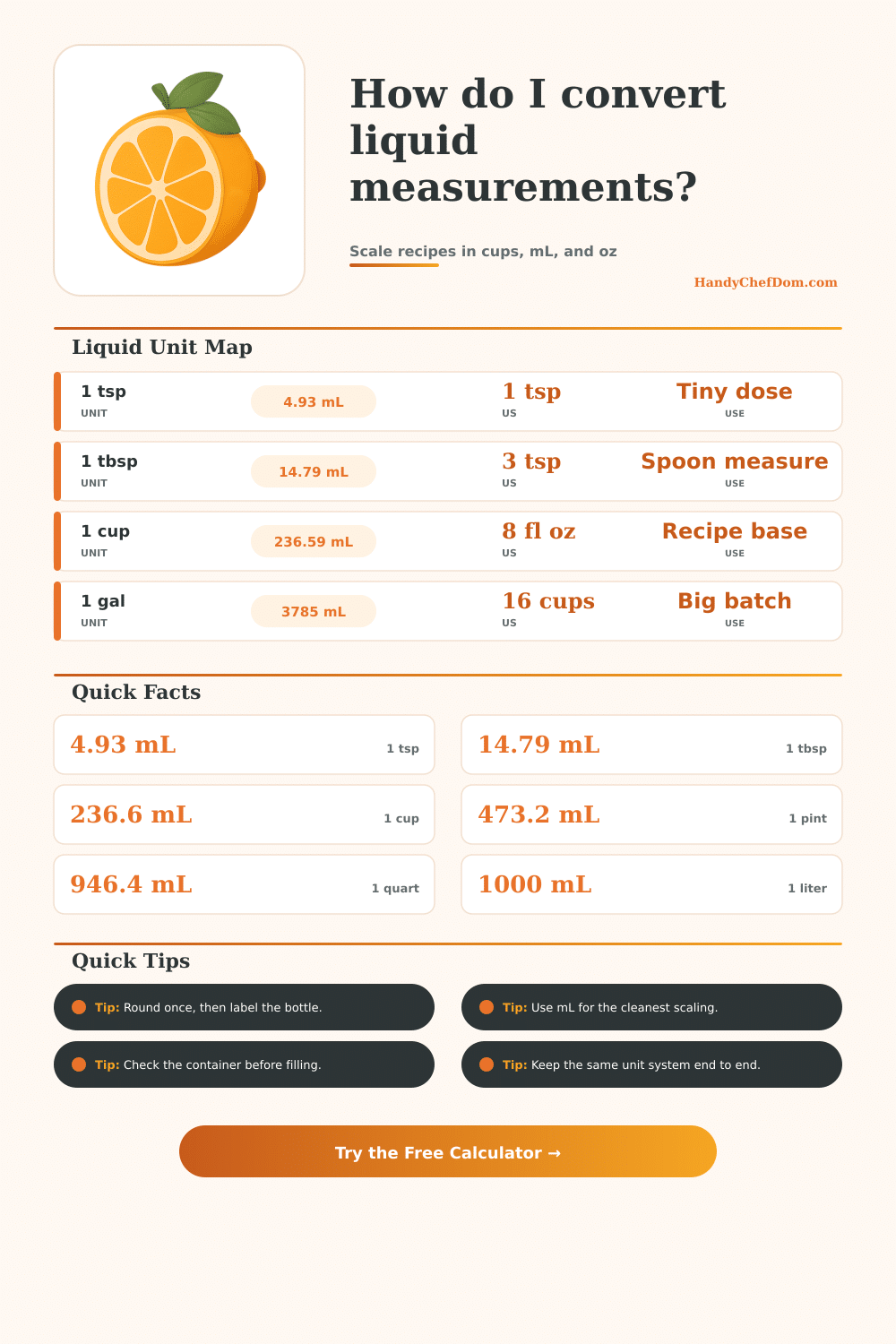
| Unit | mL | US | Note |
|---|---|---|---|
| 1 tsp | 4.93 | 1 tsp | Smallest |
| 1 tbsp | 14.79 | 3 tsp | Spoon |
| 1 fl oz | 29.57 | 2 tbsp | Pour |
| 1 cup | 236.59 | 8 fl oz | Recipe base |
| 1 pint | 473.18 | 2 cups | Half quart |
| 1 quart | 946.35 | 4 cups | Batch size |
| 1 gal | 3785.41 | 16 cups | Big batch |
| Metric | Cups | fl oz | Note |
|---|---|---|---|
| 5 mL | 0.02 | 0.17 | Tea spoon |
| 15 mL | 0.06 | 0.51 | Tablespoon |
| 100 mL | 0.42 | 3.38 | Small pour |
| 250 mL | 1.06 | 8.45 | Mini bottle |
| 500 mL | 2.11 | 16.91 | Half liter |
| 1 L | 4.23 | 33.81 | Quart-ish |
| Swap | Equals | Rule | Use |
|---|---|---|---|
| 3 tsp | 1 tbsp | Spoon | Quick mix |
| 2 tbsp | 1 fl oz | Pour | Dressings |
| 8 fl oz | 1 cup | Base | Recipes |
| 2 cups | 1 pint | Double | Soups |
| 4 cups | 1 quart | Quad | Meal prep |
| 16 cups | 1 gal | Big fill | Party mix |
| Container | mL | fl oz | Best for |
|---|---|---|---|
| 4 oz vial | 125 | 4.2 | Samples |
| 250 mL bottle | 250 | 8.5 | Small batch |
| 12 oz bottle | 355 | 12.0 | Tea syrup |
| 16 oz bottle | 473 | 16.0 | Kitchen base |
| 500 mL bottle | 500 | 16.9 | Half liter |
| 1 L jug | 1000 | 33.8 | Family batch |
Liquid measurement conversion are the process of changing the unit of measurement of a liquid to a different unit of measurement. You use liquid measurement conversion if you are making a batch of an recipe or if you are moving the liquid from one container to another container. Different recipes use different unit of measurement for liquids, and different containers hold different amount of liquid.
Because of these different variables, it is difficult for many individuals to perform unit conversions for liquid measurements. A conversion tool will allow you to convert your source amount of a liquid to a target amount of that same liquid. For instance, you can use the tool to change an amount of teaspoons to tablespoons, cups, or liters.
How to Convert Liquid Measurements
You can use a batch multiplier to increase the amount of the liquid in the recipe if you are preparing a larger batch of the recipe. This batch multiplier will allow you to select how many times you would like to multiply the original recipe. You will also need to account for headspace for the container of liquid.
Head space allows room for the liquid to expand if it is heated, or for the liquid to foam up if mixed with other ingredients. By allowing head space, the liquid wont spill out of the container. There are many units of liquid measurement.
Smaller units include teaspoons and tablespoons; a tablespoon has three teaspoons, and is therefore a larger unit of measurement. Cups is used as a unit of measurement for liquids in many recipes; one cup contains eight fluid ounce of liquid. Larger units of measurement include pints, quarts, and gallons.
A pint is a larger unit than a quart, and a gallon is a larger unit than a quart. Metric units of measurement include liters and milliliters. A liter is a larger unit of measurement than a milliliter.
Most international recipes use metric units for ease in avoiding fraction. You must be cautious to use the correct system of fluid ounces; US fluid ounces is different from UK fluid ounces, and vice versa. Using the incorrect system will lead to incorrect measurements of liquids.
In addition to unit conversions, you may also have to round the measurements. It is difficult to measure liquids that contain decimals, as most kitchen measuring tools dont have markings for liquids that are measured in decimals. Therefore, you can use a rounding mode to change the decimal measurement to a kitchen measurement that is feasible to use in the recipe.
Using kitchen measurements will make it easier for you to follow the recipe and prepare the liquids. For large batches of liquids, using whole unit of measurement instead of fractions will also make the process easier. There are many ways to use liquid measurement conversion.
For instance, you may have to prepare a sauce for a meal; in this case, you may need to know how many milliliters are in a cup of liquid. You may also have to prepare a large batch of soup, in which case you would have to convert the amount of soup from quarts to liters to know how many liter jug of soup you would need to prepare. Additionally, you should always account for the volume that will be contained within the container.
By knowing the volume of the container, you can ensure that the amount of liquid that you are preparing will fit within the container. The temperature of the liquid will not change its volume, but can affect how you take the measurement. For instance, liquids like honey will be thicker when the temperature is lower, and may behave different when poured into a container compared to a liquid that is thinner.
Therefore, you should always measure your liquids at the temperature that you would like to use the liquids. In addition, it may be helpful to add five percent to your measurements to account for differences in the density of the liquids, or for changes in the temperature of the liquids. Using milliliters as the unit of measurement for your liquids is useful in that it measures pure volume, and it avoids the ambiguities that may exist for using ounces as the unit of measurement for your liquids.
Reference tables exist that show the relationship between the various units of liquid measurement. For instance, a reference table will show you the relationship between teaspoons and tablespoons; there are three teaspoons in a tablespoon. Additionally, a reference table will allow you to understand the relationship between ounces, cups, pints, quarts, and gallons.
By memorizing these reference tables, you will be able to remember the different amounts for the various sized containers. By understanding the relationship between each of the different units of measurement, you will be able to perform the unit conversions for various liquids. To correctly perform unit conversions of liquids, you must understand the source amount of the liquid, the target amount of the liquid, and the size of the containers to which you will pour the liquid.
You should of used a tool to help with the math.