🥜 Cashew Nuts Calorie Calculator
Estimate calories from cashew weight, cups, handfuls, pieces, mixed-nut share, roast style, serving count, and portion goals.
Choose how your cashews are measured. The calculator converts everything to grams, then estimates calories and macros for the selected roast style.
Used directly in mixed-nut mode and shown for bowl planning.
| Cashew style | Calories per 100g | Calories per ounce | Best calculator use |
|---|---|---|---|
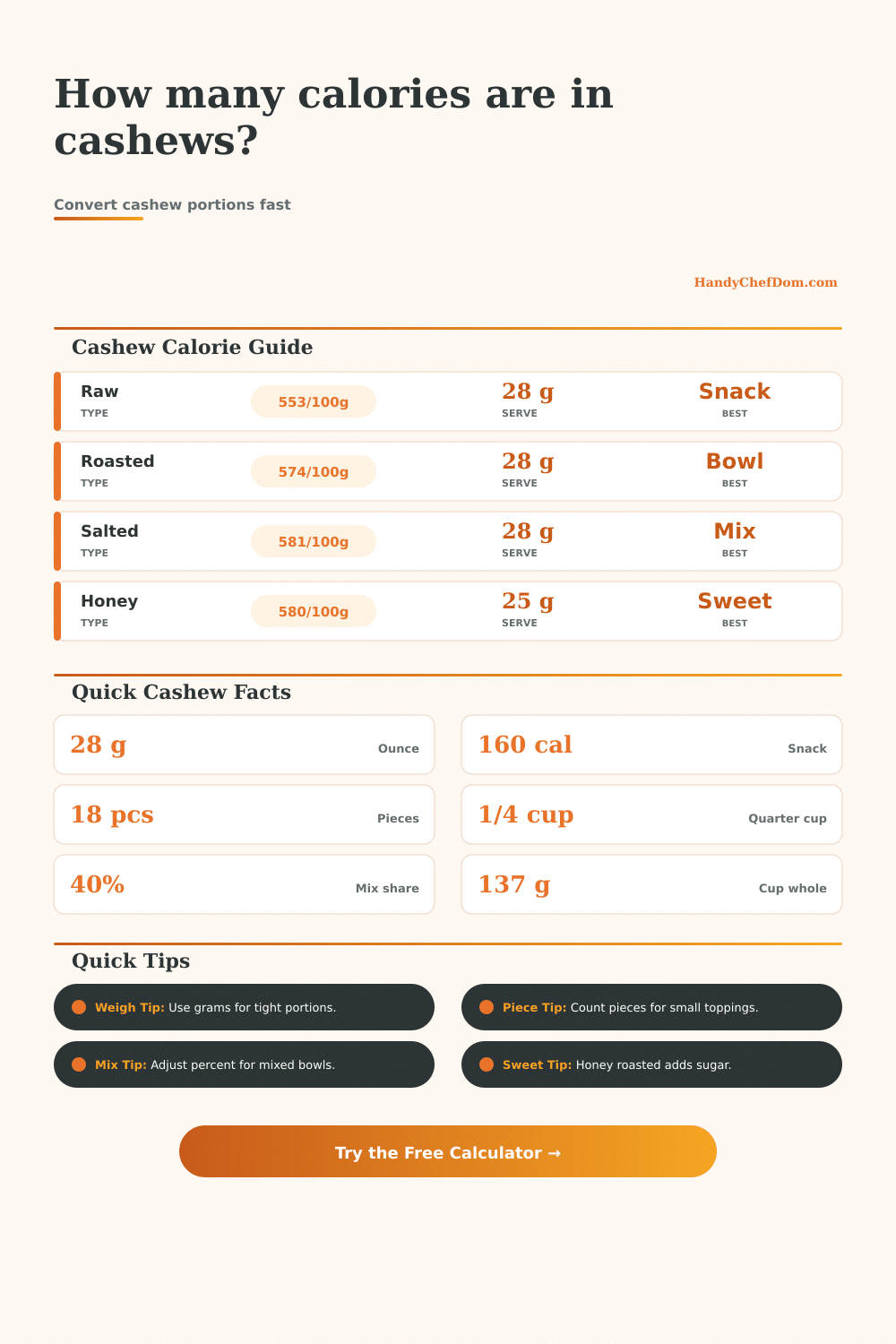
| Raw cashews | 553 | 157 | Basic snacks, baking, sauces |
| Dry roasted cashews | 574 | 163 | Snack bowls and trail mixes |
| Oil roasted salted cashews | 581 | 165 | Salted party bowls |
| Dry roasted salted cashews | 574 | 163 | Salted snack bags |
| Honey roasted cashews | 580 | 164 | Sweet portions and toppings |
| Roasted unsalted cashews | 574 | 163 | Meal prep without salt focus |
| Measure | Whole cashews | Broken pieces | Portion note |
|---|---|---|---|
| 1 ounce | 28 g | 28 g | About 18 whole cashews |
| 1/4 cup | 34 g | 38 g | Good snack scoop |
| 1/3 cup | 46 g | 51 g | Large snack serving |
| 1/2 cup | 69 g | 76 g | Two small servings |
| 1 cup | 137 g | 152 g | Shared bowl planning |
| One handful | 28 g | Varies | Best checked by scale |
| Recipe use | Suggested cashew grams | Raw calories | Planning note |
|---|---|---|---|
| Standalone snack | 28 g | 155 | Classic ounce serving |
| Trail mix portion | 18 g | 100 | Leaves room for fruit and seeds |
| Curry garnish | 8 g | 44 | Crunch without a heavy topping |
| Party nut bowl | 22 g | 122 | Graze-friendly amount |
| Meal prep snack bag | 30 g | 166 | Simple scale target |
| Salad topper | 12 g | 66 | Small add-in with texture |
| Mixed-nut cashew share | Cashew grams in 4 oz mix | Raw cashew calories | When to use it |
|---|---|---|---|
| 25% | 28 g | 157 | Cashews are a light accent |
| 40% | 45 g | 251 | Balanced trail mix bowl |
| 50% | 57 g | 314 | Cashews are a main nut |
| 65% | 74 g | 408 | Cashew-forward snack mix |
| 75% | 85 g | 470 | Mostly cashews with add-ins |
| 100% | 113 g | 627 | Pure cashew bowl |
And they’re also very high in calories: You can eat a ton of energy before you even know what happened. One small handful of cashews contains almost three-hundred calories. Cashews are creamy and satisfying; it’s realy easy to overeat. But most people guess at how much they eat. They think that “a moderate portion” must be a quarter-cup or so. And that’s where the math fall apart for most.
It’s not typically a failure of willpower; its a failure of knowing how much space things take up when it comes to dense fats. If it’s in your day’s allowance, you don’t need to guess. The calculator will crunch those numbers for you. It will also account for serving size. Enter the weight in grams if you’re portioning out a big ol’ batch for your meals this week. Or, count ’em out and put amount into the calculator if they’re just going to be a garnish.
Why You Need to Count Your Cashews
It also accounts for the type of nut, because turns out, that makes a bigger difference than you’d expect. A hundred-gram bag of raw cashews has five-hundred fifty-three calories. After being roasted with a little bit of oil and salt? That goes up. Not by a huge margin, no. But when you eat a bunch of serving, it all adds up. If you want to track strictly, go for plain nuts. Want to indulge yourself once in a while, knowing you’ve got some wiggle room in the budget? Choose the sweet stuff. Knowing the difference helps you decide and that is what this thing does.
The tricky thing about nuts is that when you break them down, their volume doesn’t equal one another. Chopped pieces will weigh more than whole ones because they fill out the space better. That’s why using a measuring cup isn’t precise. Depending on what you’re chopping them for, say, folding them into cookie dough, or throwing them into a curry, weight-per-cup becomes greater. The calculator helps by letting you choose between chopped, halved, or whole pieces; this ensures the calorie estimate match the density of what you are using.
It is a little thing, but it stops us from making one of the most frequent errors of all: underestimating the topping. Most people think sprinkling some nuts on top is no big deal. Wrong. Four tablespoons (about eight grams) of chopped cashews on top of a salad clocks in at around forty-four calories. It doesn’t seem like much, but you must factor in carbs in your bread and the fat in your dressing.
Then there’s the complexity of mixed nut bowls. Maybe you’re at a party and grabbing a few handfuls from a shared party platter. What percentage of those cashews? How many almonds? How about some dried fruit too? There’s no way that you’ll get a hundred percent cashews. And the tool lets you enter how much of your overall mix is cashews. That helps when you’re trying to estimate what your share would be out of a shared bowl. Say you grabbed twenty-two grams worth of mixed nuts. But if just forty percent of them were cashews, then you didn’t really eat as many cashews as you think (meaning fewer calories, right?). That sort of detailed planning can help turn an otherwise vague guess into something that feels like a number you can manage. It take away the anxiety of the unknown.
But this is where it gets realy useful: Understanding portion size, and how much food you’re putting into your body at any given moment… Is the real deal here. Eighteen” doesn’t sound like very many until you realize its about an ounce, which is about as big as a handful (so now I picture eighteen small pieces whenever I’m tempted by something). That gives me a tangible limit on my snack. I can count out eighteen items beforehand; then there’s no more because they’re all gone. It’s like having someone literal put a hand around your food.
What the presets also do is show you what a normal serving is, in various situations. One piece isn’t a serving. Eighteen pieces aren’t either. How does it feel to scoop out a handful of trail mix? How does it feel to put a pile on your plate? Does that look like one serving? Can you differentiate between a bowlful of pasta vs. Is it a garnish? Once you know how to tell the difference, you can begin matching your eating with what your body require.
Cashews? In the end, this is all about awareness… Not deprivation. Nuts like these have plenty of nutrients to offer: they’re high in protein, they’re filling with healthy fats, etc. But their energy density should of been respected. The point isn’t to avoid eating them at all, just to be aware of when and how often. So use the calculator to convert your handfuls into numbers, and see what happens.
No more guesswork; now you know. Now that you realize exactly how many there are in that bag, no guilt necessary! It is a deliberate choice. You open up the bag, you count them out, and you know what you’re doing.