🥩 Meat Cure Calculator
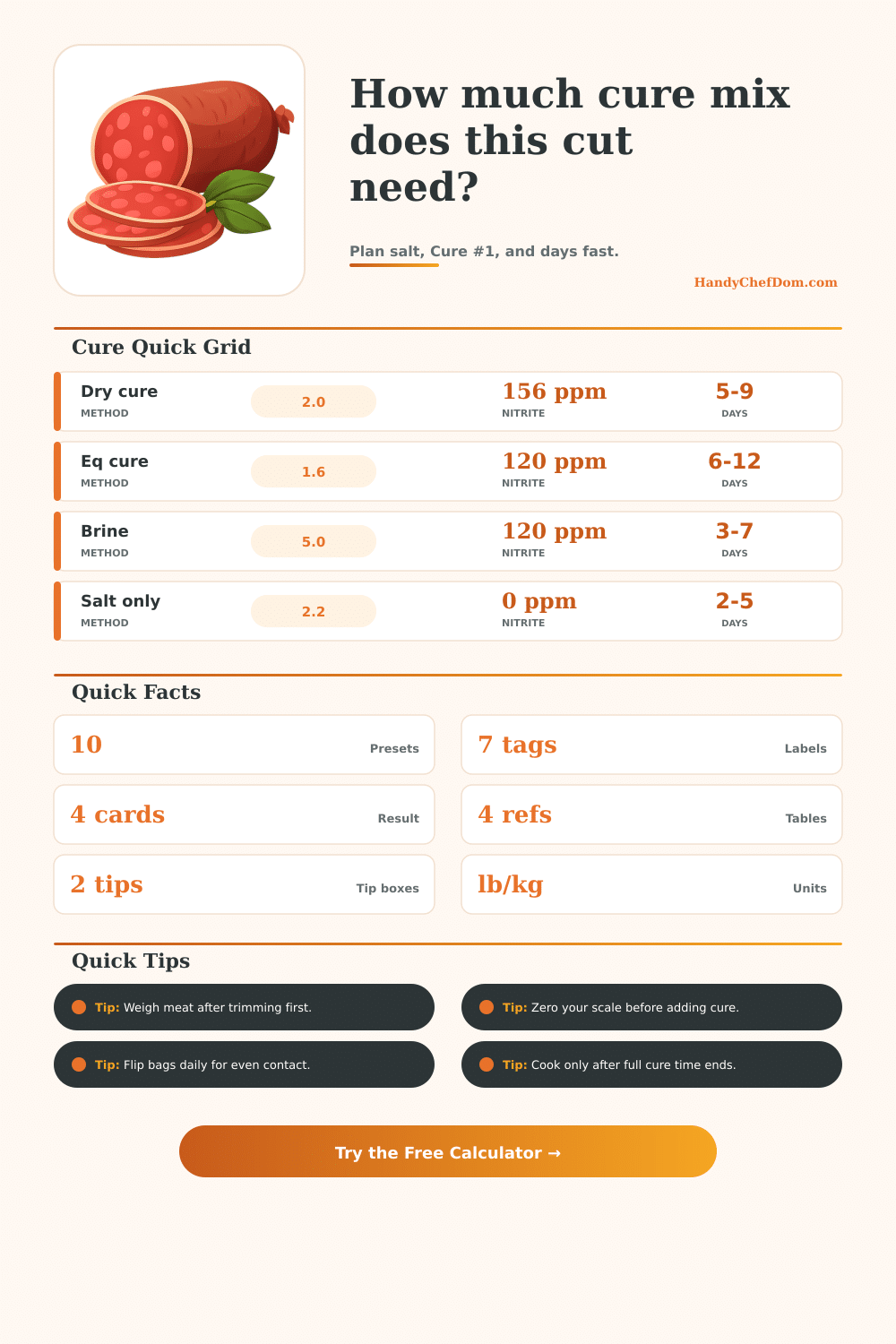
Dial in cure salt, Cure #1, and minimum day count by cut type, method, thickness, and unit system.
Use measured weight, not package weight. Cure #1 is calculated with a 6.25% nitrite assumption and should follow local food safety rules.
Calculation Breakdown
Dry Cure
Great for bacon and loin when you want firmer texture and stronger surface seasoning.
Equilibrium
Designed to avoid over-salting because the final concentration settles near your set ratio.
Brine Cure
Useful for ham and turkey pieces where water pickup and shorter handling are practical.
Salt-Only
No nitrite cure mix. Use for quick gravlax-style or short refrigerator salt cures.
| Product | Typical ppm | US cap | Common use |
|---|---|---|---|
| Bacon style | 120 | 120 | Pump or rub |
| Ground cured | 156 | 156 | Sausage mix |
| Whole muscle | 156 | 200 | Ham, loin |
| Dry-cured long | 180 | 200 | Air dry cuts |
| Style | Salt % | Sugar % | Texture |
|---|---|---|---|
| Mild belly | 1.8 | 0.8 | Soft bite |
| Classic bacon | 2.0 | 1.0 | Balanced |
| Firm ham | 2.4 | 0.6 | Tighter slice |
| Snack stick | 2.6 | 0.2 | Drier set |
| Brine L | Salt g/L | Sugar g/L | Cure #1 g/L |
|---|---|---|---|
| 1.0 | 45 | 15 | 2.0 |
| 2.0 | 90 | 30 | 4.0 |
| 3.0 | 135 | 45 | 6.0 |
| 4.0 | 180 | 60 | 8.0 |
| Thickness | Dry days | Eq days | Brine days |
|---|---|---|---|
| 1.0 in | 4 | 5 | 3 |
| 1.5 in | 6 | 7 | 4 |
| 2.0 in | 8 | 9 | 5 |
| 2.5 in | 10 | 12 | 7 |
To properly cure the meat, an understanding of the role of salt, sugar, and nitrite is required because each of these ingredients perform a specific function within the cured meat. Salt draws moisture out of the meat and helps the texture of the meat to become firm. Nitrite converts to nitric oxide in the meat that provides color to the cured meat and protects the cured meat from certain bacteria.
Sugar is used to balance the saltiness of the salt that is used in the curing process and sugar can assist in the browning of the cured meat. An understanding of each of these ingredients and their functions is required to ensure the quality of the cured meat. To begin the curing process, you must measure the weight of the trimmed meat.
How to Cure Meat Safely
The weight of the meat must be measured after trimming the meat to account for trim loss. If the weight of the meat from the package is used rather than weighing the trimmed meat, there is the potential for using too much or too little salt. Based off the weight of the meat, there are four different curing methods that can be used.
Pushing the salt directly onto the surface of the meat performs dry curing and produces a drier texture than the other curing methods. Equilibrium curing requires that the percentage of salt in the meat be calculated based only upon the weight of the meat. Adding the water to the total mass of the meat performs brine curing and allows for the cure to increase the speed at which the salt makes contact with the meat.
Lastly, salt-only curing is performed by skipping the addition of nitrite and is used when the color retention of the cured meat is not a priority. The thickness of the meat is another factor to consider when curing the meat. The movement of salt through the meat occurs at a constant rate.
Thus, a thin piece of meat will take less time for the salt to move through the entire thickness of the meat than a thick piece of meat. For instance, a one-inch loin will take five or six days to cure using the dry curing method whereas a two-and-a-half-inch ham will require ten days for curing. An additional day should always be given to the curing time for the safety of the meat.
Due to the fact that the muscle and fat in the meat has different rates of salt movement, curing the meat to a specific time ensures that the center of the meat will not remain raw. Another factor to consider is the level of nitrite to be added to the cured meat. If the type of meat to be cured is a whole muscle, 156 parts per million of nitrite will be used.
This level has been proven to be effective for whole muscles. However, if the meat to be cured is bacon, the level of nitrite will be 120 parts per million because bacon is smoked and has shorter cook times. For long air-dried products, the level of nitrite will be 180 or 200 parts per million because the air-dried products will lose moisture and the nitrite will need more time to break down the meat.
While it is possible to memorize the percentages of nitrite to use for each type of meat, a calculator can make it easier to convert the parts per million of nitrite to the grams of cure needed. Sugar is often included in the cure but should be used in small amounts. Most recipes will use between half and one percent of sugar by the weight of the cured meat.
The sugar will balance the salt and help the meat to brown during the cooking process but should not mask the savory flavor of the meat. Another decision must be made regarding which curing method to use. Dry curing will produce the firmest surface to the cured meat.
Equilibrium curing will prevent the outside of the cured meat from being too salty yet ensure that the inside of the meat reaches the proper level of salt. Brine curing will allow for the cure to reach the inside of large pieces of meat, such as turkey breast. Lastly, salt-only curing is the least complicated method yet is still used for delicate meats because of the ability to skip nitrite.
No curing method is the best for all types of meat but each will change the flavor, texture, and speed in which the meat is cured. It is easy to make errors in the curing process if adjustments are not made to account for the conditions of the curing process. If the weight of the meat from the package is used instead of weighing the trimmed meat, an error is likely to be made.
If you dont flip the vacuum bags daily, the salt may not distribute evenly throughout the meat. Lastly, if the timer is started at the wrong time, the salt may not fully contact the meat. Each of these errors will likely result in inconsistent tasting of the cured meat or uneven levels of salt within the meat.
Another factor to consider when curing meat is the drying loss of the meat. Drying loss is the amount of weight that the meat will lose as it dries. For instance, if the type of cured meat that is being prepared is coppa or lonza, it is essential to know the weight of the finished meat as this will affect the texture of the cured meat.
The target drying loss should be set early in the curing process because the percentage of drying loss will dictate the amount of salt that will be present in the cured meat. Factors outside of the measurements can still affect the curing process of the meat. For instance, if the refrigerator is warmer than the desired temperature, the movement of the salt will be slower.
Very dry air will remove the moisture from the cured meat at a faster rate than the movement of the salt. High humidity will keep the cured meat wet and may lead to the growth of mold. These factors are difficult to control yet essential to consider.
A safety margin for these issues and flipping the cured meat daily will account for these variables. By using the framework and the information provided, success can be achieved with the curing of meat. Not only will this framework allow for the repeatability of the process, but it will allow for the adjustments to be made to each of the variables in the process.