Water Boiling Time Calculator
Estimate boil time by volume, altitude, stove power, lid use, and pot setup
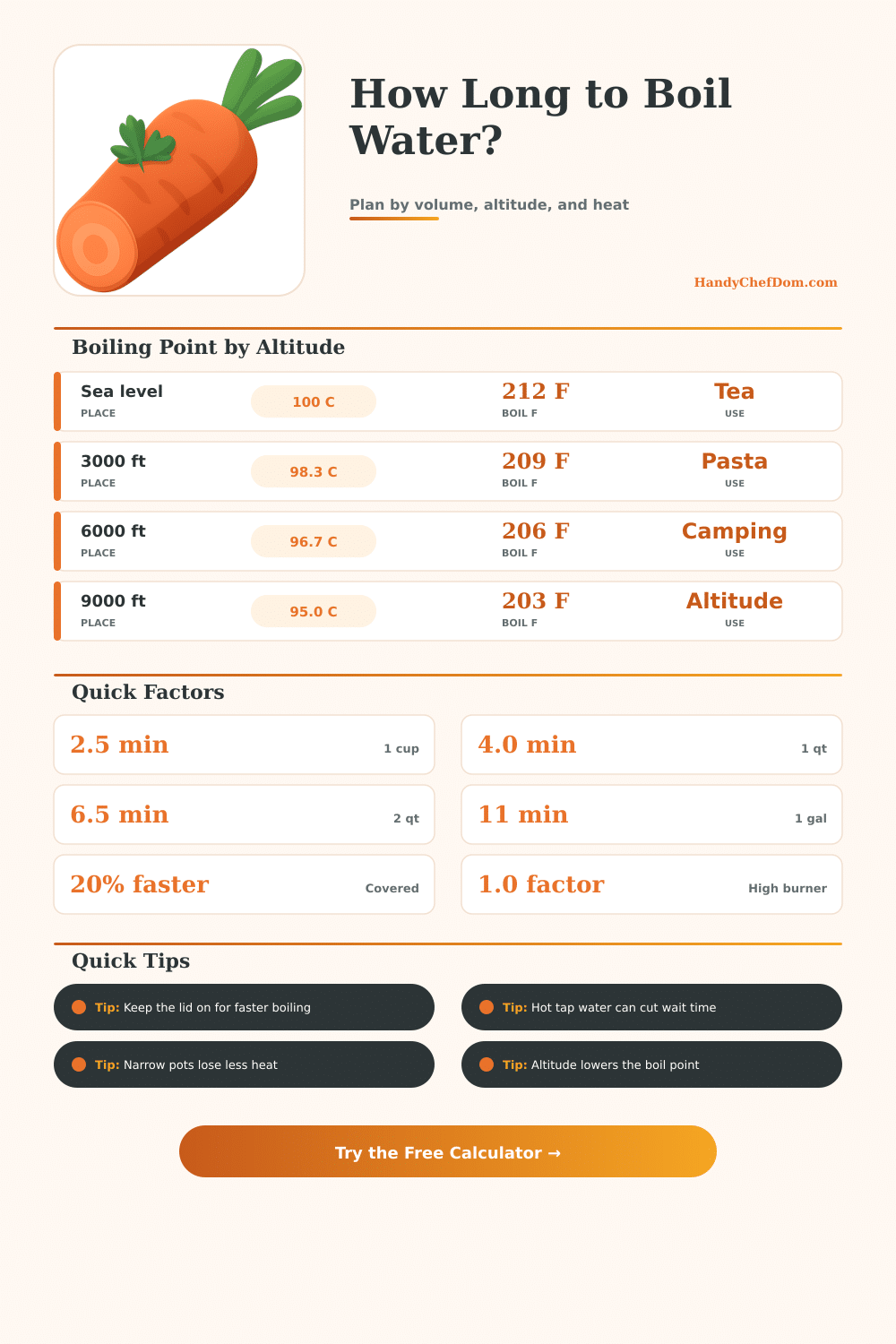
| Altitude | Boil C | Boil F | Note |
|---|---|---|---|
| Sea level | 100 C | 212 F | Baseline |
| 3,000 ft | 98.3 C | 209 F | Low drop |
| 6,000 ft | 96.7 C | 206 F | Noticeable |
| 9,000 ft | 95.0 C | 203 F | High alt |
| Pot | Factor | Heat Hold | Best Use |
|---|---|---|---|
| Stainless | 0.86 | Good | Everyday |
| Aluminum | 0.92 | Fair | Fast boil |
| Copper | 0.96 | Great | Speed |
| Cast iron | 0.74 | Heavy | Slow boil |
| Unit | Liters | Quarts | Cups |
|---|---|---|---|
| 1 cup | 0.24 | 0.25 | 1 |
| 1 quart | 0.95 | 1 | 4 |
| 1 gallon | 3.79 | 4 | 16 |
| 1 liter | 1 | 1.06 | 4.2 |
| Setup | Factor | Trend | Note |
|---|---|---|---|
| Gas High | 1.00 | Fast | Common |
| Electric | 0.94 | Steady | Even heat |
| Induction | 1.08 | Very fast | Efficient |
| Camp | 0.68 | Slow | Outdoor |
Boiling water involve the transfer of energy to the water. To boil water, a specific amount of energy are required to reach the boiling point of water. Water requires 4 kilojoules of energy to heat it one degree Celsius per kilogram of water.
Once the water reaches it boiling point, the water will undergo a phase changes from liquid to gas. Several factor impact the boiling point of water. These factors includes the starting temperature of the water, the material that the water is boiling in, and the type of stove that you are using to boil the water.
Things That Change How Water Boils
The starting temperature of the water is one of the primary factor that impacts the boiling point of water. If you start with cold tap water, you will have to add more energy to help the water reach its boiling point. Starting with hot water from the tap will require you to add less energy to the water to allow it to reach its boiling point.
Using hot water from the tap will reduce the amount of time that you must wait for the water to reach a boiling point. Another factor that will influence the boiling point of water is the material that you use to boil the water in. If you use a narrow kettle, it will heat the water more fast than if you boiled the water in a wide stockpot.
This is because the narrow kettle will have less surface area in contact with the air, reducing the amount of heat that will be lost to the air around the pot. Copper pots will heat the water faster then cast iron pots. This is because the copper retains and conducts heat better than cast iron.
Thin aluminum pots will heat the water faster than stainless steel pots. However, the aluminum pots will lose the heat more faster than the steel pots. The type of stove that you use will also impact the boiling point of the water.
Gas stoves will heat the water faster than electric coils. Induction stoves will heat the water the most fastest because induction stoves will use magnetism to heat the cooking pot directly. Using a lid on the pot will retain more energy within the pot.
If you leave the pot uncovered, the steam will exit the pot, taking the energy from the water with it. Using a lid will allow you to retain more of the energy that the water receives from the stove. This will allow the water to reach a boiling point in a shorter amount of time.
Another factor that will impact the boiling point of the water is the altitude at which you are boiling the water. As the altitude increases, the air pressure around the water decrease. A decrease in air pressure will decrease the boiling point of the water.
For instance, at an altitude of 3,000 feet above sea level, the boiling point of water will be 209 degrees Fahrenheit instead of 212 degrees Fahrenheit. This boiling point will change the way that food cooked in boiling water will cook. It will require more time to cook food such as pasta or egg.
Another way to change the boiling point of water is to add another substance to the water. Adding salt to the water will increase the boiling point of the water. Although the increase in boiling point will be small, it can be helpful to those cooking pasta who would like to ensure that the pasta boils at the proper time.
You can follow several steps to boil water efficient. First, use the amount of water that you need. Second, use a lid on the pot.
Third, use the burner setting that will allow you to achieve you goal for the water boiling. Using these steps and planning ahead to follow these steps will allow you to boil water efficient.