🧄 Garlic in Honey Fermenting Time Calculator
Estimate active bubbling, burping rhythm, mellowing time, and jar fill balance for fermented garlic honey using batch ratio, room temperature, headspace, and acidity cues.
Use this as a kitchen planning estimate, not a lab result. A clean jar, fully submerged garlic, and a measured acidity check are better than judging a ferment by the calendar alone.
| Flavor Stage | Typical Time | Kitchen Cues | Common Use |
|---|---|---|---|
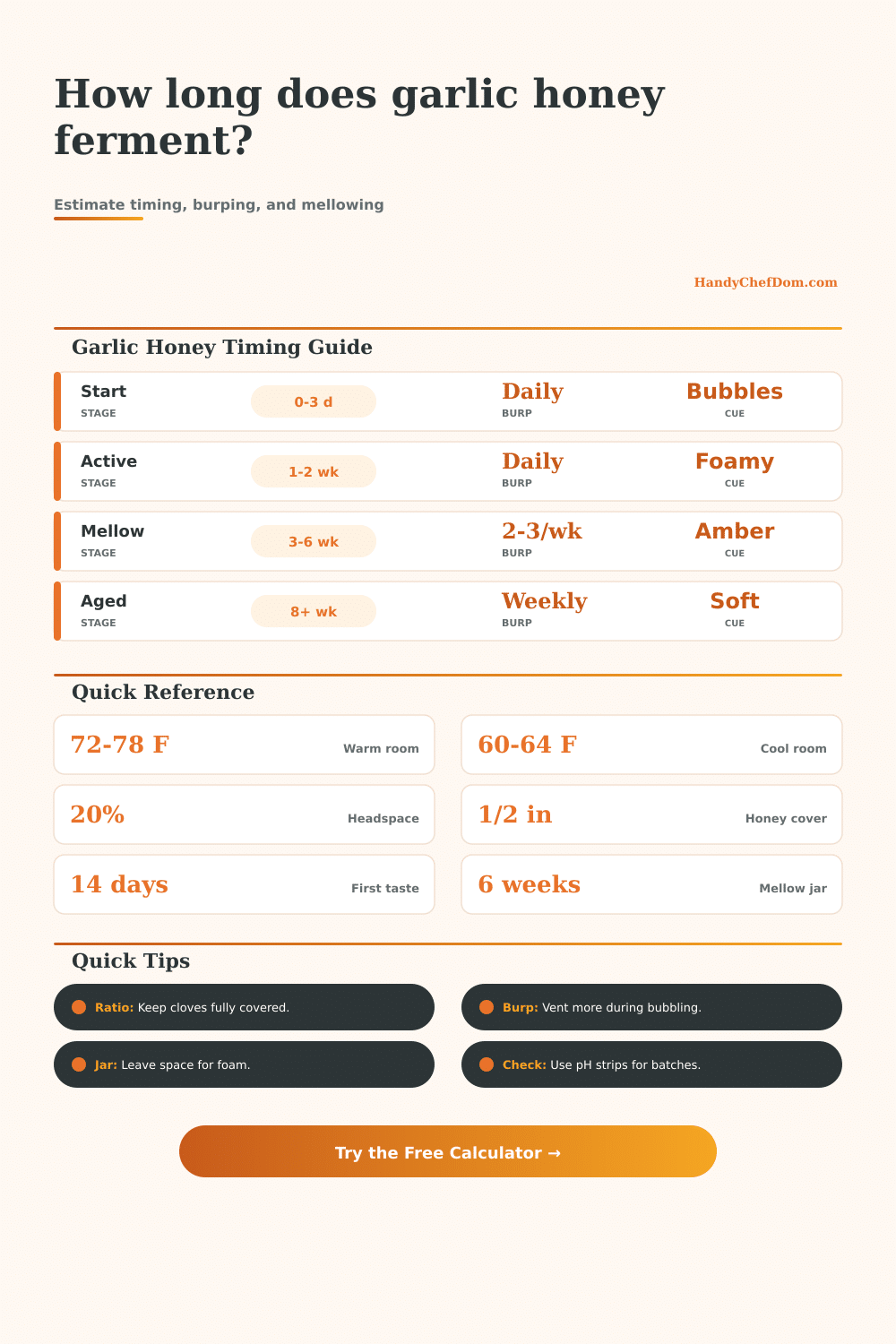
| Freshly mixed | 0 to 3 days | Garlic is sharp, honey is thick, first bubbles may appear. | Turn jar to coat floating cloves. |
| Active ferment | 4 to 14 days | Honey loosens, bubbles collect, cloves may float strongly. | Burp often and keep rims clean. |
| First taste | 14 to 21 days | Garlic bite softens and honey picks up savory aroma. | Good for dressings and marinades. |
| Balanced jar | 28 to 42 days | Cloves darken slightly and honey tastes rounder. | Drizzle, glaze, and spoon over vegetables. |
| Mellow jar | 45 to 70 days | Garlic becomes sweeter and honey turns more amber. | Use when raw garlic heat should be gentle. |
| Aged jar | 90 days or more | Flavor is deep, syrupy, and less aggressively garlicky. | Small spoonfuls for finishing sauces. |
| Room Temperature | Timing Effect | Burping Need | Planning Note |
|---|---|---|---|
| 58 to 62°F / 14 to 17°C | Slow by about 35% | Low to moderate | Expect a longer wait before bubbles are obvious. |
| 63 to 67°F / 17 to 19°C | Slow by about 18% | Moderate | Good for a controlled, gradual ferment. |
| 68 to 72°F / 20 to 22°C | Baseline timing | Daily early | Common room-temperature reference range. |
| 73 to 78°F / 23 to 26°C | Fast by about 18% | High early | Leave more headspace and watch foam. |
| 79 to 82°F / 26 to 28°C | Fast by about 30% | Very high early | Check more often and avoid overfilling the jar. |
| Above 82°F / 28°C | Unsteady timing | Very high | Move to a cooler place for better flavor control. |
| Garlic Prep | Surface Area | Timing Change | Texture Note |
|---|---|---|---|
| Whole peeled cloves | Low | Baseline | Slowest mellowing, cleanest finished texture. |
| Halved large cloves | Medium | About 12% faster | Good for large cloves that resist softening. |
| Lightly crushed cloves | High | About 22% faster | More aroma early, stronger bubbling potential. |
| Thin-sliced cloves | Very high | About 30% faster | Fast flavor transfer but cloudier honey. |
| Small young cloves | Medium | About 8% faster | Tender cloves usually mellow sooner. |
| Large storage cloves | Low | About 10% slower | Dense cloves may stay sharper longer. |
| Batch Size | Peeled Garlic | Honey Weight | Jar Choice |
|---|---|---|---|
| Tasting jar | 2 oz / 55 g | 5 oz / 140 g | 8 fl oz half-pint jar |
| Small pantry jar | 4 oz / 115 g | 9 oz / 255 g | 12 to 16 fl oz jar |
| Classic pint | 5 oz / 140 g | 12 oz / 340 g | 16 fl oz pint jar |
| High-garlic jar | 7 oz / 200 g | 13 oz / 370 g | 24 fl oz jar |
| Quart batch | 10 oz / 285 g | 24 oz / 680 g | 32 fl oz quart jar |
| Large gift batch | 16 oz / 455 g | 36 oz / 1020 g | Two quart jars |
| Acidity Cue | What It Means | Timing Adjustment | Calculator Treatment |
|---|---|---|---|
| Not measured | Honey acidity is unknown. | No speed change | Plan a measured check before long storage. |
| pH under 4.0 | Acidic honey reading. | About 5% faster confidence window | Still watch bubbles, aroma, and coverage. |
| pH 4.0 to 4.6 | Common target zone for acidic foods. | Baseline timing | Use a clean sample and fresh strip or meter. |
| pH over 4.6 | Less acidic reading. | Add about 20% holding time | Consider retesting or adding culinary acid. |
| Added vinegar or lemon | Small culinary acid addition. | About 8% steadier start | Flavor may brighten before it mellows. |
| Cloudy or odd aroma | Quality cue needs attention. | Do not rely on timing | Discard questionable batches instead of tasting. |
At some point along the way, there is always that unmistakable point in each of your garlic honeys where the liquid turns thin as soup, the cloves rise to the top, and little bubbles stick to the sides like water droplets on a chilled glass. At this instant, most people freak out and think their jars has gone bad. But no. That’s the active fermenting period. It’s when natural lactobacillus bacteria is working hard to pull the tough chemicals from the garlic. The sharp bite softens into a deep, savory sweetness.
To get a good batch, you need to know when it occurs; and for how long. How long? That’s up to you (and what your climate is like). The pace of the process depends on the temperature where it takes place. An actively bubbling kitchen at seventy-five degrees will race along. It’ll finish half as fast than one that’s cooler, around sixty degrees. Those temperature factors is built into the calculator, above. And yes, they adjust to the time frame if your jar is tucked away in a warm nook of the counter, or in the back of a cool pantry corner.
How to Make Garlic Honey
The condition of the garlic itself also play a role. Less surface area means less exposure to the honey: whole cloves take longer than crushed or sliced ones. They give up their goodness more quickly, which speeds things along, but may result in a less clear finished liquid. Your choice: clear, or fast?
You must also consider another factor: the headspace. Do not overfill the jar. Carbon dioxide are created as part of the fermentation process. Where does it go? It has to escape somewhere. If there’s no space above the layer of honey, the resulting pressure could crack the glass, or even force liquid up and out of seal. To create a little bit of breathing room, I aim for around a 20 percent headspace. This means leaving 20 percent of the jar between the surface of whatever you’re fermenting and top of the liquid. This gives me a safety zone from foaminess. It keeps things oxygen-free (which keeps the garlic happy) and prevents any messy situation. It also ensures the gas can escape.
If your lid is regular, be sure to open every day at least for the initial week. Burping is essential. Use an airlock lid to avoid having to do this manually. But even with that, you’ll want to visually check on things.
As it ages, it change flavors, each time hitting new levels. Week 2-ish marks the initial tasting window. It is bright and alive with garlic heat. It is good to use in dressings, as the cloves still has some bite. At week 6, the jar enters the mellow phase. The honey turns a darker amber color. The garlic gets softer… Far softer, really, and mellows from its aggressive side. This is most peoples’ goal for the jar. Honey’s sweetness balance the savory side of the garlic. Beyond that is the three-month-plus period when you’ll find a thicker, syrup-like drizzle. It is less garlicky and has more of the floral notes of the honey itself.
The main rule is to not skip the submersion. Exposed garlic will become moldy from airborne spores. Ensure every clove is completely covered by at least half an inch of honey. For both shelf life and safety reasons, you want full immersion. Use a glass weight to hold the cloves under water, or stir them back down if they float. The mechanical action also help the honey’s natural acid guard the garlic, more so than even a temperature check or timer.
But again: the calendar’s just a suggestion. Pay attention to your senses. The calculator is an accurate guess at timing. Your eyes; and your nose, will signal completion. Look for a slowdown in the strong bubbling. Also look for a shift in the color of the cloves; they’ll darken. Breathe it in: The smell will be rich, the flavors fully blended.
Don’t push it. Time helps change raw elements into something complex. Begin with the math, but believe the jar. When it’s time, the bubbles will slow down on their own. You should of waited for a richness of flavor that no fresh garlic can match.