🦃 Turkey Cooking Time Calculator Convection Oven
Turn turkey weight, stuffing, oven temp, and rest into a convection roast window that is easier to trust.
The calculator starts from a convection base of minutes per pound, then layers bird size, stuffed state, oven temperature, start temperature, altitude, and the rest window so the finish stays believable.
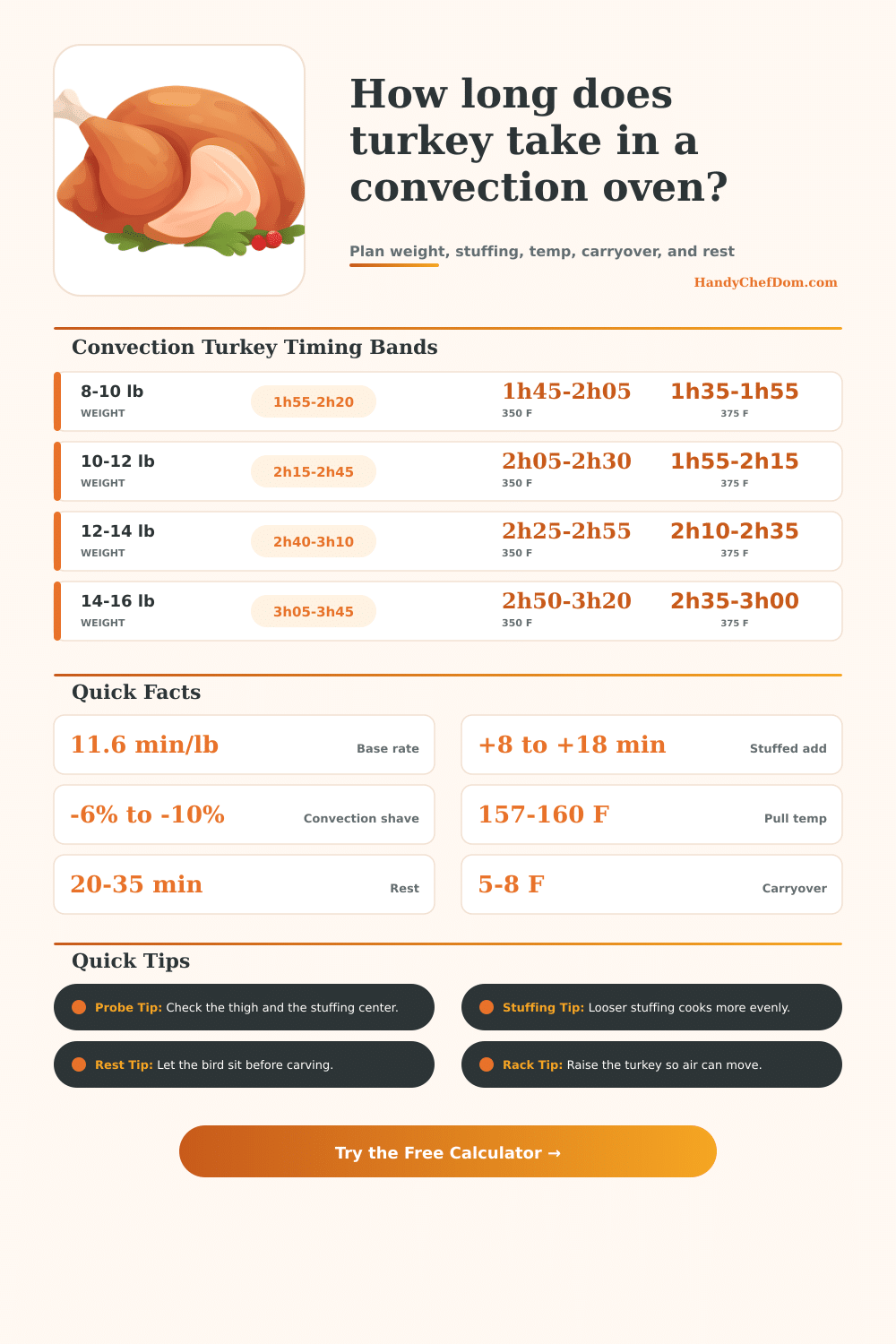
| Weight | 325 F | 350 F | 375 F | Serves |
|---|---|---|---|---|
| 8-10 lb | 1h55-2h20 | 1h45-2h05 | 1h35-1h55 | 6-8 |
| 10-12 lb | 2h15-2h45 | 2h05-2h30 | 1h55-2h15 | 8-10 |
| 12-14 lb | 2h40-3h10 | 2h25-2h55 | 2h10-2h35 | 10-12 |
| 14-16 lb | 3h05-3h45 | 2h50-3h20 | 2h35-3h00 | 12-14 |
| 16-18 lb | 3h35-4h15 | 3h15-3h50 | 3h00-3h25 | 14-16 |
| 18-20 lb | 4h00-4h45 | 3h40-4h20 | 3h25-3h55 | 16-18 |
| Stuffed state | Min / lb | Bonus | Pull | Note |
|---|---|---|---|---|
| Unstuffed | 11.6 | 0 min | 160 F | Fastest cavity heat-up |
| Lightly stuffed | 12.5 | +8 min | 159 F | Loose fill, steady finish |
| Loosely stuffed | 13.7 | +12 min | 158 F | Plan a longer rest |
| Fully stuffed | 14.4 | +18 min | 157 F | Slowest center to heat |
| Convection profile | Factor | Heat pattern | Use when |
|---|---|---|---|
| True convection | 0.90x | Fast moving air | You want the shortest roast |
| Convection roast | 0.94x | Balanced fan heat | You want the default setting |
| Fan assist | 0.97x | Gentler circulation | You want softer browning |
| Conventional | 1.00x | No fan offset | The oven lacks a convection mode |
| Temp | Unstuffed factor | Stuffed factor | Pull | Rest |
|---|---|---|---|---|
| 300 F | 1.15x | 1.18x | 160 F | 28-35m |
| 325 F | 1.08x | 1.10x | 160 F | 25-30m |
| 350 F | 1.00x | 1.02x | 159 F | 20-25m |
| 375 F | 0.92x | 0.95x | 159 F | 20-22m |
| 400 F | 0.86x | 0.90x | 158 F | 18-20m |
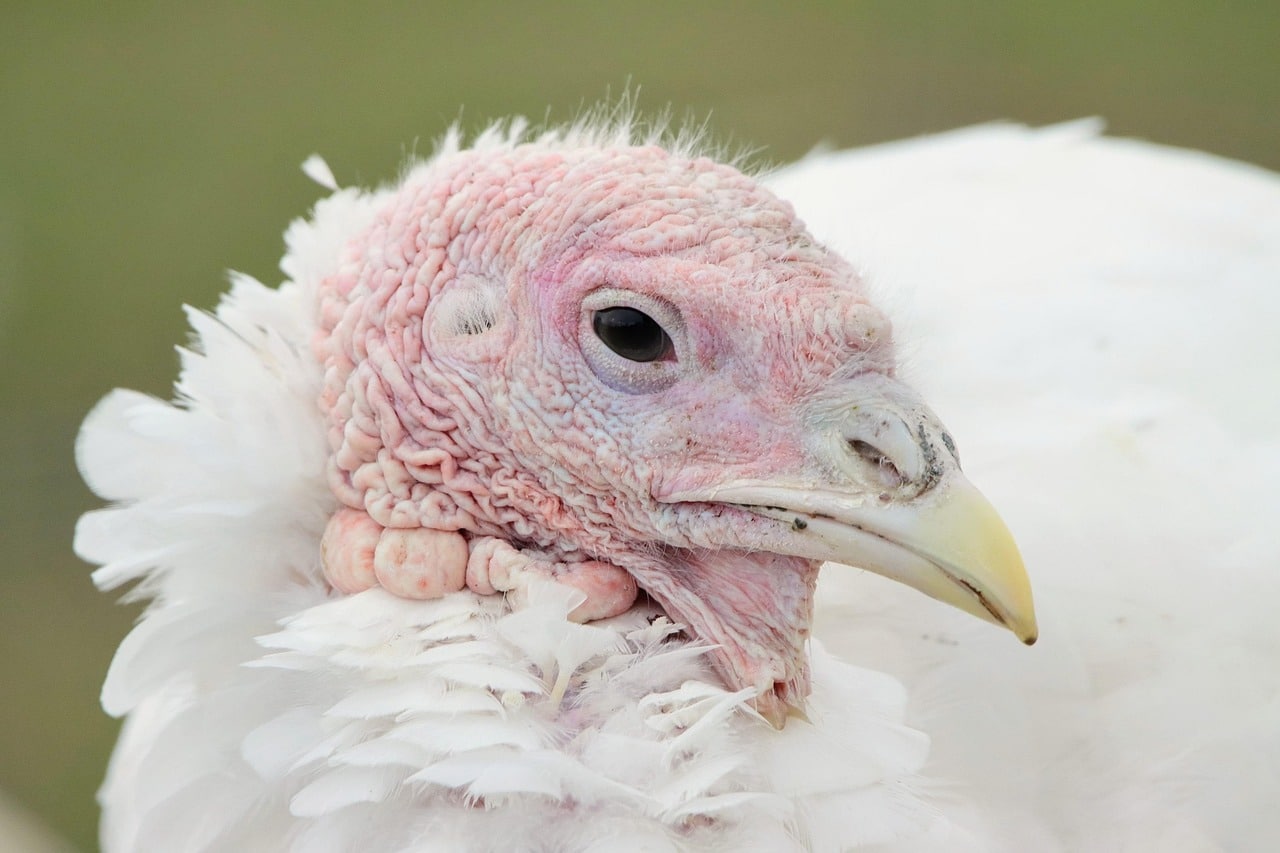
To cook a turkey in a convection oven, an understanding of how convection ovens works is necessary. Convection ovens uses a fan to circulate hot air around the turkey. Because the hot air circulates more efficient in the convection oven, the cook will reduce the cooking time by up to ten percents as compared to a conventional oven.
The weights and the composition of the turkey will change the cooking time require for the turkey. A ten-pound turkey that isnt stuffed will take longer to cook than a ten-pound turkey that is stuffed with cornbread mix. If the turkey is stuffed with cornbread mix, the heat will have to travel through the cornbread mix to reach the center of the turkey.
How to Cook a Turkey in a Convection Oven
This will require the turkey’s stuffing to cook for twelve to eighteen extra minutes to reach the proper cooking temperature. The size of the turkey will also affect the cooking time. An eighteen-pound turkey will take longer to cook than an eight-to-ten-pound turkey.
This is because the outer layers of the eighteen-pound turkey will cook to the desired temperature well before the deep cavity of the turkey are cooked. The altitude at which the turkey is cooked will also affect the cooking time. If the cooking takes place at a higher elevation, the thin air will slow the transfer of heat to the turkey by three to ten percent.
This means that the turkey will take longer to cook to the proper temperature if it is cooked at a high altitude. If the turkey is prepared at 38 degrees, the cooking time will be five percent longer than if the turkey was prepared at room temperature. If the turkey was left out of the refrigerator for one hour before cooking, the turkey will cook to the desired temperature according to the time estimates for cooking turkeys.
The mode in which the convection oven is set will also affect the cooking time. If you set the convection oven to true convection mode, the fan will be set to a full fan blast to circulate the hot air around the turkey efficient. Using this mode will reduce the cooking time of the turkey by eight to ten percent.
If the cook uses the fan-assist mode and sets it to gentle, the cooking time will be reduced by only three percent. In both modes, a thermometer should be used to monitor the cooking of the turkey because each oven and each turkey will not cook according to the same charts. A thermometer must be used to monitor the cooking of the turkey to ensure that it is safe to eat.
The pull temperature of the turkey should be between 157 and 160 degrees in the thigh of the turkey. The turkey should be pulled from the oven when the temperature is between 157 and 160 degrees. This is because the turkey will continue to cook after it is taken out of the oven and will rise in temperature by five to eight degrees.
This is call carryover cooking. If the turkey contains stuffing, the stuffing must reach a temperature of 165 degrees. A probe can be used to monitor the internal temperature of the stuffing.
The probe must be placed in the deepest part of the stuffing to ensure that the stuffing has reach the proper cooking temperature. The number of guests that will eat the roasted turkey will determine the size of the turkey that should be purchased. If eight people are to be served and each person eats eight ounce of turkey, the weight of the turkey should be calculated.
A twelve-pound turkey will yield approximately five pounds of edible turkey meat after the turkey has been deboned. With five pounds of meat from a twelve-pound turkey, a twelve-pound turkey will feed ten people if the portions are to be light. However, if the people eating the turkey will eat hearty portions, a twelve-pound turkey may not provide enough turkey for all of the guests.
An eight percent buffer can be used in determining the size of the turkey that will be cooked. The temperature to which the oven is set will also affect the cooking time of the turkey. If the oven is set to 375 degrees, the cooking time will be eight percent less than if the turkey was roasted at 350 degrees.
However, cooking the turkey to 375 degrees may dry out the turkey if it contains stuffing. If the oven is set to 325 degrees, the turkey will brown more gently and the carryover cooking will be steadier after a thirty-minute resting period of the turkey. Using convection roast mode will allow enough fan speed to cook the turkey without over-browning the wings of the turkey.
To avoid mistakes while roasting the turkey, certain steps should be followed. The resting period of the turkey should not be skipped. If the resting period is skipped, the juices will exit the turkey, making the turkey dry when sliced.
The stuffing of the turkey should not be packed too tightly. If the stuffing is packed too tightly, the cooking time will be prolonged. The turkey should be placed on a rack.
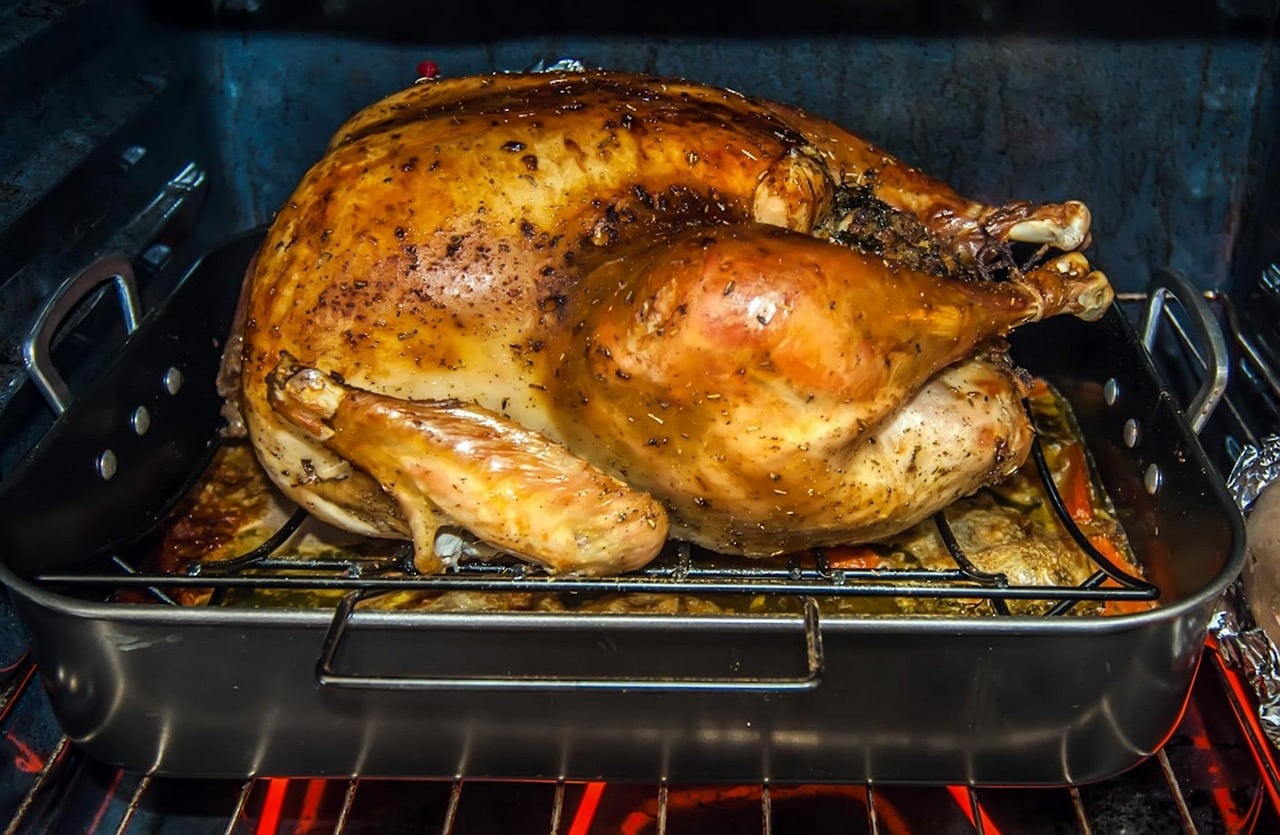
Placing the turkey on a rack will allow the hot air to swirl underneath the turkey, thus helping to crisp the skin of the turkey. Finally, care should be taken in placing the thermometer correctly into the turkey. If the probe is not placed correctly, the cooking time will be incorrect.
For example, placing the thermometer against a bone will give an incorrect reading of the cooking temperature of the turkey. You should of used a probe to ensure teh meat is cooked. It is a moddern way to make sure you dont serve raw meat.
You’re turkey will be delicious if you follow these steps, but dont forget that the cook must monitor the process. One should of checked the turkey earlier. The turkey’s size matter alot when you are planning the meal.
It isnt easy to get the size right. The turkey meat should be cooked based off the weight. The cook should of checked the temperature more than once.
Youll need to be careful with the seasoning too. The seasoning should be applied to the turkey’s skin.